.svg)
10 Event Planning Tips From a CEO Who Quit Her Six-Figure Job to Change Lives

Wendi Freeman of Be Bright Events shares hard-won advice on building boundaries, managing vendors, designing transformative attendee experiences, and why your Pinterest board is not a strategy.
There's a specific type of person who walks away from a six-figure salary, zero safety net, and a stable corporate career — to start a business centered around feelings.
Wendi Freeman is that person.
The founder and CEO of Be Bright Events didn't just stumble into event planning. She spent over a decade managing multimillion-dollar events for a tech company, checked every societal box (career, home, travel, marriage — the last one didn't stick, as she'll tell you herself), and still felt like something was profoundly missing. It took a four-day transformational event — and quite a few tears — for her to realize she wasn't meant to climb the corporate ladder. She was meant to build the stage.
Within three months, she left her corporate job as a single mom to launch Be Bright Events. Not to plan pretty parties, but to architect experiences that change lives. The kind of events where attendees walk in as one version of themselves and walk out as another.
What followed is the kind of entrepreneurial journey that makes for excellent reading — global pandemic cancellations, hotel bathroom breakdowns, six-figure first-year revenue during a worldwide shutdown, and a ceremony involving glow sticks, healing frequencies, and a woman whose cancer doctors reportedly ran out of explanations.
Below, we've pulled together the most valuable lessons from Wendi's experience, backed by data and grounded in real talk, for every event planner who's still Googling centerpieces when they should be building strategy.
1. Know Why You're Planning the Event Before You Plan Anything Else
Wendi's first principle is deceptively simple: purpose before Pinterest. She builds every event backward from a clear set of outcomes — what the host needs to achieve, what attendees need to experience, and how every element (seating, flow, pacing, signage) serves that mission.
This isn't just philosophy. It's a measurable business advantage. According to G2, only 23% of companies can effectively track event ROI, which means most events are being planned and executed with no clear measure of success. When you don't define what winning looks like, you're basically spending a lot of money on vibes.
Pro Tip: In your first client conversation, ask: "What does success look like for an attendee who walks out of this event?" If they can't answer it, that's your first deliverable — not the floral mock-up.
2. Build the Business You Actually Want to Run
Wendi's early mistake? Saying yes to everything. Every inquiry, every budget, every chaotic timeline. She thought flexibility was a virtue. The market rewarded her by turning her into a person working 14+ hour days, seven days a week.
She's not alone. A PCMA report found that 88% of event planners reported feeling exhausted, and 78% had negative feelings about their job. For a field built on creating joy for other people, those numbers are genuinely grim.
The fix, according to Wendi, isn't hustle harder — it's systematize smarter. Her Blueprint to Brilliance process (strategy, structure, systems, support) now acts as a filter for every project. Clear scope. Clear expectations. Clear processes. The hustle era ended; the systems era began.
Pro Tip: Create a non-negotiables document before your next client onboarding. What timelines won't you work within? What budgets don't pencil out? What deliverables require a longer lead time than clients assume? Define it once. Apply it forever.
3. Clarity Is the Currency of Successful Events
Wendi doesn't sugarcoat what it takes to execute a great event. Her first client conversation is a numbers-and-reality check — timelines, budgets, roles, risks. She "slows down to get clear" before she speeds up to execute.
This approach matters more than ever. According to RSVPify's 2025 Future of Events survey, 8.4% of event planners cite late registrations and delayed vendor commitments as top stressors — problems that almost always trace back to unclear expectations set (or not set) at the start.
Most clients come in with a vision and no roadmap, and no understanding that event planning is effectively a full-time job. Wendi's role, as she describes it, is to educate and lead — not just take orders.
Pro Tip: Consider adding a "What We Don't Do" slide to your onboarding deck. It resets expectations fast and positions you as an expert with a process, not a vendor who'll do whatever is asked.
4. Your Vendor Relationships Are Your Insurance Policy
Wendi has been working with her preferred AV partner, Lifted AV, for five years. She describes the relationship not as a vendor arrangement but as a partnership — one built on aligned expectations, shared standards, and the kind of trust that means she can focus on the room while they own the production.
The alternative? She's lived it. Mic batteries dying mid-session. Cues missed after a full Zoom run-through. Manually cueing lights, music, and visuals herself because the team couldn't follow the run of show in real time. (And her run-of-show, for the record, is pristine — columns for lighting, audio, visuals, cameras, the works.)
The data backs up the stakes: 64.6% of event attendees agree that the venue and production experience can make or break their event experience, according to G2.
Wendi puts it perfectly: "The right vendors don't wait to be heroes. They prevent the fires from ever starting."
Pro Tip: Vet vendors the way you'd hire staff. Ask for references. Run a small test project before a big one. Build a trusted roster before you need it — not the week of the event.
5. Contingency Planning Is Not Optional — It's the Job
Every event Wendi leads has a documented Plan A and Plan B — and the mental readiness to activate C or D if needed. Backup vendors are identified. Timelines have buffers. Her team is trained to make fast decisions without spiraling.
Her analogy: "I plan events like Smoky the Bear. When we do the prep right, I'm not on site putting out fires. I'm creating moments."
This is not overcaution — it's professional excellence. The events industry is, by nature, a high-stakes environment. And as Wendi notes, emergencies don't derail a well-built operation. They reinforce it.
Pro Tip: Add a dedicated "contingency" column to your run-of-show template. For every critical element, document the backup. The 30 minutes you spend building it will save you three hours of panic on-site.
6. Stop Building Backward From Pinterest
This one deserves its own section because Wendi says it with conviction: "Stop building backward from Pinterest. Start building forward from purpose."
Aesthetics-first planning is the most common (and expensive) mistake in the industry. A beautiful event that doesn't achieve what the host needed — more conversions, deeper connection, clear transformation — is a failure dressed up in good lighting.
According to Eventgroove's 2025 statistics, 74% of event marketers expect budget increases in 2025, which means more money is flowing into events. Whether that money drives results depends almost entirely on whether the strategy came before the swag.
Pro Tip: When a client leads with aesthetics ("I want it to feel like a luxury spa retreat with a celestial theme"), redirect with a strategy question: "Love that vision — what do you want attendees to do differently after they leave?" Let the purpose shape the aesthetic, not the other way around.
7. Design for How People Feel, Think, and Move — Not Just What They See
Wendi's approach to attendee experience goes well beyond logistics. She studies group dynamics and engagement psychology the way others study decor. Seating is curated to spark connection. Session pacing is designed to support focus and retention. Entry points are intentional, calibrated to ground attendees in the energy of the space.
This is increasingly what attendees are asking for. Research shows that 70% of millennials prioritize experiences over material possessions — and that 91% of consumers feel more connected to brands after attending an in-person event with them. Connection and transformation aren't nice-to-haves. They're the entire product.
Pro Tip: Map the emotional arc of your event the way a screenwriter maps a story. Where does energy peak? Where does it dip? Where do you create space for reflection, connection, or decision-making? Design the feeling of the day before you design the schedule.
8. Crisis Will Test Your Systems — Build Them Before You Need Them
In early 2020, every event on Wendi's calendar was canceled overnight. She was seven months into her business, sitting on a hotel bathroom floor, watching cancellation emails arrive one by one. By her own account: crushed.
What happened next is the lesson. She renegotiated every contract so no client lost any money. She leaned into her tech background and rebranded as "The Virtual Event Expert." She closed out her first year as an entrepreneur with six figures — during a global pandemic that shut down in-person gatherings entirely.
The events industry contracted dramatically in 2020, but Wendi's infrastructure held because her systems held. As she puts it: "When you build with systems and strategy from the start, you're never at the mercy of circumstance."
Pro Tip: Audit your current processes for single points of failure. What breaks if your top vendor cancels? What breaks if your timeline compresses by two weeks? Identify the weak links before a crisis does it for you.
9. AI Is a Tool, Not a Replacement for Presence
Wendi is direct on this one: AI is reshaping how events are marketed, but it hasn't changed what people fundamentally need. Audiences want a real relationship with the host. If your voice isn't leading — if you're not visible — no amount of AI-generated content will fill seats.
The data agrees. According to Eventgroove, 50% of event professionals plan to incorporate AI into their events in 2025, but the top driver of attendance remains authentic engagement and meaningful connection.
Tech can accelerate strategy. It cannot replicate presence.
Pro Tip: Use AI to free up time — draft templates, summarize research, build first-pass timelines — so that you can show up more fully in the places it can't: client relationships, room energy, live event decisions.
10. What Looks Like One Task Is Usually Ten
Wendi's parting wisdom for every event planner: the hidden time cost is always the thing that bites you. What looks like a single task often involves layers of approvals, follow-ups, dependencies, and rework. One overlooked detail compresses your entire timeline.
Her solution isn't to work faster. It's to build better timelines — ones that protect the experience, the budget, and the result — from the very first planning session.
The Bottom Line
Wendi Freeman didn't build Be Bright Events to plan pretty parties. She built it to engineer experiences that drive transformation — for hosts and attendees alike. Every principle she operates by connects back to that mission: start with purpose, build with systems, protect your energy, and trust the right partners.
For event planners looking to go from reactive to strategic — this is the playbook.
Find Your Hotels Faster With Hopskip
Speaking of the right partners — if you're an event planner still sourcing venues through spreadsheets, group texts, and prayers to the hotel proposal gods, it's time to upgrade.
Hopskip is the venue sourcing platform built specifically for event planners and group bookings. Submit one RFP, receive hotel proposals in one place, compare options side by side, and take the chaos out of the sourcing process entirely. Planners save 30+ hours per RFP, and hotels close deals faster with full visibility into planner intent.
Get started with Hopskip for free today or book a demo and discover how the right tools can transform your event planning process from overwhelming to organized.
References
- RSVPify & pc/nametag — Future of Events Survey: Biggest Challenges for Event Planners in 2025 — https://rsvpify.com/event-planners-challenges-2025/
- G2 — 70 Must-Know Event Planning Industry Statistics for 2025 — https://www.g2.com/articles/event-industry-statistics
- virsitour — Burnout Behind the Spotlight: The Hidden Struggles of Event Planners — https://virsitour.com/burnout-behind-the-spotlight-the-hidden-struggles-of-event-planners/
- Upmetrics — 60+ Must Know Event Industry Statistics in 2025 — https://upmetrics.co/blog/event-planning-industry-statistics
- Eventgroove — 80+ Must-Know Event Industry Statistics for 2025 — https://products.eventgroove.com/blog/articles/event-industry-statistics/
- Workstaff — 9 Event Planning Statistics You Need to Know About in 2024 — https://workstaff.app/blog/event-planning-statistics
Curabitur bibendum ad viverra eu fringilla ad eu. Eget placerat ultricies quis amet mattis himenaeos ullamcorper facilisi volutpat.
Start for free
Send your first one for free.

10 Event Planning Tips From a CEO Who Quit Her Six-Figure Job to Change Lives
Wendi Freeman of Be Bright Events shares hard-won advice on building boundaries, managing vendors, designing transformative attendee experiences, and why your Pinterest board is not a strategy.
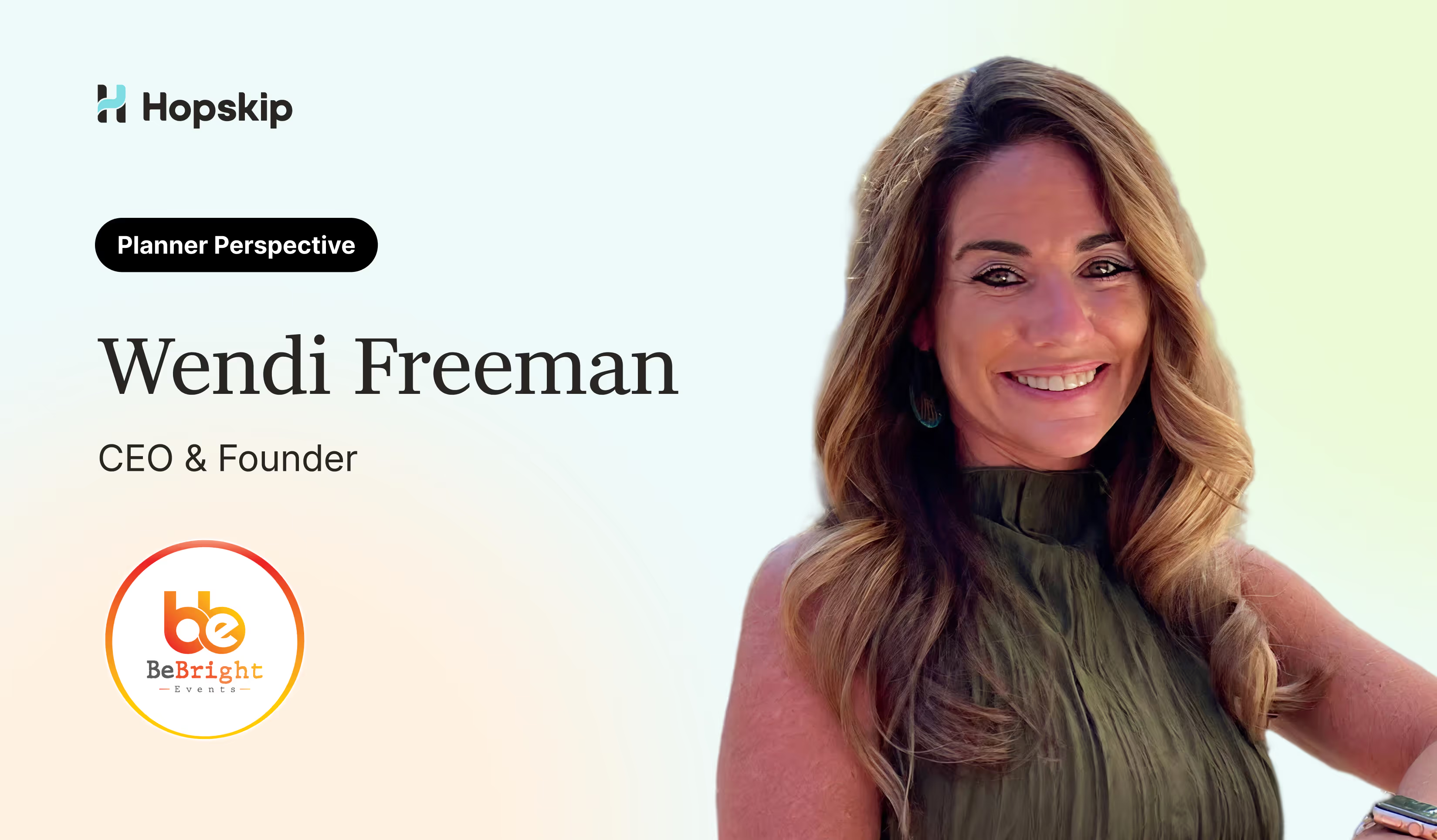
There's a specific type of person who walks away from a six-figure salary, zero safety net, and a stable corporate career — to start a business centered around feelings.
Wendi Freeman is that person.
The founder and CEO of Be Bright Events didn't just stumble into event planning. She spent over a decade managing multimillion-dollar events for a tech company, checked every societal box (career, home, travel, marriage — the last one didn't stick, as she'll tell you herself), and still felt like something was profoundly missing. It took a four-day transformational event — and quite a few tears — for her to realize she wasn't meant to climb the corporate ladder. She was meant to build the stage.
Within three months, she left her corporate job as a single mom to launch Be Bright Events. Not to plan pretty parties, but to architect experiences that change lives. The kind of events where attendees walk in as one version of themselves and walk out as another.
What followed is the kind of entrepreneurial journey that makes for excellent reading — global pandemic cancellations, hotel bathroom breakdowns, six-figure first-year revenue during a worldwide shutdown, and a ceremony involving glow sticks, healing frequencies, and a woman whose cancer doctors reportedly ran out of explanations.
Below, we've pulled together the most valuable lessons from Wendi's experience, backed by data and grounded in real talk, for every event planner who's still Googling centerpieces when they should be building strategy.
1. Know Why You're Planning the Event Before You Plan Anything Else
Wendi's first principle is deceptively simple: purpose before Pinterest. She builds every event backward from a clear set of outcomes — what the host needs to achieve, what attendees need to experience, and how every element (seating, flow, pacing, signage) serves that mission.
This isn't just philosophy. It's a measurable business advantage. According to G2, only 23% of companies can effectively track event ROI, which means most events are being planned and executed with no clear measure of success. When you don't define what winning looks like, you're basically spending a lot of money on vibes.
Pro Tip: In your first client conversation, ask: "What does success look like for an attendee who walks out of this event?" If they can't answer it, that's your first deliverable — not the floral mock-up.
2. Build the Business You Actually Want to Run
Wendi's early mistake? Saying yes to everything. Every inquiry, every budget, every chaotic timeline. She thought flexibility was a virtue. The market rewarded her by turning her into a person working 14+ hour days, seven days a week.
She's not alone. A PCMA report found that 88% of event planners reported feeling exhausted, and 78% had negative feelings about their job. For a field built on creating joy for other people, those numbers are genuinely grim.
The fix, according to Wendi, isn't hustle harder — it's systematize smarter. Her Blueprint to Brilliance process (strategy, structure, systems, support) now acts as a filter for every project. Clear scope. Clear expectations. Clear processes. The hustle era ended; the systems era began.
Pro Tip: Create a non-negotiables document before your next client onboarding. What timelines won't you work within? What budgets don't pencil out? What deliverables require a longer lead time than clients assume? Define it once. Apply it forever.
3. Clarity Is the Currency of Successful Events
Wendi doesn't sugarcoat what it takes to execute a great event. Her first client conversation is a numbers-and-reality check — timelines, budgets, roles, risks. She "slows down to get clear" before she speeds up to execute.
This approach matters more than ever. According to RSVPify's 2025 Future of Events survey, 8.4% of event planners cite late registrations and delayed vendor commitments as top stressors — problems that almost always trace back to unclear expectations set (or not set) at the start.
Most clients come in with a vision and no roadmap, and no understanding that event planning is effectively a full-time job. Wendi's role, as she describes it, is to educate and lead — not just take orders.
Pro Tip: Consider adding a "What We Don't Do" slide to your onboarding deck. It resets expectations fast and positions you as an expert with a process, not a vendor who'll do whatever is asked.
4. Your Vendor Relationships Are Your Insurance Policy
Wendi has been working with her preferred AV partner, Lifted AV, for five years. She describes the relationship not as a vendor arrangement but as a partnership — one built on aligned expectations, shared standards, and the kind of trust that means she can focus on the room while they own the production.
The alternative? She's lived it. Mic batteries dying mid-session. Cues missed after a full Zoom run-through. Manually cueing lights, music, and visuals herself because the team couldn't follow the run of show in real time. (And her run-of-show, for the record, is pristine — columns for lighting, audio, visuals, cameras, the works.)
The data backs up the stakes: 64.6% of event attendees agree that the venue and production experience can make or break their event experience, according to G2.
Wendi puts it perfectly: "The right vendors don't wait to be heroes. They prevent the fires from ever starting."
Pro Tip: Vet vendors the way you'd hire staff. Ask for references. Run a small test project before a big one. Build a trusted roster before you need it — not the week of the event.
5. Contingency Planning Is Not Optional — It's the Job
Every event Wendi leads has a documented Plan A and Plan B — and the mental readiness to activate C or D if needed. Backup vendors are identified. Timelines have buffers. Her team is trained to make fast decisions without spiraling.
Her analogy: "I plan events like Smoky the Bear. When we do the prep right, I'm not on site putting out fires. I'm creating moments."
This is not overcaution — it's professional excellence. The events industry is, by nature, a high-stakes environment. And as Wendi notes, emergencies don't derail a well-built operation. They reinforce it.
Pro Tip: Add a dedicated "contingency" column to your run-of-show template. For every critical element, document the backup. The 30 minutes you spend building it will save you three hours of panic on-site.
6. Stop Building Backward From Pinterest
This one deserves its own section because Wendi says it with conviction: "Stop building backward from Pinterest. Start building forward from purpose."
Aesthetics-first planning is the most common (and expensive) mistake in the industry. A beautiful event that doesn't achieve what the host needed — more conversions, deeper connection, clear transformation — is a failure dressed up in good lighting.
According to Eventgroove's 2025 statistics, 74% of event marketers expect budget increases in 2025, which means more money is flowing into events. Whether that money drives results depends almost entirely on whether the strategy came before the swag.
Pro Tip: When a client leads with aesthetics ("I want it to feel like a luxury spa retreat with a celestial theme"), redirect with a strategy question: "Love that vision — what do you want attendees to do differently after they leave?" Let the purpose shape the aesthetic, not the other way around.
7. Design for How People Feel, Think, and Move — Not Just What They See
Wendi's approach to attendee experience goes well beyond logistics. She studies group dynamics and engagement psychology the way others study decor. Seating is curated to spark connection. Session pacing is designed to support focus and retention. Entry points are intentional, calibrated to ground attendees in the energy of the space.
This is increasingly what attendees are asking for. Research shows that 70% of millennials prioritize experiences over material possessions — and that 91% of consumers feel more connected to brands after attending an in-person event with them. Connection and transformation aren't nice-to-haves. They're the entire product.
Pro Tip: Map the emotional arc of your event the way a screenwriter maps a story. Where does energy peak? Where does it dip? Where do you create space for reflection, connection, or decision-making? Design the feeling of the day before you design the schedule.
8. Crisis Will Test Your Systems — Build Them Before You Need Them
In early 2020, every event on Wendi's calendar was canceled overnight. She was seven months into her business, sitting on a hotel bathroom floor, watching cancellation emails arrive one by one. By her own account: crushed.
What happened next is the lesson. She renegotiated every contract so no client lost any money. She leaned into her tech background and rebranded as "The Virtual Event Expert." She closed out her first year as an entrepreneur with six figures — during a global pandemic that shut down in-person gatherings entirely.
The events industry contracted dramatically in 2020, but Wendi's infrastructure held because her systems held. As she puts it: "When you build with systems and strategy from the start, you're never at the mercy of circumstance."
Pro Tip: Audit your current processes for single points of failure. What breaks if your top vendor cancels? What breaks if your timeline compresses by two weeks? Identify the weak links before a crisis does it for you.
9. AI Is a Tool, Not a Replacement for Presence
Wendi is direct on this one: AI is reshaping how events are marketed, but it hasn't changed what people fundamentally need. Audiences want a real relationship with the host. If your voice isn't leading — if you're not visible — no amount of AI-generated content will fill seats.
The data agrees. According to Eventgroove, 50% of event professionals plan to incorporate AI into their events in 2025, but the top driver of attendance remains authentic engagement and meaningful connection.
Tech can accelerate strategy. It cannot replicate presence.
Pro Tip: Use AI to free up time — draft templates, summarize research, build first-pass timelines — so that you can show up more fully in the places it can't: client relationships, room energy, live event decisions.
10. What Looks Like One Task Is Usually Ten
Wendi's parting wisdom for every event planner: the hidden time cost is always the thing that bites you. What looks like a single task often involves layers of approvals, follow-ups, dependencies, and rework. One overlooked detail compresses your entire timeline.
Her solution isn't to work faster. It's to build better timelines — ones that protect the experience, the budget, and the result — from the very first planning session.
The Bottom Line
Wendi Freeman didn't build Be Bright Events to plan pretty parties. She built it to engineer experiences that drive transformation — for hosts and attendees alike. Every principle she operates by connects back to that mission: start with purpose, build with systems, protect your energy, and trust the right partners.
For event planners looking to go from reactive to strategic — this is the playbook.
Find Your Hotels Faster With Hopskip
Speaking of the right partners — if you're an event planner still sourcing venues through spreadsheets, group texts, and prayers to the hotel proposal gods, it's time to upgrade.
Hopskip is the venue sourcing platform built specifically for event planners and group bookings. Submit one RFP, receive hotel proposals in one place, compare options side by side, and take the chaos out of the sourcing process entirely. Planners save 30+ hours per RFP, and hotels close deals faster with full visibility into planner intent.
Get started with Hopskip for free today or book a demo and discover how the right tools can transform your event planning process from overwhelming to organized.
References
- RSVPify & pc/nametag — Future of Events Survey: Biggest Challenges for Event Planners in 2025 — https://rsvpify.com/event-planners-challenges-2025/
- G2 — 70 Must-Know Event Planning Industry Statistics for 2025 — https://www.g2.com/articles/event-industry-statistics
- virsitour — Burnout Behind the Spotlight: The Hidden Struggles of Event Planners — https://virsitour.com/burnout-behind-the-spotlight-the-hidden-struggles-of-event-planners/
- Upmetrics — 60+ Must Know Event Industry Statistics in 2025 — https://upmetrics.co/blog/event-planning-industry-statistics
- Eventgroove — 80+ Must-Know Event Industry Statistics for 2025 — https://products.eventgroove.com/blog/articles/event-industry-statistics/
- Workstaff — 9 Event Planning Statistics You Need to Know About in 2024 — https://workstaff.app/blog/event-planning-statistics

.svg)