.svg)
Four Cruise Ships, a Fake Bar, and 70 Countries: Event Planning Lessons From Someone Who’s Seen Everything

Lance Wieland has planned events in 70+ countries, survived 9/11, a death on site, and a hurricane — and once built a fake bar in Australia that won a SITE Crystal Award. Here’s what he knows.
Lance Wieland didn't plan to start an event agency. He planned to keep doing great work at a company he believed in. Then that company went through a merger, the culture changed overnight, and it became clear that he and his boss weren't aligned. So instead of waiting it out, he took the opening.
Global Events Group was born. And from day one, it wasn't thinking small.
Wieland brings more than three decades of experience to the industry, having led event teams at two Fortune 500 companies, at Boston Consulting Group, and as an independent agency owner. He's planned programs in more than 70 countries across six continents, managed single events with budgets exceeding $35 million, and navigated crises that most planners only read about — a death on site, volcanic ash disruptions, hurricanes, Zika, COVID, and hotel cancellations mid-program.
This is a man who has been to the edge of the event planning map. Here's what's on the other side.
When a Defining Moment Shows Up, You Deliver
Early in GEG's history, Wieland landed a project that had "career-defining" written all over it: building a temporary port facility for four cruise ships being used as housing during Super Bowl XXXIX in Jacksonville. The scope was staggering — security, transportation, infrastructure, retail, and VIP services running 24 hours a day for 4,000 guests.
Four cruise ships. Four thousand guests. Non-stop.
Wieland delivered. And it opened the door to more complex, high-impact work that would define GEG for years to come.
The lesson isn't that you should take every enormous project that lands in your lap. It's that when the right opportunity shows up — one that stretches your capabilities and aligns with your strengths — you say yes and you execute. Reputation in this industry is built on exactly those moments.
9/11 and the Diversification Wake-Up Call
About 18 months into running GEG, Wieland had eight to ten international incentives lined up. The pipeline he'd worked hard to build, aligned with the type of work he excelled at. Then September 11 happened. Within a month, every single program was canceled.
"I had to rebuild a domestic client base from scratch," Wieland says. "It was a tough lesson, but an invaluable one: client diversification isn't optional. It's a core part of how I run the business today."
For event agencies, where entire revenue pipelines can evaporate in 24 hours, diversification isn't just a growth strategy. It's a survival strategy. If your client list is heavily weighted toward one sector, one geography, or one program type, you're not running a business — you're running a bet.
Pro tip: Audit your client mix annually. If any single segment, sector, or client represents more than 40% of your revenue, that's a risk conversation worth having now rather than during the next disruption.
Listen Before You Plan Anything
Ask Wieland about his approach to setting client expectations and he doesn't talk about proposals or pricing. He talks about listening.
"The first conversation is always about why — why this program matters, how it supports the business, what attendees are like, what has worked or failed in the past, and what's personally at stake for the client," he says. "Before we talk about destinations or dates, I want to understand the purpose behind the meeting and the problem they're trying to solve."
Most planners hear a budget and a date and immediately start thinking venues. Wieland hears a budget and a date and starts asking questions. Clients who feel heard give better briefs. Better briefs produce better programs. Better programs produce referrals and repeat business.
Pro tip: Before your next kickoff call, write down three questions about the why behind the event that you'd normally never ask. Then ask them.
Vendor Relationships Don't Occasionally Save Events. They Save Events Every Day.
Wieland is emphatic: "Strong vendor relationships don't just occasionally save events — they save them every day."
His most memorable example involves a dinner on top of Hoover Dam. Midway through the event, the catering company realized they had no dessert for the group. Wieland called the hotel where his group was staying, explained the situation, and the property immediately secured a suite large enough for the entire group — drinks and desserts waiting when the buses arrived.
That's not luck. That's a relationship. The hotel responded the way it did because of the trust and history Wieland had built with that property over years of consistent, professional partnership. Treat your vendors like colleagues, not contractors. Include them early. Communicate clearly. Pay on time. When you do, they tend to return the favor in exactly the moments that matter.
AI Is Reshaping the Industry. The Early Adopters Will Win.
Wieland has a strong view on the most important trend in event planning right now: AI.
"AI is the most transformative force shaping the events industry today," he says. "The planners who embrace it early will have a significant advantage."
He's already watching it happen in real time. A client's internal tech team is using an AI agent to reconcile hotel invoices — a task that once took days. Planners are uploading hotel menus and attendee demographics to instantly generate meal plans that accommodate global dietary needs.
The data backs this up. In 2026, 95% of surveyed organizers expect their organization's use of AI in events to increase. Yet 26% of planners report not using AI at all. That gap between the adopters and the holdouts is where competitive advantage lives right now.
Wieland's framing is useful: AI doesn't replace the planner. It handles the operational and analytical work that currently consumes enormous time — freeing planners to focus on the creativity, the relationship management, the judgment calls, and the moments that make an event actually feel like something.
Pro tip: Start small. Pick one repetitive task — invoice reconciliation, dietary coordination, communication drafts — and experiment with AI for 30 days. You'll find your entry point faster than you think.
Start Before You Leap
When asked what he'd do differently if starting GEG today, Wieland's answer is practical and honest: "I would have launched quietly and built a small client base before resigning from my job. Walking out the door to start something brand new was bold — and it worked — but it's not the approach I'd recommend today. A more measured transition would have reduced the risk without changing the outcome."
For planners considering making the jump to independent work, this is worth sitting with. The agency you're dreaming about doesn't require a dramatic resignation. It requires a few clients, a process, and proof of concept. You can build those while you're still employed. The boldness can come later, when the foundation is already there.
Emergencies Are Inevitable. Panic Is Optional.
Wieland's approach to crisis management is systematic. Most emergencies — theft, medical issues, lost passports, travel disruptions — can be anticipated and planned for in advance. The differentiator is preparation: building a team that includes legal, risk, insurance, travel, and security stakeholders from the beginning, aligning everyone on their roles, and communicating expectations with vendors before anything goes wrong.
"When everyone understands their role and the plan, even the unexpected becomes manageable," he says.
The goal isn't to eliminate the unexpected. It's to shrink the amount of time you spend in panic mode when it inevitably arrives.
Pro tip: Build a simple "what if" document for every event. What if the speaker cancels? What if the room flip runs long? Having a rough answer to each scenario in advance saves significant stress when you inevitably need one.
True Hospitality Creates Moments That Last a Lifetime
Wieland's philosophy on attendee experience comes down to authenticity. "Pay attention to the small things and put yourself in the attendees' shoes. Start by thinking big — even 'crazy' — and refine once the budget becomes clear. If something moved you, surprised you, or made you feel seen, chances are it will resonate with others too."
And then there's The Mango House.
For a top global incentive program in Cairns, Australia, Wieland and his team built a fictional venue from the ground up. The Mango House was a rundown bar — completely fake, constructed from the sand up — supposedly discovered during a site inspection. Actors played the regulars. A storyline unfolded throughout the evening. Guests were completely immersed.
As the night progressed, the actors invited everyone to dinner on the beach. The program went on to win a SITE Crystal Award. The team sent guests a video of the build afterward — and guests still didn't believe the venue wasn't real.
The lesson isn't "be more theatrical." It's something simpler: design for feeling, not just logistics. Authenticity is often the most memorable part of an event.
"True hospitality is about creating the moments people talk about for the rest of their lives," Wieland says. "Policies and rules exist for good reasons, but great planners know how to show flexibility within those boundaries when it benefits the guest experience."
That's not a tip. That's a philosophy.
Planners on Hopskip save 30+ hours per RFP, get cleaner proposals faster, and have all the information they need to make confident venue decisions. The best part? It's free to start for planners. Book a demo today to get started.
Sources
- Bizzabo. (2026). Event Industry Trends 2026: AI, Budgets, ROI & What Event Leaders Report.
- EventsAir. (2026). Top 12 Event Industry Insights & Trends for 2026.
- SITE (Society for Incentive Travel Excellence). Crystal Awards.
Curabitur bibendum ad viverra eu fringilla ad eu. Eget placerat ultricies quis amet mattis himenaeos ullamcorper facilisi volutpat.
Start for free
Send your first one for free.

Four Cruise Ships, a Fake Bar, and 70 Countries: Event Planning Lessons From Someone Who’s Seen Everything
Lance Wieland has planned events in 70+ countries, survived 9/11, a death on site, and a hurricane — and once built a fake bar in Australia that won a SITE Crystal Award. Here’s what he knows.
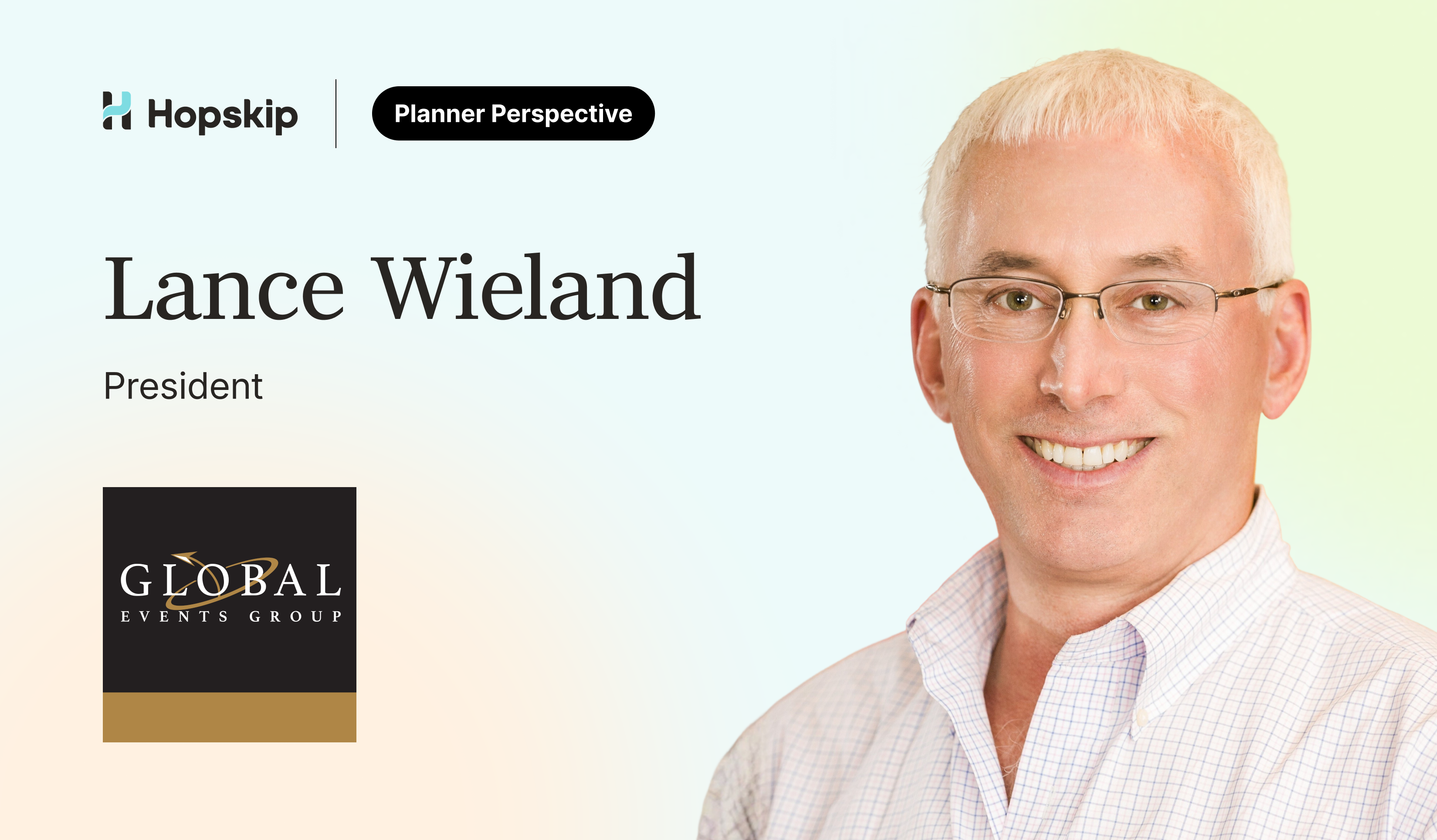
Lance Wieland didn't plan to start an event agency. He planned to keep doing great work at a company he believed in. Then that company went through a merger, the culture changed overnight, and it became clear that he and his boss weren't aligned. So instead of waiting it out, he took the opening.
Global Events Group was born. And from day one, it wasn't thinking small.
Wieland brings more than three decades of experience to the industry, having led event teams at two Fortune 500 companies, at Boston Consulting Group, and as an independent agency owner. He's planned programs in more than 70 countries across six continents, managed single events with budgets exceeding $35 million, and navigated crises that most planners only read about — a death on site, volcanic ash disruptions, hurricanes, Zika, COVID, and hotel cancellations mid-program.
This is a man who has been to the edge of the event planning map. Here's what's on the other side.
When a Defining Moment Shows Up, You Deliver
Early in GEG's history, Wieland landed a project that had "career-defining" written all over it: building a temporary port facility for four cruise ships being used as housing during Super Bowl XXXIX in Jacksonville. The scope was staggering — security, transportation, infrastructure, retail, and VIP services running 24 hours a day for 4,000 guests.
Four cruise ships. Four thousand guests. Non-stop.
Wieland delivered. And it opened the door to more complex, high-impact work that would define GEG for years to come.
The lesson isn't that you should take every enormous project that lands in your lap. It's that when the right opportunity shows up — one that stretches your capabilities and aligns with your strengths — you say yes and you execute. Reputation in this industry is built on exactly those moments.
9/11 and the Diversification Wake-Up Call
About 18 months into running GEG, Wieland had eight to ten international incentives lined up. The pipeline he'd worked hard to build, aligned with the type of work he excelled at. Then September 11 happened. Within a month, every single program was canceled.
"I had to rebuild a domestic client base from scratch," Wieland says. "It was a tough lesson, but an invaluable one: client diversification isn't optional. It's a core part of how I run the business today."
For event agencies, where entire revenue pipelines can evaporate in 24 hours, diversification isn't just a growth strategy. It's a survival strategy. If your client list is heavily weighted toward one sector, one geography, or one program type, you're not running a business — you're running a bet.
Pro tip: Audit your client mix annually. If any single segment, sector, or client represents more than 40% of your revenue, that's a risk conversation worth having now rather than during the next disruption.
Listen Before You Plan Anything
Ask Wieland about his approach to setting client expectations and he doesn't talk about proposals or pricing. He talks about listening.
"The first conversation is always about why — why this program matters, how it supports the business, what attendees are like, what has worked or failed in the past, and what's personally at stake for the client," he says. "Before we talk about destinations or dates, I want to understand the purpose behind the meeting and the problem they're trying to solve."
Most planners hear a budget and a date and immediately start thinking venues. Wieland hears a budget and a date and starts asking questions. Clients who feel heard give better briefs. Better briefs produce better programs. Better programs produce referrals and repeat business.
Pro tip: Before your next kickoff call, write down three questions about the why behind the event that you'd normally never ask. Then ask them.
Vendor Relationships Don't Occasionally Save Events. They Save Events Every Day.
Wieland is emphatic: "Strong vendor relationships don't just occasionally save events — they save them every day."
His most memorable example involves a dinner on top of Hoover Dam. Midway through the event, the catering company realized they had no dessert for the group. Wieland called the hotel where his group was staying, explained the situation, and the property immediately secured a suite large enough for the entire group — drinks and desserts waiting when the buses arrived.
That's not luck. That's a relationship. The hotel responded the way it did because of the trust and history Wieland had built with that property over years of consistent, professional partnership. Treat your vendors like colleagues, not contractors. Include them early. Communicate clearly. Pay on time. When you do, they tend to return the favor in exactly the moments that matter.
AI Is Reshaping the Industry. The Early Adopters Will Win.
Wieland has a strong view on the most important trend in event planning right now: AI.
"AI is the most transformative force shaping the events industry today," he says. "The planners who embrace it early will have a significant advantage."
He's already watching it happen in real time. A client's internal tech team is using an AI agent to reconcile hotel invoices — a task that once took days. Planners are uploading hotel menus and attendee demographics to instantly generate meal plans that accommodate global dietary needs.
The data backs this up. In 2026, 95% of surveyed organizers expect their organization's use of AI in events to increase. Yet 26% of planners report not using AI at all. That gap between the adopters and the holdouts is where competitive advantage lives right now.
Wieland's framing is useful: AI doesn't replace the planner. It handles the operational and analytical work that currently consumes enormous time — freeing planners to focus on the creativity, the relationship management, the judgment calls, and the moments that make an event actually feel like something.
Pro tip: Start small. Pick one repetitive task — invoice reconciliation, dietary coordination, communication drafts — and experiment with AI for 30 days. You'll find your entry point faster than you think.
Start Before You Leap
When asked what he'd do differently if starting GEG today, Wieland's answer is practical and honest: "I would have launched quietly and built a small client base before resigning from my job. Walking out the door to start something brand new was bold — and it worked — but it's not the approach I'd recommend today. A more measured transition would have reduced the risk without changing the outcome."
For planners considering making the jump to independent work, this is worth sitting with. The agency you're dreaming about doesn't require a dramatic resignation. It requires a few clients, a process, and proof of concept. You can build those while you're still employed. The boldness can come later, when the foundation is already there.
Emergencies Are Inevitable. Panic Is Optional.
Wieland's approach to crisis management is systematic. Most emergencies — theft, medical issues, lost passports, travel disruptions — can be anticipated and planned for in advance. The differentiator is preparation: building a team that includes legal, risk, insurance, travel, and security stakeholders from the beginning, aligning everyone on their roles, and communicating expectations with vendors before anything goes wrong.
"When everyone understands their role and the plan, even the unexpected becomes manageable," he says.
The goal isn't to eliminate the unexpected. It's to shrink the amount of time you spend in panic mode when it inevitably arrives.
Pro tip: Build a simple "what if" document for every event. What if the speaker cancels? What if the room flip runs long? Having a rough answer to each scenario in advance saves significant stress when you inevitably need one.
True Hospitality Creates Moments That Last a Lifetime
Wieland's philosophy on attendee experience comes down to authenticity. "Pay attention to the small things and put yourself in the attendees' shoes. Start by thinking big — even 'crazy' — and refine once the budget becomes clear. If something moved you, surprised you, or made you feel seen, chances are it will resonate with others too."
And then there's The Mango House.
For a top global incentive program in Cairns, Australia, Wieland and his team built a fictional venue from the ground up. The Mango House was a rundown bar — completely fake, constructed from the sand up — supposedly discovered during a site inspection. Actors played the regulars. A storyline unfolded throughout the evening. Guests were completely immersed.
As the night progressed, the actors invited everyone to dinner on the beach. The program went on to win a SITE Crystal Award. The team sent guests a video of the build afterward — and guests still didn't believe the venue wasn't real.
The lesson isn't "be more theatrical." It's something simpler: design for feeling, not just logistics. Authenticity is often the most memorable part of an event.
"True hospitality is about creating the moments people talk about for the rest of their lives," Wieland says. "Policies and rules exist for good reasons, but great planners know how to show flexibility within those boundaries when it benefits the guest experience."
That's not a tip. That's a philosophy.
Planners on Hopskip save 30+ hours per RFP, get cleaner proposals faster, and have all the information they need to make confident venue decisions. The best part? It's free to start for planners. Book a demo today to get started.
Sources
- Bizzabo. (2026). Event Industry Trends 2026: AI, Budgets, ROI & What Event Leaders Report.
- EventsAir. (2026). Top 12 Event Industry Insights & Trends for 2026.
- SITE (Society for Incentive Travel Excellence). Crystal Awards.


.svg)