.svg)
Event Planning vs. Event Managing: Hard-Won Lessons From 40 Years in the Industry

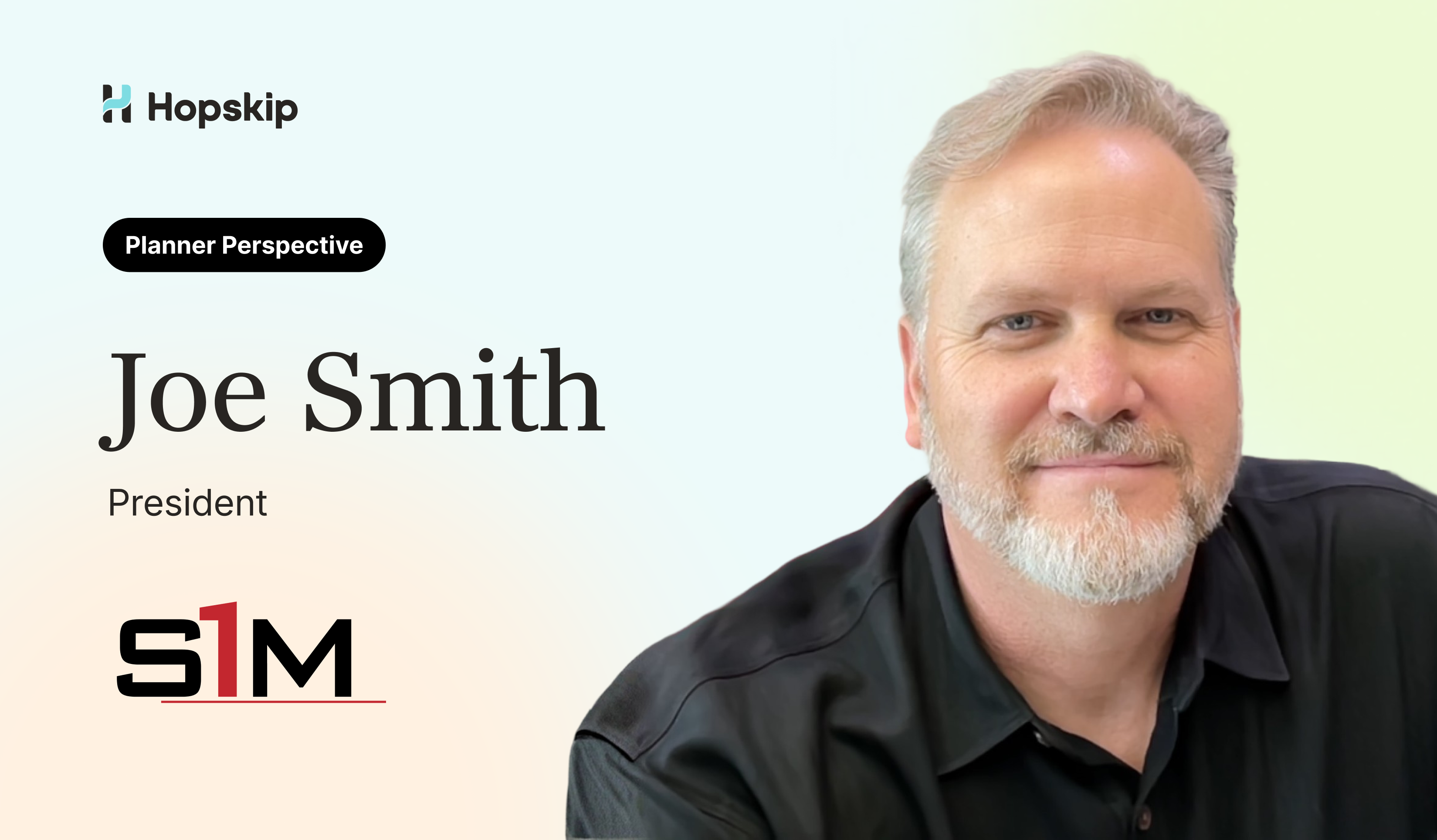
Joe Smith, President of StageOne Management & Events, has planned everything from law enforcement conferences to yacht dinners on four hours' notice. Here's what four decades in events has taught him about customer service, emergency prep, and why "setting expectations" is the fastest way to mediocrity.
There's a fine line between an event planner and an event manager. One is laser-focused on whether the coffee station is fully stocked. The other is the person who books a yacht for 200 scientists with four hours' notice and somehow pulls it off.
Joe Smith, President of StageOne Management & Events, is firmly in the second camp. With nearly four decades in the industry, Joe has seen trends come and go (RIP, fax machine), survived a wildfire evacuation in South Lake Tahoe, and built a business that still runs on a deceptively simple foundation: genuine, unapologetic customer service.
Below, we've pulled out the sharpest lessons from Joe's career, backed by industry data, so you can decide which kind of professional you want to be.
1. Stop "Setting Expectations." Start Exceeding Them.
Ask Joe Smith about client expectation-setting, and you'd better have a thick skin. "I think 'setting client expectations' is the single biggest mistake an Event Manager can make," he says. "It's nothing but an excuse for poor service."
It's a provocative take, but it's hard to argue with. In an industry where 42.6% of organizers report delays with venue proposals and client communication is consistently cited as a top pain point, the instinct to manage expectations downward is understandable. But Joe argues it's a race to the bottom.
His alternative? Listen first, ask questions second, then figure out how to over-deliver. From the very first conversation, his job isn't to tell clients what's realistic. It's to understand exactly what they need, and then find a way to make it happen.
Pro Tip: Replace "expectation-setting" conversations with discovery conversations. Your first call with a client should be 80% you listening and 20% you talking. The questions you ask in that call are what separate a commodity service from a trusted partnership.
2. Vendor Relationships Are Your Emergency Insurance Policy
In August 2021, Joe was setting up for what should have been a straightforward conference in South Lake Tahoe when the Caldor Fire changed everything. By Sunday evening, ash was falling like snow and an evacuation order was imminent.
What saved the event, and the association that depended on its revenue to survive, wasn't a robust crisis management software or a 50-page contingency plan. It was a 30-year friendship with production partner Rich Izzi of Izzi Productions. Within hours of the evacuation announcement, the two had pivoted the entire three-day in-person conference to a fully virtual format, produced out of a hospitality suite at the Grand Sierra Resort in Reno.
"Could I have done it without Rich? Maybe," Joe admits. "But if he wasn't there, I'm not even sure I would have made the recommendation."
This is not an outlier story. The global corporate events market was valued at $325 billion in 2023 and is expected to grow to nearly $600 billion by 2029, meaning the stakes at any given event are only getting higher. Your vendor network isn't a nice-to-have. It's a load-bearing wall. Cvent
Pro Tip: Treat your best vendors like colleagues, not contractors. Attend their industry events, send referrals their way, and make deposits into that relationship bank long before you need to make a withdrawal at 11pm during a wildfire evacuation.
3. Event Planner vs. Event Manager: Know the Difference
Joe has a vivid mental image he's developed over four decades of walking into events: the planning team, moving twice as fast as everyone else, hyperfocused on a task they've deemed urgent, walking straight past the attendee who's clearly lost or uncomfortable.
"Event Planners worry about running out of coffee," he says. "Event Managers empower their F&B partner to focus on the coffee while they focus on the client and attendees."
The distinction matters more than it sounds. Only 15% of organizers rate their networking experiences as very effective, despite networking being one of the top reasons attendees show up. That gap isn't a technology problem. It's a human attention problem. Someone needs to be in the room playing host, making introductions, noticing the vendor sitting alone in their booth, and bringing people together. That's the event manager's job. The logistics should be delegated or systematized so that person is free to do it.
Pro Tip: Build your run-of-show so thoroughly that your team can execute it without you. Then spend the event doing what no checklist can replace: reading the room, connecting people, and solving problems before attendees even realize there was one.
4. Don't Chase Trends. Chase Your Client.
When asked what emerging trends event planners should take seriously, Joe gives the kind of answer that makes a lot of people uncomfortable: "None."
He doesn't mean ignore innovation. He means don't confuse the tools with the job. The fax machine was a trend. Email was a trend. Web registration was a trend. Apps were a trend. The underlying work, finding a venue, registering attendees, welcoming them onsite, and taking care of them, hasn't changed in 40 years.
The data actually supports this philosophy. Over 85% of event planners use event management software, and the list of tools keeps growing. 19% of marketers rely on 4 to 7 different event technology providers to meet their needs. That's a lot of tab-switching for what is, at its core, a relationship business.
Joe's advice: let your clients' needs drive your technology adoption, not the other way around.
Pro Tip: Before you add any new tool or technology to your stack, ask yourself one question: does this help me serve my clients better, or does it just make me feel more sophisticated? If you can't answer clearly, save the subscription fee.
5. Niche Diversification Could Save Your Business
Early in his career, Joe refused association clients entirely. He was a corporate events guy, full stop. Then, in 2006, a chance encounter at the Red Rock Hotel in Las Vegas changed his entire outlook. An association of California attorneys needed help, their sales manager was late, and Joe stepped in.
"I loved working with a client that truly needed our services," he recalls. That association became a 12-year client relationship, one Joe now wishes he'd started on day one.
The lesson here isn't that associations are better than corporate clients. It's that rigid niche thinking can leave revenue, and more importantly, meaningful work, on the table. 52% of event planners say their biggest challenge is increasing attendance. Adding an adjacent market segment, whether associations, nonprofits, or a new vertical, can provide both stability and the kind of client relationships that keep the work interesting.
Pro Tip: Make a list of the types of clients you've declined in the past year. For each one, ask yourself honestly: was that a capacity decision or a comfort-zone decision? The answer might surprise you.
6. Emergency Planning Is Not One-Size-Fits-All
Joe's approach to crisis preparedness is less "laminated binder" and more "think like a local." Every event gets a tailored emergency plan based on its location, activity type, attendee profile, and risk exposure. For international events, that includes contracting with a medevac company to repatriate injured attendees. For a conference of 150 law enforcement officers, the calculus looks very different than for 20 C-suite executives.
"A 150 law enforcement officers need far less of an emergency plan than 20 C-Level execs," he says. That's not a knock on officers. It's a recognition that context shapes risk, and cookie-cutter plans miss that entirely.
The core non-negotiables: cell numbers for all attendees, a complete attendee list, the hotel's in-house guest list, emergency contacts, and at least one off-site team member who has access to all of it.
Pro Tip: After every event, add a five-minute debrief question to your team review: "What emergency scenario were we not prepared for?" The answer to that question is your next planning improvement.
7. Relationships Beat Differentiation Every Time
Joe doesn't try to out-market his competitors. Many of them are his friends. "If you put two competent event planning companies side by side, we all do basically the same thing," he says. "The real difference is going to be who you feel comfortable with."
In a services industry where 85% of meeting professionals are optimistic about the state of meetings and events in 2026 and competition is increasing accordingly, this might sound like a losing strategy. It isn't. It's a filtering strategy. Joe isn't trying to win every pitch. He's trying to find the clients who will sleep soundly knowing his team is on the job, and then deliver the kind of service that makes them never want to work with anyone else.
Pro Tip: The next time you're in a pitch meeting, stop trying to differentiate and start trying to connect. Ask the client what keeps them up at night before their events. Then tell them, honestly, how you address that. That conversation will do more for your win rate than any capability deck.
The Bottom Line
Joe Smith built a business from a kitchen table in Mountain View, California, and has kept it running for nearly 40 years by staying focused on one thing: taking care of people. Not trends. Not differentiation frameworks. Not expectation-setting scripts. People.
In an industry projected to grow from $1.47 trillion in 2025 to $2.43 trillion by 2035, there will be no shortage of new tools, new jargon, and new "best practices" to chase. Joe's advice, earned the hard way across four decades of corporate events, association conferences, wildfires, and last-minute yacht charters, is to let everyone else chase those things while you focus on your clients.
That's the difference between an event planner and an event manager. And it's a difference that tends to show up at the end of every event, in how people talk about you on their way out the door.
Start Smart: Use Hopskip to Lock In the Right Venue
Before Joe Smith can WOW a client, he needs the right venue. And that process, sourcing, sending RFPs, comparing proposals, and negotiating contracts, is where a lot of event planners lose hours they'll never get back.
Hopskip is the venue sourcing platform built specifically for event planners and third-party agencies. It streamlines the entire RFP process, from discovery to proposal comparison, so you can spend less time chasing hotels and more time doing the work Joe's been preaching about for four decades: building relationships and taking care of people.
Planners on Hopskip save 30+ hours per RFP, get cleaner proposals faster, and have all the information they need to make confident venue decisions. The best part? It's free to start for planners. Book a demo today to get started.
References & Sources
Curabitur bibendum ad viverra eu fringilla ad eu. Eget placerat ultricies quis amet mattis himenaeos ullamcorper facilisi volutpat.
Start for free
Send your first one for free.

Event Planning vs. Event Managing: Hard-Won Lessons From 40 Years in the Industry
Joe Smith, President of StageOne Management & Events, has planned everything from law enforcement conferences to yacht dinners on four hours' notice. Here's what four decades in events has taught him about customer service, emergency prep, and why "setting expectations" is the fastest way to mediocrity.
There's a fine line between an event planner and an event manager. One is laser-focused on whether the coffee station is fully stocked. The other is the person who books a yacht for 200 scientists with four hours' notice and somehow pulls it off.
Joe Smith, President of StageOne Management & Events, is firmly in the second camp. With nearly four decades in the industry, Joe has seen trends come and go (RIP, fax machine), survived a wildfire evacuation in South Lake Tahoe, and built a business that still runs on a deceptively simple foundation: genuine, unapologetic customer service.
Below, we've pulled out the sharpest lessons from Joe's career, backed by industry data, so you can decide which kind of professional you want to be.
1. Stop "Setting Expectations." Start Exceeding Them.
Ask Joe Smith about client expectation-setting, and you'd better have a thick skin. "I think 'setting client expectations' is the single biggest mistake an Event Manager can make," he says. "It's nothing but an excuse for poor service."
It's a provocative take, but it's hard to argue with. In an industry where 42.6% of organizers report delays with venue proposals and client communication is consistently cited as a top pain point, the instinct to manage expectations downward is understandable. But Joe argues it's a race to the bottom.
His alternative? Listen first, ask questions second, then figure out how to over-deliver. From the very first conversation, his job isn't to tell clients what's realistic. It's to understand exactly what they need, and then find a way to make it happen.
Pro Tip: Replace "expectation-setting" conversations with discovery conversations. Your first call with a client should be 80% you listening and 20% you talking. The questions you ask in that call are what separate a commodity service from a trusted partnership.
2. Vendor Relationships Are Your Emergency Insurance Policy
In August 2021, Joe was setting up for what should have been a straightforward conference in South Lake Tahoe when the Caldor Fire changed everything. By Sunday evening, ash was falling like snow and an evacuation order was imminent.
What saved the event, and the association that depended on its revenue to survive, wasn't a robust crisis management software or a 50-page contingency plan. It was a 30-year friendship with production partner Rich Izzi of Izzi Productions. Within hours of the evacuation announcement, the two had pivoted the entire three-day in-person conference to a fully virtual format, produced out of a hospitality suite at the Grand Sierra Resort in Reno.
"Could I have done it without Rich? Maybe," Joe admits. "But if he wasn't there, I'm not even sure I would have made the recommendation."
This is not an outlier story. The global corporate events market was valued at $325 billion in 2023 and is expected to grow to nearly $600 billion by 2029, meaning the stakes at any given event are only getting higher. Your vendor network isn't a nice-to-have. It's a load-bearing wall. Cvent
Pro Tip: Treat your best vendors like colleagues, not contractors. Attend their industry events, send referrals their way, and make deposits into that relationship bank long before you need to make a withdrawal at 11pm during a wildfire evacuation.
3. Event Planner vs. Event Manager: Know the Difference
Joe has a vivid mental image he's developed over four decades of walking into events: the planning team, moving twice as fast as everyone else, hyperfocused on a task they've deemed urgent, walking straight past the attendee who's clearly lost or uncomfortable.
"Event Planners worry about running out of coffee," he says. "Event Managers empower their F&B partner to focus on the coffee while they focus on the client and attendees."
The distinction matters more than it sounds. Only 15% of organizers rate their networking experiences as very effective, despite networking being one of the top reasons attendees show up. That gap isn't a technology problem. It's a human attention problem. Someone needs to be in the room playing host, making introductions, noticing the vendor sitting alone in their booth, and bringing people together. That's the event manager's job. The logistics should be delegated or systematized so that person is free to do it.
Pro Tip: Build your run-of-show so thoroughly that your team can execute it without you. Then spend the event doing what no checklist can replace: reading the room, connecting people, and solving problems before attendees even realize there was one.
4. Don't Chase Trends. Chase Your Client.
When asked what emerging trends event planners should take seriously, Joe gives the kind of answer that makes a lot of people uncomfortable: "None."
He doesn't mean ignore innovation. He means don't confuse the tools with the job. The fax machine was a trend. Email was a trend. Web registration was a trend. Apps were a trend. The underlying work, finding a venue, registering attendees, welcoming them onsite, and taking care of them, hasn't changed in 40 years.
The data actually supports this philosophy. Over 85% of event planners use event management software, and the list of tools keeps growing. 19% of marketers rely on 4 to 7 different event technology providers to meet their needs. That's a lot of tab-switching for what is, at its core, a relationship business.
Joe's advice: let your clients' needs drive your technology adoption, not the other way around.
Pro Tip: Before you add any new tool or technology to your stack, ask yourself one question: does this help me serve my clients better, or does it just make me feel more sophisticated? If you can't answer clearly, save the subscription fee.
5. Niche Diversification Could Save Your Business
Early in his career, Joe refused association clients entirely. He was a corporate events guy, full stop. Then, in 2006, a chance encounter at the Red Rock Hotel in Las Vegas changed his entire outlook. An association of California attorneys needed help, their sales manager was late, and Joe stepped in.
"I loved working with a client that truly needed our services," he recalls. That association became a 12-year client relationship, one Joe now wishes he'd started on day one.
The lesson here isn't that associations are better than corporate clients. It's that rigid niche thinking can leave revenue, and more importantly, meaningful work, on the table. 52% of event planners say their biggest challenge is increasing attendance. Adding an adjacent market segment, whether associations, nonprofits, or a new vertical, can provide both stability and the kind of client relationships that keep the work interesting.
Pro Tip: Make a list of the types of clients you've declined in the past year. For each one, ask yourself honestly: was that a capacity decision or a comfort-zone decision? The answer might surprise you.
6. Emergency Planning Is Not One-Size-Fits-All
Joe's approach to crisis preparedness is less "laminated binder" and more "think like a local." Every event gets a tailored emergency plan based on its location, activity type, attendee profile, and risk exposure. For international events, that includes contracting with a medevac company to repatriate injured attendees. For a conference of 150 law enforcement officers, the calculus looks very different than for 20 C-suite executives.
"A 150 law enforcement officers need far less of an emergency plan than 20 C-Level execs," he says. That's not a knock on officers. It's a recognition that context shapes risk, and cookie-cutter plans miss that entirely.
The core non-negotiables: cell numbers for all attendees, a complete attendee list, the hotel's in-house guest list, emergency contacts, and at least one off-site team member who has access to all of it.
Pro Tip: After every event, add a five-minute debrief question to your team review: "What emergency scenario were we not prepared for?" The answer to that question is your next planning improvement.
7. Relationships Beat Differentiation Every Time
Joe doesn't try to out-market his competitors. Many of them are his friends. "If you put two competent event planning companies side by side, we all do basically the same thing," he says. "The real difference is going to be who you feel comfortable with."
In a services industry where 85% of meeting professionals are optimistic about the state of meetings and events in 2026 and competition is increasing accordingly, this might sound like a losing strategy. It isn't. It's a filtering strategy. Joe isn't trying to win every pitch. He's trying to find the clients who will sleep soundly knowing his team is on the job, and then deliver the kind of service that makes them never want to work with anyone else.
Pro Tip: The next time you're in a pitch meeting, stop trying to differentiate and start trying to connect. Ask the client what keeps them up at night before their events. Then tell them, honestly, how you address that. That conversation will do more for your win rate than any capability deck.
The Bottom Line
Joe Smith built a business from a kitchen table in Mountain View, California, and has kept it running for nearly 40 years by staying focused on one thing: taking care of people. Not trends. Not differentiation frameworks. Not expectation-setting scripts. People.
In an industry projected to grow from $1.47 trillion in 2025 to $2.43 trillion by 2035, there will be no shortage of new tools, new jargon, and new "best practices" to chase. Joe's advice, earned the hard way across four decades of corporate events, association conferences, wildfires, and last-minute yacht charters, is to let everyone else chase those things while you focus on your clients.
That's the difference between an event planner and an event manager. And it's a difference that tends to show up at the end of every event, in how people talk about you on their way out the door.
Start Smart: Use Hopskip to Lock In the Right Venue
Before Joe Smith can WOW a client, he needs the right venue. And that process, sourcing, sending RFPs, comparing proposals, and negotiating contracts, is where a lot of event planners lose hours they'll never get back.
Hopskip is the venue sourcing platform built specifically for event planners and third-party agencies. It streamlines the entire RFP process, from discovery to proposal comparison, so you can spend less time chasing hotels and more time doing the work Joe's been preaching about for four decades: building relationships and taking care of people.
Planners on Hopskip save 30+ hours per RFP, get cleaner proposals faster, and have all the information they need to make confident venue decisions. The best part? It's free to start for planners. Book a demo today to get started.

.svg)