.svg)
Event Planning Secrets From a Boutique Agency Owner Who's Seen It All

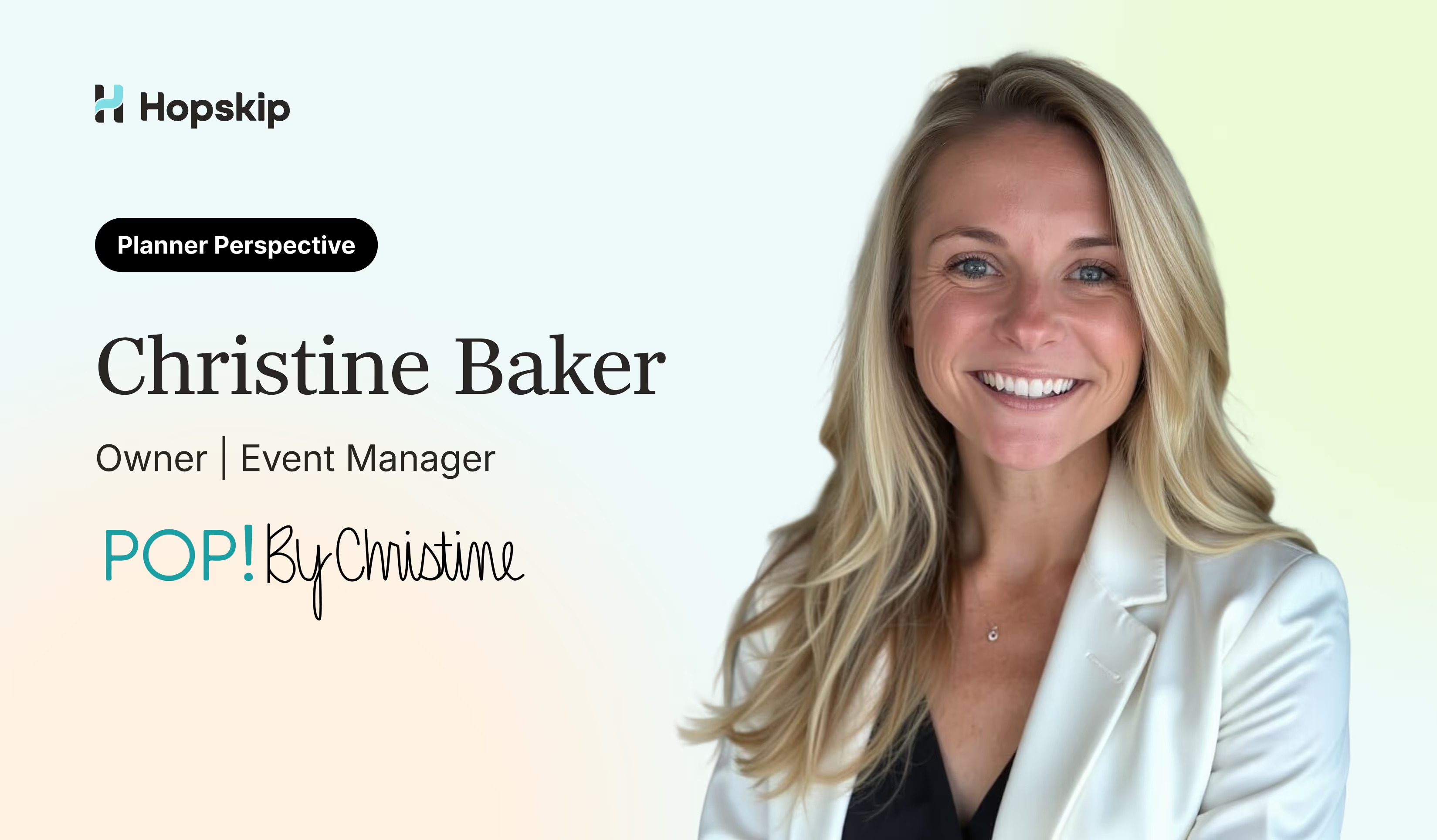
From K9 bomb sweeps to last-minute yacht sourcing, Christine Baker of POP! By Christine has navigated it all. Here are her best tips for running a smarter, stronger event planning business.
There's a certain type of event planner who thrives under pressure. The kind who, when a critical vendor cancels three days out, doesn't spiral into a Netflix documentary about their own downfall. Instead, they pick up the phone, call in a favor, and make sure not a single attendee notices a thing.
Christine Baker is that planner.
As the owner and event manager of POP! By Christine, a boutique agency based out of Washington, D.C., Christine has built her business on a foundation of strong relationships, relentless adaptability, and a healthy disregard for the idea that everything needs to be perfect before you can get started. Her clients have had her and her team sourcing yachts last-minute in foreign countries and wrangling K9 bomb sweeps before events. She's seen things. She's handled them.
In this edition of Planner Perspectives, Christine shares hard-won wisdom on running an event agency, staying ahead of industry trends, and why asking questions might be the most underrated skill in the business.
Stop Waiting. Start Doing.
If there's one piece of advice Christine would send back in time to her earlier self, it's this: move faster.
"One mistake I made early on was waiting too long to take action," she reflects. "As planners, we tend to want to perfect everything before executing. But the reality is, nothing is ever going to be perfect."
It's a trap many event professionals fall into. The run-of-show isn't quite right, the deck needs one more revision, the cold email doesn't feel ready. And meanwhile? Time keeps moving.
Christine's take: make the cold call. Ask for the referral. Take the first step.
Ironically, the event that accelerated her agency's growth was one no one planned for: COVID-19. When the industry went dark, Christine used the pause to formalize what had already been a growing passion. When events came back, she was ready. While other companies scrambled to rebuild internal teams, she was already up and running, offering execution support without the overhead of a full-time hire.
Pro Tip: If you've been sitting on an idea, a cold email, or a new service offering for longer than two weeks, send it today. Done and imperfect beats polished and never sent.
Set Expectations Before They Set You Up for Failure
When it comes to client onboarding, Christine's philosophy is refreshingly simple: listen first, talk second.
"My approach is to first really listen and understand their expectations, goals, and what success looks like to them," she says. "From there, I'm very transparent about what we can and can't execute, what's realistic within their scope, and what we would need, whether that's timeline, budget, or resources, to deliver at a high level."
This might sound obvious, but it's a step that's easy to rush when everyone's excited about a new project. Skipping the alignment conversation almost always costs more time than it saves, and usually at the worst possible moment: during execution.
Christine’sapproach also reinforces something research consistently shows: trust is built early or not at all. Setting clear, honest expectations upfront creates a working relationship that can weather the inevitable surprises that come with live events.
Pro Tip: Build a standard "first conversation" checklist that covers goals, success metrics, timeline constraints, and budget. Refer to it before every kickoff call, not after.
Your Vendor Relationships Are Your Safety Net (Treat Them Like It)
Here's a scenario that will make any event planner's stomach drop: a critical vendor cancels days before the event. Not weeks. Days.
Christine has been there. And she handled it with a single phone call.
"Because of the relationships I had built over time, I was able to immediately call a trusted partner who didn't hesitate," she says. "They understood how I work, the level of execution expected, and what was at stake. What could have been a major disruption ended up being a seamless pivot."
The attendee experience? Never impacted.
This is what years of genuine relationship investment looks like in practice. Not transactional vendor management, but treating the people in your network as extensions of your team. Because when things go sideways (and at some point, they always do), that's exactly what they need to be.
Pro Tip: Keep a "first call" vendor list: one trusted backup per key event category (AV, catering, décor, transportation) that you've already briefed on your standards. Revisit it quarterly.
In the AI Era, Human Experiences Become the Brand
Ask Christine what emerging trend every event planner should take seriously right now, and she doesn't hesitate: AI. Full stop.
But she's quick to clarify what she means by that.
"The real opportunity isn't simply using tools like ChatGPT to draft content," she explains. "It's about integrating AI into the way we design, plan, and optimize events end-to-end, whether that's for audience insights, personalization at scale, predictive planning, or streamlining operational workflows."
The data backs her up in a big way. According to the Amex GBT Meetings and Events 2025 Global Forecast, 50% of meeting planners globally planned to use AI technology in 2025. And in terms of generative AI specifically, 65% of planners said their organizations were already using generative AI platforms, with content generation leading the way at 83.8% of event professionals.
Still, there's a significant gap between awareness and fluency. Around 80% of planners are experimenting with AI, but only a small fraction feel they're using it at an advanced level. That gap, Christine would argue, is the opportunity.
At the same time, she's clear that AI doesn't cancel out the need for human connection. In fact, she believes the events industry is entering a moment where human connection becomes even more important.
"As AI-generated content becomes more abundant, curated human experiences become significantly more valuable," Christine says. "People still want connection, trust, and the feeling of being in the room together."
That shift is already influencing how some of the world's leading AI companies think about brand strategy. A recent Business Insider report highlighted that Anthropic, the company behind Claude AI, is investing heavily in live experiences and in-person brand engagement, including hiring for a senior events-focused brand role centered on thought leadership, relationship-building, and experiential marketing.
For Christine, that reinforces what event professionals have long understood: AI and live experiences are not competing forces — they're complementary ones.
Despite the rise of AI, 86.4% of organizers planned to maintain or increase the number of in-person events in 2025 compared to 2024. People want the efficiency of AI AND the irreplaceable feeling of being in a room together.
"The future sits at the intersection of both," Christine says. "Leveraging AI to make our work smarter and more efficient, while doubling down on creating intentional, high-impact in-person experiences."
Pro Tip: Start small with AI. Pick one repetitive planning task (run-of-show formatting, vendor outreach emails, post-event surveys) and use an AI tool for it consistently for 30 days. Build from there.
Design Events for Attendees, Not for the Org Chart
One of Christine's most pointed observations is about a misalignment that shows up constantly in event programming: events built around what the organization wants to say, not what attendees want to experience.
"I often see this misalignment show up most clearly in event programming," she notes. "A lot of effort goes into curating content, speakers, and show flow, but the question is: is it actually landing with the audience? Or does it end up feeling more like a promotional exercise than a meaningful, value-driven experience?"
This is a real and widespread problem. And the fix isn't complicated: ask your attendees what they want, then actually use those answers to design the experience.
The events that stick, that generate referrals, repeat attendance, and genuine buzz, are the ones where content is built through the lens of the person sitting in the seat. What do they need to learn? What are they trying to solve? What would make them say "that was worth my time"?
Research confirms this instinct: more than 61% of millennials and 63% of Gen Z attendees plan to attend more global events in 2026 and beyond, but that participation is conditional on events delivering genuine value.
Pro Tip: Add a two-question pre-event survey to your registration flow: "What's the one thing you're hoping to walk away with?" and "What would make this event a waste of your time?" The second question is usually more useful.
The Secret Weapon Nobody Talks About: Asking Questions
Here's something a lot of planners know but don't say out loud: they feel like they're supposed to have all the answers, all the time. And that pressure, mostly self-imposed, can actually slow things down.
Christine pushes back on that idea directly.
"We're frequently in rooms where we don't have all the answers, and that's okay," she says. "The role shifts from being the person who knows everything to the person who knows how to connect the right people, ask the right questions, and move things forward with clarity."
Her rule of thumb: "Asking questions is actually a strength, not a gap."
It's a mindset shift that's especially valuable when something goes wrong on-site. In an industry where the stakes are high and the margin for error is slim, the planner who asks the right question at the right moment can surface a risk, unlock a solution, or realign a team faster than the one who's busy projecting certainty they don't actually have.
Christine's emergency protocol reflects this: detailed run-of-show documents, clear roles and responsibilities, real-time communication channels, and a command structure that enables fast decisions. She describes it as being "a duck on water: calm and composed on the surface while everything is moving quickly underneath."
Pro Tip: Before any large event, run a 20-minute "What If" session with your team. Pose three plausible worst-case scenarios and talk through the response plan. It surfaces gaps before they surface on-site.
The Takeaway: Build the Relationships, Skip the Perfection
Christine Baker didn't build POP! by waiting until everything was perfect. She built it by moving, adapting, listening, and investing heavily in the people around her, clients, vendors, and the curated specialists of the POP! Collective alike. Along the way, she continued growing the business while navigating COVID, the birth of her first child, and a divorce, experiences she openly shares to remind other entrepreneurs that growth rarely happens under perfect circumstances. In many ways, those seasons reinforced the resilience and adaptability required to succeed in the events industry.
Her advice for any event planner looking to level up? Move faster than feels comfortable. Set expectations earlier than feels necessary. Ask the questions others are too afraid to ask. And when the vendor cancels three days out, make sure you already know who to call.
Start Sourcing Smarter With Hopskip
If you're an event planner spending hours chasing down hotel proposals, following up on RFPs, and trying to make sense of a dozen different PDF responses, there's a better way.
Hopskip is a venue sourcing platform built specifically for planners who want more control, more clarity, and a lot less back-and-forth. Planners save an average of 30+ hours per RFP, and hotels on the platform convert at 80% from proposal to booking.
The best part? It's free for planners. Book a demo today to get started.
Sources
- Event Industry News & EventMobi: How AI Will Transform The Events Industry 2025 — https://www.eventindustrynews.com/guides/event-industry-news-launches-groundbreaking-ai-report-2025-in-partnership-with-eventmobi
- Convene: How Event Planners Can Use AI in 2025 — https://convene.com/catalyst/meeting-event-planning/how-event-planners-can-use-ai-in-2025/
- PCMA: New Study Identifies Missed Opportunities to Use AI in Event Planning — https://www.pcma.org/study-missed-opportunities-use-ai-event-planning/
- Bizplanr: 50+ Event Industry Statistics to Watch in 2025 — https://bizplanr.ai/blog/event-industry-statistics
- EMS Events: 15+ Event Industry Trends for 2026: The Ultimate Guide — https://www.ems-events.co.uk/event-industry-trends-for-2026
- Momencio: 50 Key Event Industry Statistics (2026 Report) — https://www.momencio.com/50-event-industry-statistics-for-2025/
Curabitur bibendum ad viverra eu fringilla ad eu. Eget placerat ultricies quis amet mattis himenaeos ullamcorper facilisi volutpat.
Start for free
Send your first one for free.

Event Planning Secrets From a Boutique Agency Owner Who's Seen It All
From K9 bomb sweeps to last-minute yacht sourcing, Christine Baker of POP! By Christine has navigated it all. Here are her best tips for running a smarter, stronger event planning business.
There's a certain type of event planner who thrives under pressure. The kind who, when a critical vendor cancels three days out, doesn't spiral into a Netflix documentary about their own downfall. Instead, they pick up the phone, call in a favor, and make sure not a single attendee notices a thing.
Christine Baker is that planner.
As the owner and event manager of POP! By Christine, a boutique agency based out of Washington, D.C., Christine has built her business on a foundation of strong relationships, relentless adaptability, and a healthy disregard for the idea that everything needs to be perfect before you can get started. Her clients have had her and her team sourcing yachts last-minute in foreign countries and wrangling K9 bomb sweeps before events. She's seen things. She's handled them.
In this edition of Planner Perspectives, Christine shares hard-won wisdom on running an event agency, staying ahead of industry trends, and why asking questions might be the most underrated skill in the business.
Stop Waiting. Start Doing.
If there's one piece of advice Christine would send back in time to her earlier self, it's this: move faster.
"One mistake I made early on was waiting too long to take action," she reflects. "As planners, we tend to want to perfect everything before executing. But the reality is, nothing is ever going to be perfect."
It's a trap many event professionals fall into. The run-of-show isn't quite right, the deck needs one more revision, the cold email doesn't feel ready. And meanwhile? Time keeps moving.
Christine's take: make the cold call. Ask for the referral. Take the first step.
Ironically, the event that accelerated her agency's growth was one no one planned for: COVID-19. When the industry went dark, Christine used the pause to formalize what had already been a growing passion. When events came back, she was ready. While other companies scrambled to rebuild internal teams, she was already up and running, offering execution support without the overhead of a full-time hire.
Pro Tip: If you've been sitting on an idea, a cold email, or a new service offering for longer than two weeks, send it today. Done and imperfect beats polished and never sent.
Set Expectations Before They Set You Up for Failure
When it comes to client onboarding, Christine's philosophy is refreshingly simple: listen first, talk second.
"My approach is to first really listen and understand their expectations, goals, and what success looks like to them," she says. "From there, I'm very transparent about what we can and can't execute, what's realistic within their scope, and what we would need, whether that's timeline, budget, or resources, to deliver at a high level."
This might sound obvious, but it's a step that's easy to rush when everyone's excited about a new project. Skipping the alignment conversation almost always costs more time than it saves, and usually at the worst possible moment: during execution.
Christine’sapproach also reinforces something research consistently shows: trust is built early or not at all. Setting clear, honest expectations upfront creates a working relationship that can weather the inevitable surprises that come with live events.
Pro Tip: Build a standard "first conversation" checklist that covers goals, success metrics, timeline constraints, and budget. Refer to it before every kickoff call, not after.
Your Vendor Relationships Are Your Safety Net (Treat Them Like It)
Here's a scenario that will make any event planner's stomach drop: a critical vendor cancels days before the event. Not weeks. Days.
Christine has been there. And she handled it with a single phone call.
"Because of the relationships I had built over time, I was able to immediately call a trusted partner who didn't hesitate," she says. "They understood how I work, the level of execution expected, and what was at stake. What could have been a major disruption ended up being a seamless pivot."
The attendee experience? Never impacted.
This is what years of genuine relationship investment looks like in practice. Not transactional vendor management, but treating the people in your network as extensions of your team. Because when things go sideways (and at some point, they always do), that's exactly what they need to be.
Pro Tip: Keep a "first call" vendor list: one trusted backup per key event category (AV, catering, décor, transportation) that you've already briefed on your standards. Revisit it quarterly.
In the AI Era, Human Experiences Become the Brand
Ask Christine what emerging trend every event planner should take seriously right now, and she doesn't hesitate: AI. Full stop.
But she's quick to clarify what she means by that.
"The real opportunity isn't simply using tools like ChatGPT to draft content," she explains. "It's about integrating AI into the way we design, plan, and optimize events end-to-end, whether that's for audience insights, personalization at scale, predictive planning, or streamlining operational workflows."
The data backs her up in a big way. According to the Amex GBT Meetings and Events 2025 Global Forecast, 50% of meeting planners globally planned to use AI technology in 2025. And in terms of generative AI specifically, 65% of planners said their organizations were already using generative AI platforms, with content generation leading the way at 83.8% of event professionals.
Still, there's a significant gap between awareness and fluency. Around 80% of planners are experimenting with AI, but only a small fraction feel they're using it at an advanced level. That gap, Christine would argue, is the opportunity.
At the same time, she's clear that AI doesn't cancel out the need for human connection. In fact, she believes the events industry is entering a moment where human connection becomes even more important.
"As AI-generated content becomes more abundant, curated human experiences become significantly more valuable," Christine says. "People still want connection, trust, and the feeling of being in the room together."
That shift is already influencing how some of the world's leading AI companies think about brand strategy. A recent Business Insider report highlighted that Anthropic, the company behind Claude AI, is investing heavily in live experiences and in-person brand engagement, including hiring for a senior events-focused brand role centered on thought leadership, relationship-building, and experiential marketing.
For Christine, that reinforces what event professionals have long understood: AI and live experiences are not competing forces — they're complementary ones.
Despite the rise of AI, 86.4% of organizers planned to maintain or increase the number of in-person events in 2025 compared to 2024. People want the efficiency of AI AND the irreplaceable feeling of being in a room together.
"The future sits at the intersection of both," Christine says. "Leveraging AI to make our work smarter and more efficient, while doubling down on creating intentional, high-impact in-person experiences."
Pro Tip: Start small with AI. Pick one repetitive planning task (run-of-show formatting, vendor outreach emails, post-event surveys) and use an AI tool for it consistently for 30 days. Build from there.
Design Events for Attendees, Not for the Org Chart
One of Christine's most pointed observations is about a misalignment that shows up constantly in event programming: events built around what the organization wants to say, not what attendees want to experience.
"I often see this misalignment show up most clearly in event programming," she notes. "A lot of effort goes into curating content, speakers, and show flow, but the question is: is it actually landing with the audience? Or does it end up feeling more like a promotional exercise than a meaningful, value-driven experience?"
This is a real and widespread problem. And the fix isn't complicated: ask your attendees what they want, then actually use those answers to design the experience.
The events that stick, that generate referrals, repeat attendance, and genuine buzz, are the ones where content is built through the lens of the person sitting in the seat. What do they need to learn? What are they trying to solve? What would make them say "that was worth my time"?
Research confirms this instinct: more than 61% of millennials and 63% of Gen Z attendees plan to attend more global events in 2026 and beyond, but that participation is conditional on events delivering genuine value.
Pro Tip: Add a two-question pre-event survey to your registration flow: "What's the one thing you're hoping to walk away with?" and "What would make this event a waste of your time?" The second question is usually more useful.
The Secret Weapon Nobody Talks About: Asking Questions
Here's something a lot of planners know but don't say out loud: they feel like they're supposed to have all the answers, all the time. And that pressure, mostly self-imposed, can actually slow things down.
Christine pushes back on that idea directly.
"We're frequently in rooms where we don't have all the answers, and that's okay," she says. "The role shifts from being the person who knows everything to the person who knows how to connect the right people, ask the right questions, and move things forward with clarity."
Her rule of thumb: "Asking questions is actually a strength, not a gap."
It's a mindset shift that's especially valuable when something goes wrong on-site. In an industry where the stakes are high and the margin for error is slim, the planner who asks the right question at the right moment can surface a risk, unlock a solution, or realign a team faster than the one who's busy projecting certainty they don't actually have.
Christine's emergency protocol reflects this: detailed run-of-show documents, clear roles and responsibilities, real-time communication channels, and a command structure that enables fast decisions. She describes it as being "a duck on water: calm and composed on the surface while everything is moving quickly underneath."
Pro Tip: Before any large event, run a 20-minute "What If" session with your team. Pose three plausible worst-case scenarios and talk through the response plan. It surfaces gaps before they surface on-site.
The Takeaway: Build the Relationships, Skip the Perfection
Christine Baker didn't build POP! by waiting until everything was perfect. She built it by moving, adapting, listening, and investing heavily in the people around her, clients, vendors, and the curated specialists of the POP! Collective alike. Along the way, she continued growing the business while navigating COVID, the birth of her first child, and a divorce, experiences she openly shares to remind other entrepreneurs that growth rarely happens under perfect circumstances. In many ways, those seasons reinforced the resilience and adaptability required to succeed in the events industry.
Her advice for any event planner looking to level up? Move faster than feels comfortable. Set expectations earlier than feels necessary. Ask the questions others are too afraid to ask. And when the vendor cancels three days out, make sure you already know who to call.
Start Sourcing Smarter With Hopskip
If you're an event planner spending hours chasing down hotel proposals, following up on RFPs, and trying to make sense of a dozen different PDF responses, there's a better way.
Hopskip is a venue sourcing platform built specifically for planners who want more control, more clarity, and a lot less back-and-forth. Planners save an average of 30+ hours per RFP, and hotels on the platform convert at 80% from proposal to booking.
The best part? It's free for planners. Book a demo today to get started.
Sources
- Event Industry News & EventMobi: How AI Will Transform The Events Industry 2025 — https://www.eventindustrynews.com/guides/event-industry-news-launches-groundbreaking-ai-report-2025-in-partnership-with-eventmobi
- Convene: How Event Planners Can Use AI in 2025 — https://convene.com/catalyst/meeting-event-planning/how-event-planners-can-use-ai-in-2025/
- PCMA: New Study Identifies Missed Opportunities to Use AI in Event Planning — https://www.pcma.org/study-missed-opportunities-use-ai-event-planning/
- Bizplanr: 50+ Event Industry Statistics to Watch in 2025 — https://bizplanr.ai/blog/event-industry-statistics
- EMS Events: 15+ Event Industry Trends for 2026: The Ultimate Guide — https://www.ems-events.co.uk/event-industry-trends-for-2026
- Momencio: 50 Key Event Industry Statistics (2026 Report) — https://www.momencio.com/50-event-industry-statistics-for-2025/

.svg)