.svg)
From Cancer Diagnosis to CEO: How Stephanie McVeigh Built an Incentive Agency on Resilience, Strategy, and "Oh My" Moments

Strategic Incentive Solutions CEO Stephanie McVeigh shares hard-won lessons on building a thriving event agency—from surviving cancer to securing pro golfers at a Masters cocktail party. Here's what every planner can learn from her story.
Some people start their event planning agencies because they love logistics. Others because they have a knack for party favors and florals. And then there's Stephanie McVeigh, CEO and Founder of Strategic Incentive Solutions, who launched her agency in the aftermath of a Stage III breast cancer diagnosis — and turned one of life's most terrifying moments into the foundation of a business that has served clients for over 15 years.
That's not just a great origin story. That's a masterclass in running toward the hard thing instead of away from it.
Based in Ontario, Canada, Stephanie leads a boutique third-party agency specializing in incentive travel and performance marketing programs. What makes Strategic Incentive Solutions different isn't just their portfolio of world-class destinations — it's the philosophy behind every program they design: experiences should be earned, felt, and purposeful.
Here's what every event planner can take away from her journey.
Start With the "Why" — Not the Venue
If there's a single thread running through Stephanie's entire philosophy, it's this: clarity of purpose drives everything else.
Her approach to every client program begins not with a site inspection or a catering proposal, but with a fundamental question — what is this event actually for? What behavior are we trying to drive? What does success look like six months after everyone goes home?
It sounds simple. Most planners would nod and say "yes, of course." But in practice, the seductive pull of venue research, swag bags, and dinner menus means the "why" often gets skipped in favor of the "what." That's a costly mistake — literally.
The events industry is projected to reach $2.5 trillion by 2035, growing at a compound annual rate of 6.8%. But growth in the industry doesn't automatically translate to growth for individual programs. Without alignment to business objectives, even the most beautiful event is essentially a very expensive party that no one can justify in the boardroom.
Stephanie's model flips this around. She works closely with clients to build a strategic scope of work tied to their goals before a single venue is discussed. When that foundation is solid, everything else — the destination, the agenda, the activations — serves a clear purpose.
Pro Tip: Before your next client kickoff, ask three questions: What performance behavior do you want to change or reinforce? How will you measure whether this program worked? What does a win look like 90 days after the event? If the client can't answer these, that's your first deliverable — not the venue options.
Events Are Performance Tools, Not Perks
Here's where Stephanie's agency really diverges from the pack. While many competitors are happy to be "a great event company," Strategic Incentive Solutions has positioned itself as a full-service performance marketing partner. That distinction is not just branding — it changes everything about how programs are designed and sold.
The data backs this up compellingly. According to the Incentive Research Foundation, well-designed incentive programs can increase sales productivity by 18% and generate a 112% ROI. Companies using non-cash rewards, including incentive travel, experience three times higher revenue increases than those that don't. And 88.5% of employees who earned an incentive trip were identified as top performers — more than half of whom had been with their company for four or more years.
In other words, incentive travel isn't a nice-to-have. It's a retention and performance engine with measurable returns. When Stephanie talks about helping clients "drive engagement, performance, and organic growth within their organizations," she's not speaking in buzzwords — she's describing a quantifiable business outcome.
That's also why many of her clients have been with her for 15+ years. When your agency is attached to business results, not just event aesthetics, the relationship becomes nearly impossible to replace.
Pro Tip: The next time a client pushes back on program budget, reframe the conversation around performance metrics, not event costs. An incentive travel program that drives a 15% lift in sales revenue pays for itself. Come to the budget conversation armed with ROI data — not just a comparison of two hotel options.
Delegation Isn't Weakness. It's the Business Model.
Ask most founders what mistake they made early on, and the answer almost always involves the same word: everything. Stephanie is no exception. Early in her career, she tried to maintain deep involvement in every detail, convinced that her presence was what guaranteed quality.
What she discovered over time was the opposite — that the ceiling on her business was set by how much she could personally carry. And businesses with ceilings don't grow.
Today, her focus is on coaching, mentoring, and building an environment where her team has the confidence to make decisions, own client relationships, and take creative risks. It's a model that's increasingly supported by industry data: staffing shortages and burnout are among the top challenges facing event agencies right now, with 17% of planners citing workforce issues as a significant problem. Teams that are empowered and invested grow through challenges. Teams that are micromanaged collapse under them.
For boutique agencies especially, the ability to retain and develop talent isn't just an HR issue — it's a competitive advantage.
Pro Tip: Identify one task you do this week that could be done by someone on your team with the right briefing. Write out the process, hand it over, and resist the urge to take it back. Scalable businesses are built on documented processes and trusted people — not heroic individual effort.
Vendor Relationships Are Not a "Nice to Have"
There is a version of event planning that treats vendors as interchangeable commodities — whoever has the best price on a Tuesday wins the contract. Stephanie takes a sharply different view.
She's built long-term partnerships with destination management companies, properties, and suppliers that span years of shared history. And those relationships have paid dividends in moments that would have derailed lesser-prepared planners: last-minute program changes, weather disruptions, logistical surprises that no contingency plan could have fully anticipated.
When you have a vendor partner who knows your standards, understands your clients' expectations, and is personally invested in the outcome of your program — a challenge becomes an opportunity to overdeliver. When you don't have that history? You're negotiating trust in the middle of a crisis. That's not a position anyone wants to be in.
In a market where nearly 30% of planners cite increasing vendor costs as a major obstacle, the temptation to shop around for cheaper alternatives grows every year. Stephanie's career is an argument for investing in depth over breadth when it comes to partnerships.
Pro Tip: Treat your top three vendor relationships like client relationships. Schedule annual check-ins even when you don't have active programs together. Share feedback — positive and constructive. These partnerships are long-term assets, not transactional line items.
Budget Pressure Is Real — Strategy Is the Answer
One of the most important things Stephanie flagged in her experience is the escalating tension between rising costs and flat or shrinking budgets. This isn't a niche concern for boutique agencies — it's an industry-wide pressure point.
The average daily cost per meeting attendee reached $169 in 2025, up 4.3% from the prior year, driven by increases in food and beverage, venue costs, labor, and technology. Meanwhile, nearly half of planners surveyed report that their budgets remain unchanged or have decreased. Ninety percent of meeting professionals cite potential cost increases as their top current concern.
That math doesn't work unless you change the approach. And Stephanie's answer isn't to cut corners or shrink ambitions — it's to plan earlier, align more tightly to business objectives, and design experiences with real strategic discipline. Programs that are clearly tied to performance outcomes are far easier to defend in a budget review than programs that exist to reward tenure or provide a nice send-off for a retiring VP.
The future of event planning, in her view, belongs to planners who combine creativity with operational discipline and financial fluency. Not just great ideas — great ideas with a business case.
Pro Tip: When building program proposals, include a projected ROI section — even a simple one. Tie proposed activities to measurable outcomes. Showing clients how the program supports their business goals makes you a strategic partner. Skipping that conversation makes you a vendor.
The Wildest Idea Is Often the Best One
No story from Stephanie's career captures her agency's philosophy better than one involving The Masters golf tournament. A client offhandedly asked whether professional golfers could attend their private cocktail reception for top performers. Even within the famously exclusive, tightly controlled environment surrounding The Masters, Stephanie's team didn't dismiss the idea — they leaned into it.
Through their network of partnerships and some careful coordination, they made it happen. Professional golf personalities attended the reception, mingled with guests, and turned an already exceptional trip into something attendees are still talking about years later.
That's the difference between an agency that executes what's asked and one that pursues what seems impossible. "Oh my" moments don't happen by accident. They happen because someone decided that "no" wasn't the first answer.
For planners, there's a practical takeaway buried inside this story: your network is the infrastructure that makes extraordinary things possible. Cultivating relationships across industries, destinations, and entertainment spaces isn't a side project — it's how you deliver magic when a client asks for it.
Pro Tip: Keep a running list of "ambitious asks" from clients — even the ones you couldn't deliver. Use it as a relationship-building roadmap. Who in your network might help you say "yes" to one of those requests next time?
The Deepest Lesson: Start Sooner. Trust Yourself.
When asked what she'd do differently if starting over, Stephanie's answer is disarmingly straightforward: she would have trusted herself and started sooner. Every hard thing she walked through — the diagnosis, the recovery, the early years of building something from nothing — shaped the business and the leader she became.
That's not just an inspiring quote for a conference keynote. It's a practical argument for acting on good judgment before it feels completely safe to do so. The most dangerous thing in business isn't acting too early. It's waiting until the conditions are perfect — because they never are.
About Hopskip
Hopskip is the sourcing-only platform built for the way event planners actually work. Planners use Hopskip to send RFPs, collect hotel proposals, and compare options — all in one place, without the noise of a full-service platform they don't need. Hotels get qualified leads and the context they need to win the business. Everyone saves time.
Hopskip planners save 30+ hours per RFP cycle, and hotels on the platform see an 80% conversion rate on qualified leads. Ready to source smarter?
Get started with Hopskip for free today or book a demo and discover how the right tools can transform your event planning process from overwhelming to organized.
References
- Eventgroove — Event Industry Statistics 2025: https://products.eventgroove.com/blog/articles/event-industry-statistics/
- Skift Meetings — Rising Event Costs to Challenge 2025 Budgets: https://meetings.skift.com/2024/09/26/rising-event-costs-to-challenge-2025-budgets/
- Skift Meetings — Planners Navigate Meeting Budget Blindspots: https://meetings.skift.com/2025/07/08/planners-navigate-meeting-budget-blindspots/
- RSVPify — Biggest Challenges Facing Event Planners in 2025: https://rsvpify.com/event-planners-challenges-2025/
- GoGather — Statistics to Help You Define the ROI of Incentive Travel: https://gogather.com/blog/statistics-that-will-help-you-define-the-roi-of-incentive-travel-programs
- SDI Travel — How Do I Prove the ROI for Incentive Travel: https://www.sditravel.com/blog/how-do-i-prove-the-roi-for-incentive-travel
- Incentive Research Foundation — Anatomy of a Successful Incentive Travel Program: https://theirf.org/research_post/anatomy-of-a-successful-incentive-travel-program/
- Executive Group Travel — The ROI of Incentive Travel: https://www.executivegrouptravel.com/blog/the-roi-of-incentive-travel-why-its-worth-every-investment
Curabitur bibendum ad viverra eu fringilla ad eu. Eget placerat ultricies quis amet mattis himenaeos ullamcorper facilisi volutpat.
Start for free
Send your first one for free.

From Cancer Diagnosis to CEO: How Stephanie McVeigh Built an Incentive Agency on Resilience, Strategy, and "Oh My" Moments
Strategic Incentive Solutions CEO Stephanie McVeigh shares hard-won lessons on building a thriving event agency—from surviving cancer to securing pro golfers at a Masters cocktail party. Here's what every planner can learn from her story.
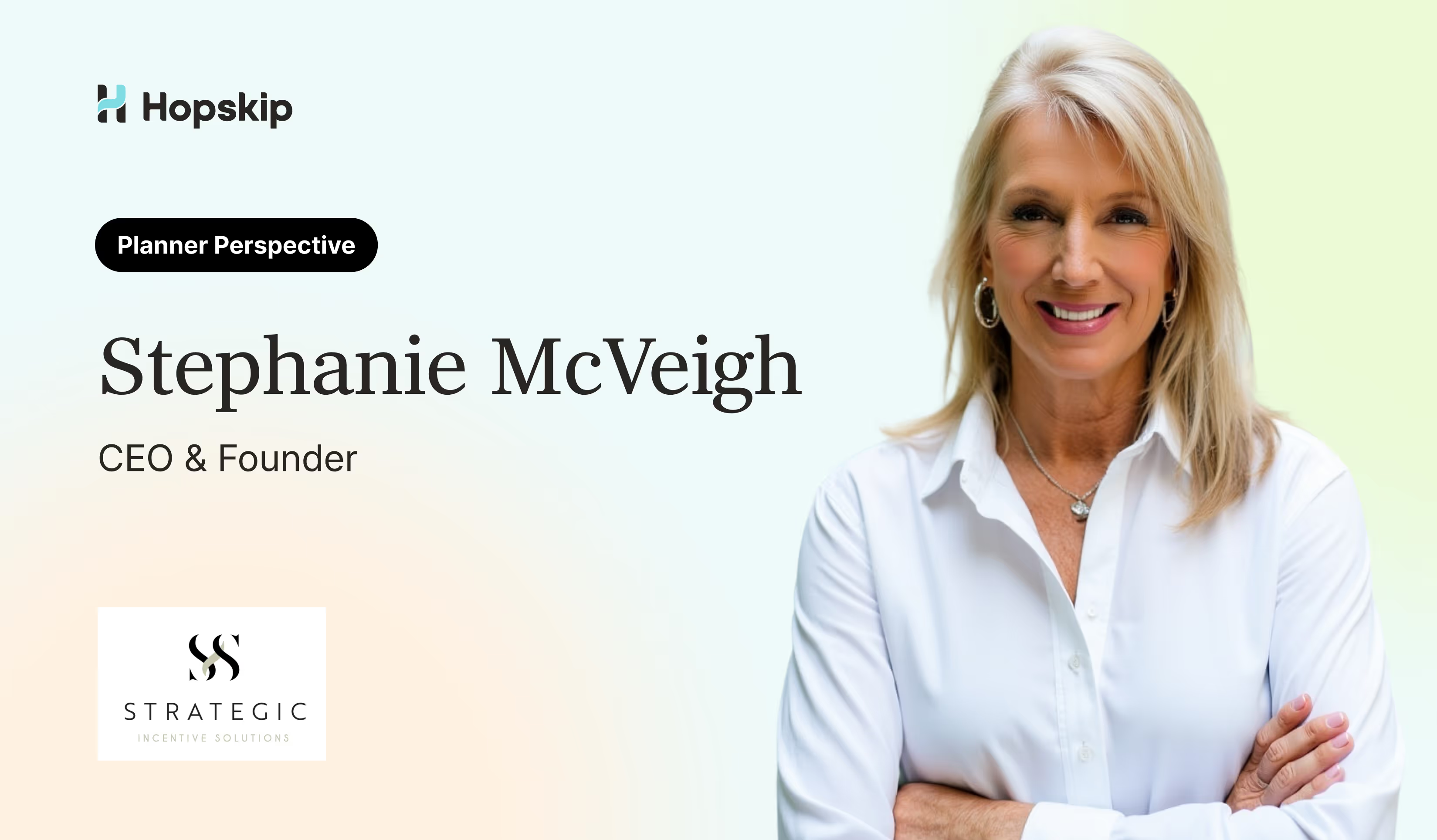
Some people start their event planning agencies because they love logistics. Others because they have a knack for party favors and florals. And then there's Stephanie McVeigh, CEO and Founder of Strategic Incentive Solutions, who launched her agency in the aftermath of a Stage III breast cancer diagnosis — and turned one of life's most terrifying moments into the foundation of a business that has served clients for over 15 years.
That's not just a great origin story. That's a masterclass in running toward the hard thing instead of away from it.
Based in Ontario, Canada, Stephanie leads a boutique third-party agency specializing in incentive travel and performance marketing programs. What makes Strategic Incentive Solutions different isn't just their portfolio of world-class destinations — it's the philosophy behind every program they design: experiences should be earned, felt, and purposeful.
Here's what every event planner can take away from her journey.
Start With the "Why" — Not the Venue
If there's a single thread running through Stephanie's entire philosophy, it's this: clarity of purpose drives everything else.
Her approach to every client program begins not with a site inspection or a catering proposal, but with a fundamental question — what is this event actually for? What behavior are we trying to drive? What does success look like six months after everyone goes home?
It sounds simple. Most planners would nod and say "yes, of course." But in practice, the seductive pull of venue research, swag bags, and dinner menus means the "why" often gets skipped in favor of the "what." That's a costly mistake — literally.
The events industry is projected to reach $2.5 trillion by 2035, growing at a compound annual rate of 6.8%. But growth in the industry doesn't automatically translate to growth for individual programs. Without alignment to business objectives, even the most beautiful event is essentially a very expensive party that no one can justify in the boardroom.
Stephanie's model flips this around. She works closely with clients to build a strategic scope of work tied to their goals before a single venue is discussed. When that foundation is solid, everything else — the destination, the agenda, the activations — serves a clear purpose.
Pro Tip: Before your next client kickoff, ask three questions: What performance behavior do you want to change or reinforce? How will you measure whether this program worked? What does a win look like 90 days after the event? If the client can't answer these, that's your first deliverable — not the venue options.
Events Are Performance Tools, Not Perks
Here's where Stephanie's agency really diverges from the pack. While many competitors are happy to be "a great event company," Strategic Incentive Solutions has positioned itself as a full-service performance marketing partner. That distinction is not just branding — it changes everything about how programs are designed and sold.
The data backs this up compellingly. According to the Incentive Research Foundation, well-designed incentive programs can increase sales productivity by 18% and generate a 112% ROI. Companies using non-cash rewards, including incentive travel, experience three times higher revenue increases than those that don't. And 88.5% of employees who earned an incentive trip were identified as top performers — more than half of whom had been with their company for four or more years.
In other words, incentive travel isn't a nice-to-have. It's a retention and performance engine with measurable returns. When Stephanie talks about helping clients "drive engagement, performance, and organic growth within their organizations," she's not speaking in buzzwords — she's describing a quantifiable business outcome.
That's also why many of her clients have been with her for 15+ years. When your agency is attached to business results, not just event aesthetics, the relationship becomes nearly impossible to replace.
Pro Tip: The next time a client pushes back on program budget, reframe the conversation around performance metrics, not event costs. An incentive travel program that drives a 15% lift in sales revenue pays for itself. Come to the budget conversation armed with ROI data — not just a comparison of two hotel options.
Delegation Isn't Weakness. It's the Business Model.
Ask most founders what mistake they made early on, and the answer almost always involves the same word: everything. Stephanie is no exception. Early in her career, she tried to maintain deep involvement in every detail, convinced that her presence was what guaranteed quality.
What she discovered over time was the opposite — that the ceiling on her business was set by how much she could personally carry. And businesses with ceilings don't grow.
Today, her focus is on coaching, mentoring, and building an environment where her team has the confidence to make decisions, own client relationships, and take creative risks. It's a model that's increasingly supported by industry data: staffing shortages and burnout are among the top challenges facing event agencies right now, with 17% of planners citing workforce issues as a significant problem. Teams that are empowered and invested grow through challenges. Teams that are micromanaged collapse under them.
For boutique agencies especially, the ability to retain and develop talent isn't just an HR issue — it's a competitive advantage.
Pro Tip: Identify one task you do this week that could be done by someone on your team with the right briefing. Write out the process, hand it over, and resist the urge to take it back. Scalable businesses are built on documented processes and trusted people — not heroic individual effort.
Vendor Relationships Are Not a "Nice to Have"
There is a version of event planning that treats vendors as interchangeable commodities — whoever has the best price on a Tuesday wins the contract. Stephanie takes a sharply different view.
She's built long-term partnerships with destination management companies, properties, and suppliers that span years of shared history. And those relationships have paid dividends in moments that would have derailed lesser-prepared planners: last-minute program changes, weather disruptions, logistical surprises that no contingency plan could have fully anticipated.
When you have a vendor partner who knows your standards, understands your clients' expectations, and is personally invested in the outcome of your program — a challenge becomes an opportunity to overdeliver. When you don't have that history? You're negotiating trust in the middle of a crisis. That's not a position anyone wants to be in.
In a market where nearly 30% of planners cite increasing vendor costs as a major obstacle, the temptation to shop around for cheaper alternatives grows every year. Stephanie's career is an argument for investing in depth over breadth when it comes to partnerships.
Pro Tip: Treat your top three vendor relationships like client relationships. Schedule annual check-ins even when you don't have active programs together. Share feedback — positive and constructive. These partnerships are long-term assets, not transactional line items.
Budget Pressure Is Real — Strategy Is the Answer
One of the most important things Stephanie flagged in her experience is the escalating tension between rising costs and flat or shrinking budgets. This isn't a niche concern for boutique agencies — it's an industry-wide pressure point.
The average daily cost per meeting attendee reached $169 in 2025, up 4.3% from the prior year, driven by increases in food and beverage, venue costs, labor, and technology. Meanwhile, nearly half of planners surveyed report that their budgets remain unchanged or have decreased. Ninety percent of meeting professionals cite potential cost increases as their top current concern.
That math doesn't work unless you change the approach. And Stephanie's answer isn't to cut corners or shrink ambitions — it's to plan earlier, align more tightly to business objectives, and design experiences with real strategic discipline. Programs that are clearly tied to performance outcomes are far easier to defend in a budget review than programs that exist to reward tenure or provide a nice send-off for a retiring VP.
The future of event planning, in her view, belongs to planners who combine creativity with operational discipline and financial fluency. Not just great ideas — great ideas with a business case.
Pro Tip: When building program proposals, include a projected ROI section — even a simple one. Tie proposed activities to measurable outcomes. Showing clients how the program supports their business goals makes you a strategic partner. Skipping that conversation makes you a vendor.
The Wildest Idea Is Often the Best One
No story from Stephanie's career captures her agency's philosophy better than one involving The Masters golf tournament. A client offhandedly asked whether professional golfers could attend their private cocktail reception for top performers. Even within the famously exclusive, tightly controlled environment surrounding The Masters, Stephanie's team didn't dismiss the idea — they leaned into it.
Through their network of partnerships and some careful coordination, they made it happen. Professional golf personalities attended the reception, mingled with guests, and turned an already exceptional trip into something attendees are still talking about years later.
That's the difference between an agency that executes what's asked and one that pursues what seems impossible. "Oh my" moments don't happen by accident. They happen because someone decided that "no" wasn't the first answer.
For planners, there's a practical takeaway buried inside this story: your network is the infrastructure that makes extraordinary things possible. Cultivating relationships across industries, destinations, and entertainment spaces isn't a side project — it's how you deliver magic when a client asks for it.
Pro Tip: Keep a running list of "ambitious asks" from clients — even the ones you couldn't deliver. Use it as a relationship-building roadmap. Who in your network might help you say "yes" to one of those requests next time?
The Deepest Lesson: Start Sooner. Trust Yourself.
When asked what she'd do differently if starting over, Stephanie's answer is disarmingly straightforward: she would have trusted herself and started sooner. Every hard thing she walked through — the diagnosis, the recovery, the early years of building something from nothing — shaped the business and the leader she became.
That's not just an inspiring quote for a conference keynote. It's a practical argument for acting on good judgment before it feels completely safe to do so. The most dangerous thing in business isn't acting too early. It's waiting until the conditions are perfect — because they never are.
About Hopskip
Hopskip is the sourcing-only platform built for the way event planners actually work. Planners use Hopskip to send RFPs, collect hotel proposals, and compare options — all in one place, without the noise of a full-service platform they don't need. Hotels get qualified leads and the context they need to win the business. Everyone saves time.
Hopskip planners save 30+ hours per RFP cycle, and hotels on the platform see an 80% conversion rate on qualified leads. Ready to source smarter?
Get started with Hopskip for free today or book a demo and discover how the right tools can transform your event planning process from overwhelming to organized.
References
- Eventgroove — Event Industry Statistics 2025: https://products.eventgroove.com/blog/articles/event-industry-statistics/
- Skift Meetings — Rising Event Costs to Challenge 2025 Budgets: https://meetings.skift.com/2024/09/26/rising-event-costs-to-challenge-2025-budgets/
- Skift Meetings — Planners Navigate Meeting Budget Blindspots: https://meetings.skift.com/2025/07/08/planners-navigate-meeting-budget-blindspots/
- RSVPify — Biggest Challenges Facing Event Planners in 2025: https://rsvpify.com/event-planners-challenges-2025/
- GoGather — Statistics to Help You Define the ROI of Incentive Travel: https://gogather.com/blog/statistics-that-will-help-you-define-the-roi-of-incentive-travel-programs
- SDI Travel — How Do I Prove the ROI for Incentive Travel: https://www.sditravel.com/blog/how-do-i-prove-the-roi-for-incentive-travel
- Incentive Research Foundation — Anatomy of a Successful Incentive Travel Program: https://theirf.org/research_post/anatomy-of-a-successful-incentive-travel-program/
- Executive Group Travel — The ROI of Incentive Travel: https://www.executivegrouptravel.com/blog/the-roi-of-incentive-travel-why-its-worth-every-investment

.svg)