.svg)
From Layoff to Launch: How Event Planner Fiona Nieman Built a Thriving Business on Relationships

Discover how Fiona Nieman, CMP, HMCC turned a layoff into opportunity, building Indaba Events from scratch using networking and authentic relationships. Expert event planning tips inside.
When Fiona Nieman, CMP, HMCC got laid off at the beginning of 2024, she could have panicked. Instead, she saw a launching pad. As the Founder and Principal Planner of Indaba Events, Fiona transformed an unexpected career setback into a flourishing independent event planning business—landing seven projects across four different clients within her first year, all through the power of relationships and networking.
Her story isn't just inspiring—it's a masterclass in how event planners can build sustainable businesses in an industry projected to reach $2.5 trillion by 2035. Here's how she did it, and what every event planner can learn from her journey.
The Power of Personal Branding: Why You're Not Just "Another Event Planner"
Before launching Indaba Events, Fiona asked herself a crucial question: "Why me, and not someone else?" It's the question every independent planner should grapple with, especially in an industry where employment is projected to grow 5% from 2024 to 2034—faster than the average for all occupations.
Fiona's answer came from deep reflection on what sets her apart in a crowded marketplace. "I went on a journey across my career to discover my personal brand," she explains. The qualities she identified—respect, trust, service excellence, loyalty, empathy, adaptability, and grace under pressure—became the foundation of her competitive advantage.
This isn't just feel-good career advice. Research shows that personal branding directly impacts business development. According to industry insights, approximately two-thirds of event planners secure their next client through networking at industry conferences. But here's the kicker: networking only works when people know what you stand for.
Pro Tip: Write down the five qualities that define your professional brand. Then, make sure every client interaction, social media post, and networking conversation reflects those values. Your personal brand is your differentiator in a market where everyone has the same technical skills.
Networking as a Business Strategy: The Numbers Don't Lie
Fiona credits her success to one core strategy: relationships. "I have always built my success on the foundation of relationships," she notes. During her first few months, she prioritized networking and marketing through her involvement in MPI Global and MPI Tennessee Chapter. That investment paid off dramatically—her first business relationship converted into four large-scale events booked for 2026.
The data backs this up. A comprehensive networking study found that 80% of professionals consider networking essential to career success, while 77.7% of event attendees say in-person B2B conferences are best for networking. For event planners specifically, face-to-face relationship building remains irreplaceable—76% of attendees name networking as their top reason to attend events.
But Fiona's approach goes deeper than just showing up. She emphasizes authenticity: "From the first conversation you have to display confidence that you are the subject matter expert. It's important to listen to your client, to ask questions, find out what their challenges are and how your company can be the solution."
Her husband's wisdom rings true: "People do business with people they like and trust." In an industry where 52% of event planners cite increasing attendance as their biggest challenge, trust becomes the currency that converts connections into contracts.
Pro Tip: Block out specific hours each week for networking activities. With professionals who dedicate 6.3 hours weekly to networking reporting it as crucial to their success, consistency matters more than one-off appearances at conferences.
The Foundation That Technology Can't Replace: Hospitality Over AI
Here's where Fiona gets refreshingly contrarian. While the event industry buzzes about AI and automation, she's sounding the alarm about losing sight of fundamentals. "Everywhere we turn, the focus is on AI and how this can support our industry, and I am supportive of it," she acknowledges. "However, we need go back to the foundation of hospitality and what that means."
Her concern? The younger generation entering the industry may be missing crucial interpersonal skills. "When last did you have a phone conversation with a hotel sales manager? Is your phone number listed in your signature? If it's not, it should be!"
This perspective couldn't be more timely. While 86.4% of organizers plan to maintain or boost the number of in-person events in 2025, and 82.8% agree these conferences offer an ideal networking environment, the quality of human connection risks dilution. Fiona argues that connection, service excellence, and relationships—the true meaning of hospitality—are getting lost.
"The foundation of this industry is people and the relationships we forge. No amount of AI or emails or technology will ever replace that," she insists.
The irony? In an increasingly digital world, this old-school approach becomes a competitive advantage. Research shows that almost 100% of professionals believe face-to-face meetings build stronger long-term relationships than any other medium.
Pro Tip: Audit your communication habits. If most of your client and vendor interactions happen via email or text, schedule weekly phone calls instead. The personal touch you think is outdated might be exactly what sets you apart.
Learning from Hotel Experience: A Love Letter to Hoteliers (With One Request)
Fiona's background as a former hotel Convention Services Manager gives her unique insight into both sides of the event planning relationship. This dual perspective shapes how she works with venues and informs her most pointed advice to fellow planners.
"Please adhere to cut off dates and send your meeting specs to the hotel at least 2-3 weeks out!" she urges. "I have seen planners send specs in days before the meeting. That is not 'planning', that's scrambling."
This isn't just about being courteous—it's about protecting your event's success. Event planning best practices emphasize that detailed timelines and deadlines are crucial for ensuring all necessary tasks are completed. Industry experts recommend providing venues with comprehensive specifications well in advance to allow proper preparation and reduce last-minute stress.
From a venue perspective, receiving specs too late means:
- Limited ability to accommodate special requests
- Rushed setup that increases error probability
- Strained relationships with hotel staff
- Potential cost increases for expedited services
- Higher risk of important details being overlooked
Fiona's plea comes from witnessing the chaos that results when planners don't respect venue timelines. And given that 64.6% of attendees agree the venue can make or break their event experience, you can't afford to scramble.
Pro Tip: Create a standardized timeline template that includes submitting venue specs 3-4 weeks before your event. Build this into your project management system as a non-negotiable deadline. Your hotel partners (and your stress levels) will thank you.
Crisis Management: When Vendors Save the Day
One of Fiona's most memorable experiences highlights the critical importance of vendor relationships. During the pandemic, she was planning a citywide event when leadership decided to enforce daily testing just eight weeks before the event. "Thankfully, our General Services Contractor had a system in place to order the test and implement the protocols," she recalls. "Without this, it would have been very costly and almost impossible to find another vendor at such short notice."
This story illustrates a crucial truth: your vendor relationships are your insurance policy. With 55% of event organizers reporting safety as the biggest challenge in resuming in-person events, having trusted partners who can pivot quickly isn't just nice—it's essential.
Fiona's approach to emergencies reflects her hotel background: "I always have an emergency plan laid out ahead of the event, so if an emergency should arise on site, there are protocols to reference. However, I understand that unexpected situations do occur and it's important to gather the information from all parties involved and make a strategic decision with the least amount of risk."
Event management experts recommend dedicating 10-15% of your budget to contingency planning. But money alone won't save your event—relationships will.
Pro Tip: Maintain a "trusted vendors" list with backup contacts for every critical role. Schedule quarterly check-ins with key partners even when you don't have active projects. When emergencies hit, these relationships become lifelines.
Walking in Your Attendees' Shoes: Experience Design That Works
Fiona has a deceptively simple strategy for enhancing attendee experience: "Every time I plan out an event, I put myself in the shoes of the attendee and literally walk the space as if I were them on their first day, ensuring the flow of their experience makes sense."
This physical walkthrough addresses crucial questions:
- What is the first order of business?
- Where would they walk to next?
- Is accessibility considered for everyone?
- Are there safety hazards?
She also emphasizes showing appreciation: "Make sure you show your appreciation to your staff and volunteers by way of gratitude, and coffee in the morning!"
This attendee-first approach aligns with research showing that 67.6% of event attendees agree that free time—beyond networking, sessions, and parties—is vital to their event experience. The most successful events balance structured activities with thoughtful flow and breathing room.
With 19% of organizers citing attendee engagement as their top priority for their next event, Fiona's physical walkthrough technique offers a practical way to identify friction points before they impact your guests.
Pro Tip: Schedule a "shadow attendee" session at least one week before your event. Walk the entire attendee journey from registration to departure, timing each transition and noting potential bottlenecks. Take photos from attendee eye level—you'll spot signage and wayfinding issues you'd never notice otherwise.
The Confidence to Think Bigger: Lessons in Business Vision
Perhaps Fiona's most revealing admission is what she'd do differently: "Think bigger!" When she established Indaba Events, her goal was modest—a business that supported her lifestyle and allowed her to do work she loved. "But the past few months have shown me there is a demand for independent planners to support the industry. Now my vision of what Indaba Events will look like a year from now is vastly different from when I launched it!"
This evolution reflects broader industry trends. The events market is experiencing significant growth, with 69% of event marketers expecting to plan more events in 2024. Meanwhile, 47.2% of event teams have grown in the past year, signaling robust demand for planning talent.
For independent planners, this creates unprecedented opportunity. The event planning industry valued at $1.7 billion in 2025 is becoming increasingly receptive to freelance and boutique agencies. With 43.2% of event planners searching for venues through social communities and only 10.9% relying on recommendations from friends and colleagues, the traditional barriers to entry are dissolving.
Fiona's advice to aspiring agency owners echoes her own experience: don't let self-doubt hold you back. "In all honesty, not believing that I could actually start up my own company at this stage in my life" was her biggest early mistake. Her family's encouragement helped her overcome that limiting belief, and her business is now flourishing.
Pro Tip: Revisit your business plan quarterly. As you gain clients and confidence, your capacity and vision should expand accordingly. What seemed ambitious six months ago might now be your baseline. Scale your thinking before you scale your team.
Setting Expectations from Day One: The Art of the First Conversation
Fiona's guidance on client expectations is gold for any planner building their practice: "From the first conversation you have to display confidence that you are the subject matter expert. It's important to listen to your client, to ask questions, find out what their challenges are and how your company can be the solution. And most of all, be your authentic self and demonstrate the qualities of your personal brand (integrity, respect, discipline, empathy)."
This approach combines authority with empathy—a balance that builds trust quickly. Research shows that 73% of event marketers cite clear objectives as the most critical factor in measuring event success. When you help clients articulate their challenges and goals in that first conversation, you're already demonstrating value.
The emphasis on authenticity is particularly important in an age when 44% of marketers note that virtual events lack the personal touch. If your brand promise is built on genuine connection, every client interaction should reinforce that differentiator.
Pro Tip: Develop a first-conversation framework that includes discovery questions about their biggest challenges, past event experiences, and success metrics. This structure ensures you listen first and solve second—building credibility while gathering the information you need to deliver excellence.
The Unconventional Ideas: When to Say "Not Yet"
Not every client request should become reality. Fiona shares a memorable example: "A client wanted to fly a drone in their exhibit hall. While it may now be an acceptable practice, at the time, drones were very new (and the pilots were too!). This idea did not materialize!"
Knowing when to pump the brakes on ambitious ideas is part of being a trusted advisor. The key is explaining why something won't work while offering alternatives that achieve the same goal. This positions you as the expert protecting both the client's vision and their event's success.
With 35% of marketers considering events the most effective strategy for generating B2B demand and 77% believing events are their most effective marketing channel, the stakes are too high for experimentation without proper risk assessment.
Pro Tip: When clients suggest unconventional ideas, respond with "I love your creativity—let's explore how we can make this work safely and successfully." Then research thoroughly, consult vendors, and present options with transparent pros, cons, and costs. This transforms "no" into collaborative problem-solving.
The Road Ahead: Building on Relationships in a Growing Industry
Fiona Nieman's journey from layoff to thriving agency owner in less than a year isn't just luck—it's a blueprint. By prioritizing authentic relationships, maintaining hospitality fundamentals, leveraging her personal brand, and thinking bigger about her potential, she's positioned Indaba Events for sustainable growth in an expanding market.
The event industry's trajectory supports her approach. With 82% of professionals optimistic about the health of the meetings and events industry, employment growing faster than average, and 67% of executives predicting increased meeting budgets, independent planners who master relationship-building will continue to thrive.
Fiona's story proves that even in an age of AI and automation, the human element remains paramount. As she wisely notes: "No amount of AI or emails or technology will ever replace" the foundation of people and relationships.
For event planners navigating their own careers—whether recovering from setbacks, building agencies, or simply seeking to level up—Fiona's experience offers a powerful reminder: your network is your net worth, your personal brand is your differentiator, and authentic relationships are the currency that drives long-term success.
Ready to Streamline Your Event Planning Process?
Building relationships is crucial, but having the right tools matters too. Hopskip is a venue sourcing and RFP management platform designed to help event planners like Fiona work more efficiently. From searching venues to managing proposals and coordinating with hotels, Hopskip streamlines the logistics so you can focus on what matters most—creating unforgettable experiences and building lasting relationships.
Want to see how Hopskip can save you time and money on venue sourcing? Book a demo with a Hopskipper, or get started for free today and discover why 500+ event planners trust our platform to simplify their venue sourcing process with an 87% conversion rate.
About Hopskip
Hopskip connects event planners with hotels through an intuitive venue sourcing and RFP management platform. Our technology streamlines the traditionally time-consuming process of finding and booking venues, allowing planners to focus on strategy and attendee experience. With features designed specifically for the needs of modern event professionals, Hopskip helps you work smarter, not harder.
References and Sources
- G2. "70 Event Planning Industry Statistics for 2025." December 3, 2024. https://www.g2.com/articles/event-industry-statistics
- Workstaff. "9 Event Planning Statistics You Need to Know About in 2024." February 26, 2025. https://workstaff.app/blog/event-planning-statistics
- U.S. Bureau of Labor Statistics. "Meeting, Convention, and Event Planners: Occupational Outlook Handbook." https://www.bls.gov/ooh/business-and-financial/meeting-convention-and-event-planners.htm
- Allied Market Research. "Events Industry Market Size, Share, Trends | Forecast 2035." https://www.alliedmarketresearch.com/events-industry-market
- ContactZilla. "Networking Statistics: Powerful insights and expert interviews from Business Leaders." November 18, 2024. https://contactzilla.com/networking-statistics-expert-interviews/
- Apollo Technical. "15 Networking Statistics Everyone Should Know (2025)." July 14, 2025. https://www.apollotechnical.com/networking-statistics/
- Financesonline. "45 Significant Business Networking Statistics: 2024 Conversion Rates & Challenges." July 5, 2025. https://financesonline.com/business-networking-statistics/
- Nunify. "Top Event Planning Statistics, Facts & Trends [2025 Update]." https://www.nunify.com/blogs/event-planning-statistics-facts-trends
- EventFlare. "Measuring the Success of Your Networking Event: Key Metrics to Track." June 25, 2025. https://eventflare.io/journal/measuring-the-success-of-your-networking-event-key-metrics-to-track
- Brella. "10 event networking metrics to help you succeed." December 13, 2021. https://www.brella.io/blog/event-networking-metrics-to-track
Curabitur bibendum ad viverra eu fringilla ad eu. Eget placerat ultricies quis amet mattis himenaeos ullamcorper facilisi volutpat.
Start for free
Send your first one for free.

From Layoff to Launch: How Event Planner Fiona Nieman Built a Thriving Business on Relationships
Discover how Fiona Nieman, CMP, HMCC turned a layoff into opportunity, building Indaba Events from scratch using networking and authentic relationships. Expert event planning tips inside.
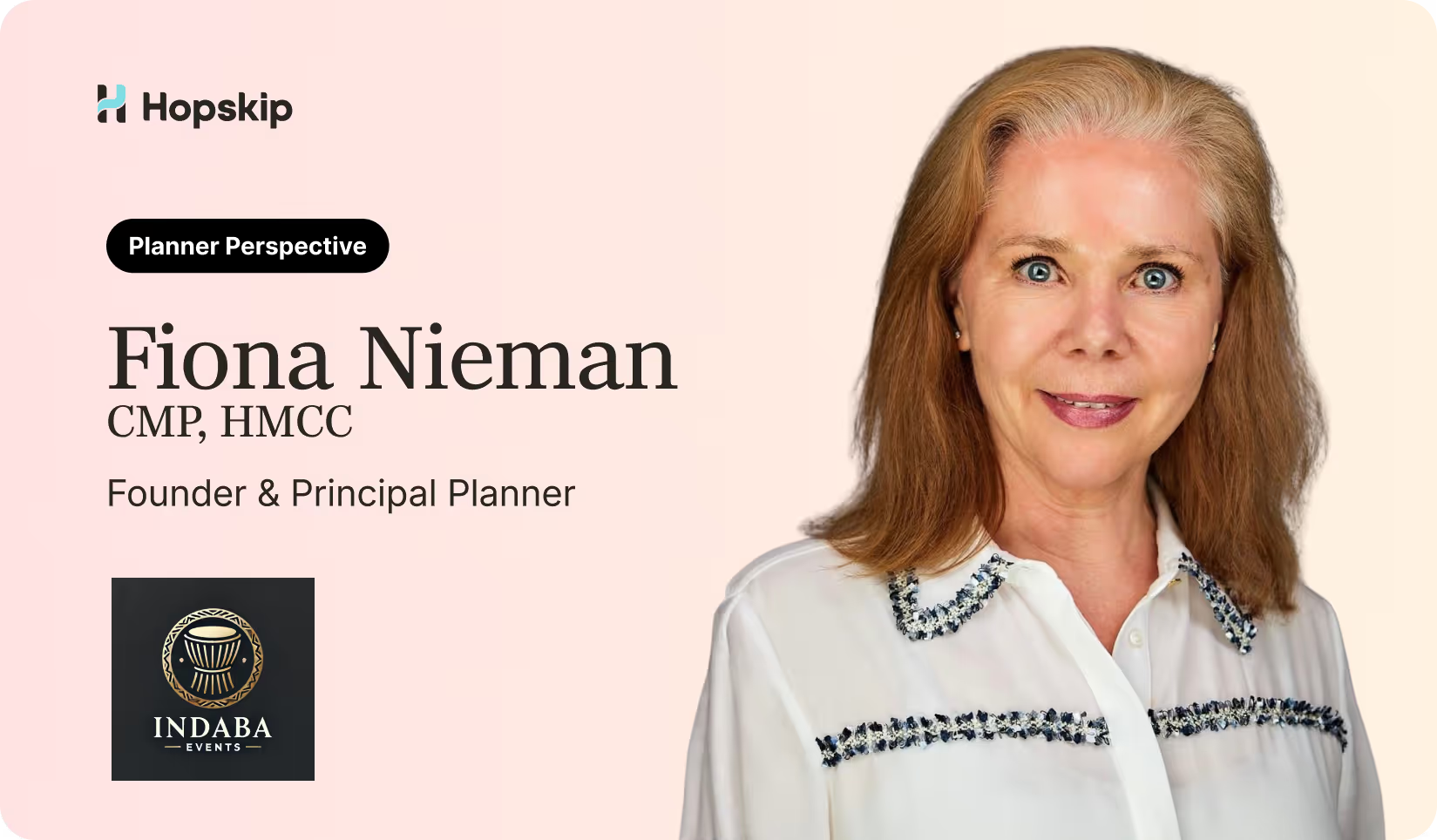
When Fiona Nieman, CMP, HMCC got laid off at the beginning of 2024, she could have panicked. Instead, she saw a launching pad. As the Founder and Principal Planner of Indaba Events, Fiona transformed an unexpected career setback into a flourishing independent event planning business—landing seven projects across four different clients within her first year, all through the power of relationships and networking.
Her story isn't just inspiring—it's a masterclass in how event planners can build sustainable businesses in an industry projected to reach $2.5 trillion by 2035. Here's how she did it, and what every event planner can learn from her journey.
The Power of Personal Branding: Why You're Not Just "Another Event Planner"
Before launching Indaba Events, Fiona asked herself a crucial question: "Why me, and not someone else?" It's the question every independent planner should grapple with, especially in an industry where employment is projected to grow 5% from 2024 to 2034—faster than the average for all occupations.
Fiona's answer came from deep reflection on what sets her apart in a crowded marketplace. "I went on a journey across my career to discover my personal brand," she explains. The qualities she identified—respect, trust, service excellence, loyalty, empathy, adaptability, and grace under pressure—became the foundation of her competitive advantage.
This isn't just feel-good career advice. Research shows that personal branding directly impacts business development. According to industry insights, approximately two-thirds of event planners secure their next client through networking at industry conferences. But here's the kicker: networking only works when people know what you stand for.
Pro Tip: Write down the five qualities that define your professional brand. Then, make sure every client interaction, social media post, and networking conversation reflects those values. Your personal brand is your differentiator in a market where everyone has the same technical skills.
Networking as a Business Strategy: The Numbers Don't Lie
Fiona credits her success to one core strategy: relationships. "I have always built my success on the foundation of relationships," she notes. During her first few months, she prioritized networking and marketing through her involvement in MPI Global and MPI Tennessee Chapter. That investment paid off dramatically—her first business relationship converted into four large-scale events booked for 2026.
The data backs this up. A comprehensive networking study found that 80% of professionals consider networking essential to career success, while 77.7% of event attendees say in-person B2B conferences are best for networking. For event planners specifically, face-to-face relationship building remains irreplaceable—76% of attendees name networking as their top reason to attend events.
But Fiona's approach goes deeper than just showing up. She emphasizes authenticity: "From the first conversation you have to display confidence that you are the subject matter expert. It's important to listen to your client, to ask questions, find out what their challenges are and how your company can be the solution."
Her husband's wisdom rings true: "People do business with people they like and trust." In an industry where 52% of event planners cite increasing attendance as their biggest challenge, trust becomes the currency that converts connections into contracts.
Pro Tip: Block out specific hours each week for networking activities. With professionals who dedicate 6.3 hours weekly to networking reporting it as crucial to their success, consistency matters more than one-off appearances at conferences.
The Foundation That Technology Can't Replace: Hospitality Over AI
Here's where Fiona gets refreshingly contrarian. While the event industry buzzes about AI and automation, she's sounding the alarm about losing sight of fundamentals. "Everywhere we turn, the focus is on AI and how this can support our industry, and I am supportive of it," she acknowledges. "However, we need go back to the foundation of hospitality and what that means."
Her concern? The younger generation entering the industry may be missing crucial interpersonal skills. "When last did you have a phone conversation with a hotel sales manager? Is your phone number listed in your signature? If it's not, it should be!"
This perspective couldn't be more timely. While 86.4% of organizers plan to maintain or boost the number of in-person events in 2025, and 82.8% agree these conferences offer an ideal networking environment, the quality of human connection risks dilution. Fiona argues that connection, service excellence, and relationships—the true meaning of hospitality—are getting lost.
"The foundation of this industry is people and the relationships we forge. No amount of AI or emails or technology will ever replace that," she insists.
The irony? In an increasingly digital world, this old-school approach becomes a competitive advantage. Research shows that almost 100% of professionals believe face-to-face meetings build stronger long-term relationships than any other medium.
Pro Tip: Audit your communication habits. If most of your client and vendor interactions happen via email or text, schedule weekly phone calls instead. The personal touch you think is outdated might be exactly what sets you apart.
Learning from Hotel Experience: A Love Letter to Hoteliers (With One Request)
Fiona's background as a former hotel Convention Services Manager gives her unique insight into both sides of the event planning relationship. This dual perspective shapes how she works with venues and informs her most pointed advice to fellow planners.
"Please adhere to cut off dates and send your meeting specs to the hotel at least 2-3 weeks out!" she urges. "I have seen planners send specs in days before the meeting. That is not 'planning', that's scrambling."
This isn't just about being courteous—it's about protecting your event's success. Event planning best practices emphasize that detailed timelines and deadlines are crucial for ensuring all necessary tasks are completed. Industry experts recommend providing venues with comprehensive specifications well in advance to allow proper preparation and reduce last-minute stress.
From a venue perspective, receiving specs too late means:
- Limited ability to accommodate special requests
- Rushed setup that increases error probability
- Strained relationships with hotel staff
- Potential cost increases for expedited services
- Higher risk of important details being overlooked
Fiona's plea comes from witnessing the chaos that results when planners don't respect venue timelines. And given that 64.6% of attendees agree the venue can make or break their event experience, you can't afford to scramble.
Pro Tip: Create a standardized timeline template that includes submitting venue specs 3-4 weeks before your event. Build this into your project management system as a non-negotiable deadline. Your hotel partners (and your stress levels) will thank you.
Crisis Management: When Vendors Save the Day
One of Fiona's most memorable experiences highlights the critical importance of vendor relationships. During the pandemic, she was planning a citywide event when leadership decided to enforce daily testing just eight weeks before the event. "Thankfully, our General Services Contractor had a system in place to order the test and implement the protocols," she recalls. "Without this, it would have been very costly and almost impossible to find another vendor at such short notice."
This story illustrates a crucial truth: your vendor relationships are your insurance policy. With 55% of event organizers reporting safety as the biggest challenge in resuming in-person events, having trusted partners who can pivot quickly isn't just nice—it's essential.
Fiona's approach to emergencies reflects her hotel background: "I always have an emergency plan laid out ahead of the event, so if an emergency should arise on site, there are protocols to reference. However, I understand that unexpected situations do occur and it's important to gather the information from all parties involved and make a strategic decision with the least amount of risk."
Event management experts recommend dedicating 10-15% of your budget to contingency planning. But money alone won't save your event—relationships will.
Pro Tip: Maintain a "trusted vendors" list with backup contacts for every critical role. Schedule quarterly check-ins with key partners even when you don't have active projects. When emergencies hit, these relationships become lifelines.
Walking in Your Attendees' Shoes: Experience Design That Works
Fiona has a deceptively simple strategy for enhancing attendee experience: "Every time I plan out an event, I put myself in the shoes of the attendee and literally walk the space as if I were them on their first day, ensuring the flow of their experience makes sense."
This physical walkthrough addresses crucial questions:
- What is the first order of business?
- Where would they walk to next?
- Is accessibility considered for everyone?
- Are there safety hazards?
She also emphasizes showing appreciation: "Make sure you show your appreciation to your staff and volunteers by way of gratitude, and coffee in the morning!"
This attendee-first approach aligns with research showing that 67.6% of event attendees agree that free time—beyond networking, sessions, and parties—is vital to their event experience. The most successful events balance structured activities with thoughtful flow and breathing room.
With 19% of organizers citing attendee engagement as their top priority for their next event, Fiona's physical walkthrough technique offers a practical way to identify friction points before they impact your guests.
Pro Tip: Schedule a "shadow attendee" session at least one week before your event. Walk the entire attendee journey from registration to departure, timing each transition and noting potential bottlenecks. Take photos from attendee eye level—you'll spot signage and wayfinding issues you'd never notice otherwise.
The Confidence to Think Bigger: Lessons in Business Vision
Perhaps Fiona's most revealing admission is what she'd do differently: "Think bigger!" When she established Indaba Events, her goal was modest—a business that supported her lifestyle and allowed her to do work she loved. "But the past few months have shown me there is a demand for independent planners to support the industry. Now my vision of what Indaba Events will look like a year from now is vastly different from when I launched it!"
This evolution reflects broader industry trends. The events market is experiencing significant growth, with 69% of event marketers expecting to plan more events in 2024. Meanwhile, 47.2% of event teams have grown in the past year, signaling robust demand for planning talent.
For independent planners, this creates unprecedented opportunity. The event planning industry valued at $1.7 billion in 2025 is becoming increasingly receptive to freelance and boutique agencies. With 43.2% of event planners searching for venues through social communities and only 10.9% relying on recommendations from friends and colleagues, the traditional barriers to entry are dissolving.
Fiona's advice to aspiring agency owners echoes her own experience: don't let self-doubt hold you back. "In all honesty, not believing that I could actually start up my own company at this stage in my life" was her biggest early mistake. Her family's encouragement helped her overcome that limiting belief, and her business is now flourishing.
Pro Tip: Revisit your business plan quarterly. As you gain clients and confidence, your capacity and vision should expand accordingly. What seemed ambitious six months ago might now be your baseline. Scale your thinking before you scale your team.
Setting Expectations from Day One: The Art of the First Conversation
Fiona's guidance on client expectations is gold for any planner building their practice: "From the first conversation you have to display confidence that you are the subject matter expert. It's important to listen to your client, to ask questions, find out what their challenges are and how your company can be the solution. And most of all, be your authentic self and demonstrate the qualities of your personal brand (integrity, respect, discipline, empathy)."
This approach combines authority with empathy—a balance that builds trust quickly. Research shows that 73% of event marketers cite clear objectives as the most critical factor in measuring event success. When you help clients articulate their challenges and goals in that first conversation, you're already demonstrating value.
The emphasis on authenticity is particularly important in an age when 44% of marketers note that virtual events lack the personal touch. If your brand promise is built on genuine connection, every client interaction should reinforce that differentiator.
Pro Tip: Develop a first-conversation framework that includes discovery questions about their biggest challenges, past event experiences, and success metrics. This structure ensures you listen first and solve second—building credibility while gathering the information you need to deliver excellence.
The Unconventional Ideas: When to Say "Not Yet"
Not every client request should become reality. Fiona shares a memorable example: "A client wanted to fly a drone in their exhibit hall. While it may now be an acceptable practice, at the time, drones were very new (and the pilots were too!). This idea did not materialize!"
Knowing when to pump the brakes on ambitious ideas is part of being a trusted advisor. The key is explaining why something won't work while offering alternatives that achieve the same goal. This positions you as the expert protecting both the client's vision and their event's success.
With 35% of marketers considering events the most effective strategy for generating B2B demand and 77% believing events are their most effective marketing channel, the stakes are too high for experimentation without proper risk assessment.
Pro Tip: When clients suggest unconventional ideas, respond with "I love your creativity—let's explore how we can make this work safely and successfully." Then research thoroughly, consult vendors, and present options with transparent pros, cons, and costs. This transforms "no" into collaborative problem-solving.
The Road Ahead: Building on Relationships in a Growing Industry
Fiona Nieman's journey from layoff to thriving agency owner in less than a year isn't just luck—it's a blueprint. By prioritizing authentic relationships, maintaining hospitality fundamentals, leveraging her personal brand, and thinking bigger about her potential, she's positioned Indaba Events for sustainable growth in an expanding market.
The event industry's trajectory supports her approach. With 82% of professionals optimistic about the health of the meetings and events industry, employment growing faster than average, and 67% of executives predicting increased meeting budgets, independent planners who master relationship-building will continue to thrive.
Fiona's story proves that even in an age of AI and automation, the human element remains paramount. As she wisely notes: "No amount of AI or emails or technology will ever replace" the foundation of people and relationships.
For event planners navigating their own careers—whether recovering from setbacks, building agencies, or simply seeking to level up—Fiona's experience offers a powerful reminder: your network is your net worth, your personal brand is your differentiator, and authentic relationships are the currency that drives long-term success.
Ready to Streamline Your Event Planning Process?
Building relationships is crucial, but having the right tools matters too. Hopskip is a venue sourcing and RFP management platform designed to help event planners like Fiona work more efficiently. From searching venues to managing proposals and coordinating with hotels, Hopskip streamlines the logistics so you can focus on what matters most—creating unforgettable experiences and building lasting relationships.
Want to see how Hopskip can save you time and money on venue sourcing? Book a demo with a Hopskipper, or get started for free today and discover why 500+ event planners trust our platform to simplify their venue sourcing process with an 87% conversion rate.
About Hopskip
Hopskip connects event planners with hotels through an intuitive venue sourcing and RFP management platform. Our technology streamlines the traditionally time-consuming process of finding and booking venues, allowing planners to focus on strategy and attendee experience. With features designed specifically for the needs of modern event professionals, Hopskip helps you work smarter, not harder.
References and Sources
- G2. "70 Event Planning Industry Statistics for 2025." December 3, 2024. https://www.g2.com/articles/event-industry-statistics
- Workstaff. "9 Event Planning Statistics You Need to Know About in 2024." February 26, 2025. https://workstaff.app/blog/event-planning-statistics
- U.S. Bureau of Labor Statistics. "Meeting, Convention, and Event Planners: Occupational Outlook Handbook." https://www.bls.gov/ooh/business-and-financial/meeting-convention-and-event-planners.htm
- Allied Market Research. "Events Industry Market Size, Share, Trends | Forecast 2035." https://www.alliedmarketresearch.com/events-industry-market
- ContactZilla. "Networking Statistics: Powerful insights and expert interviews from Business Leaders." November 18, 2024. https://contactzilla.com/networking-statistics-expert-interviews/
- Apollo Technical. "15 Networking Statistics Everyone Should Know (2025)." July 14, 2025. https://www.apollotechnical.com/networking-statistics/
- Financesonline. "45 Significant Business Networking Statistics: 2024 Conversion Rates & Challenges." July 5, 2025. https://financesonline.com/business-networking-statistics/
- Nunify. "Top Event Planning Statistics, Facts & Trends [2025 Update]." https://www.nunify.com/blogs/event-planning-statistics-facts-trends
- EventFlare. "Measuring the Success of Your Networking Event: Key Metrics to Track." June 25, 2025. https://eventflare.io/journal/measuring-the-success-of-your-networking-event-key-metrics-to-track
- Brella. "10 event networking metrics to help you succeed." December 13, 2021. https://www.brella.io/blog/event-networking-metrics-to-track


.svg)