.svg)
16 Years of Event Planning Hard-Knocks: Lessons from Five Grain Events

Joan Cinquegrani turned a non-profit side gig into a 16-year Chicago event planning agency. Here's what she's learned about assumptions, pivots, client trust, and why saving your event timeline as your phone wallpaper will change your life.
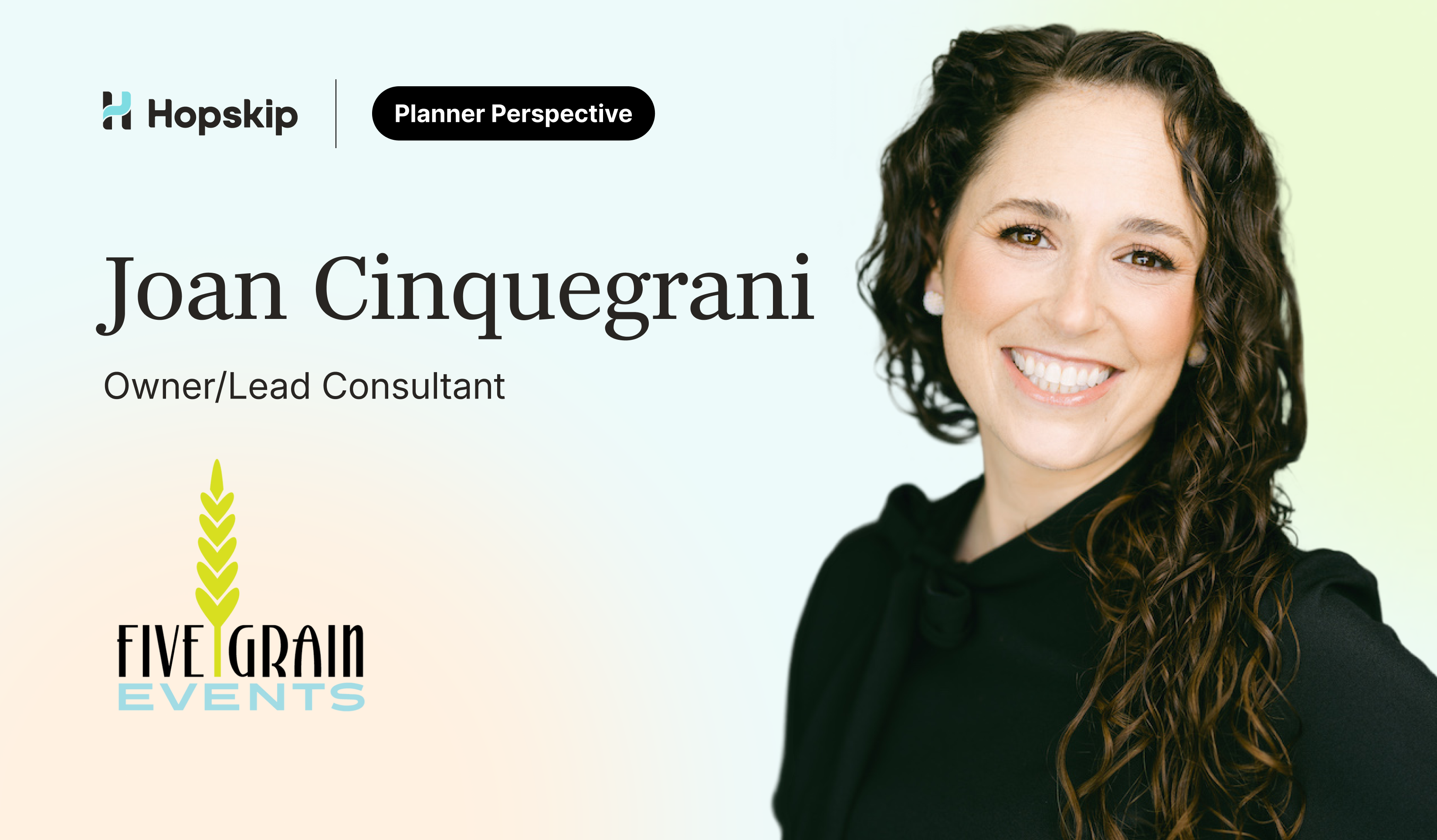
Joan Cinquegrani didn't plan to become an event planner. She planned to help out with events a little — you know, as a side gig while she worked at a non-profit. Within five months, that "side gig" became her entire career.
Sixteen years and hundreds of events later, Joan is the Owner and Lead Consultant of Five Grain Events, a Chicago-based firm known for its high-touch approach to weddings, corporate events, and non-profit programs. Her philosophy is deceptively simple: think through every controllable detail, communicate relentlessly, and make every guest feel like they were the one the whole event was designed for.
She's got the stories to back it up.
The Accidental Career That Wasn't So Accidental
Joan's origin story is one of those "happy accident" narratives that feels less accidental the longer you look at it. She was working in the non-profit sector when she discovered that the events portion of her job was the part she actually loved. She launched Five Grain Events as a side project — and less than five months later, she was running it full-time.
"I had no fear because there was so much I did not know," Joan says. When asked what she'd do differently if she were starting over today, her answer is disarming: nothing. "Every choice we make on behalf of our clients today is as a result of real lived experiences over the past 16 years. You can't fast track that."
That's not a platitude. It's a philosophy. The learning curve is the curriculum.
Pro tip: If you're early in your career and feel underprepared, that feeling of "I don't know enough" can actually work in your favor. It keeps you asking questions instead of assuming answers.
The Pivot That Changed Everything (Thanks, COVID)
For the first six years of Five Grain Events, Joan focused almost exclusively on weddings and social events. She spent four more years actively trying to break into corporate and non-profit work — with limited traction. Then the pandemic hit.
Counterintuitively, Joan's business was better positioned to weather COVID than most. Her wedding clients largely postponed rather than canceled. And when events came back in 2021 and 2022, something shifted: the corporate and non-profit work she'd been trying to crack for years finally started coming in.
"I guess it was divine timing," she says. "Though hard to see that in the moment."
Her corporate and non-profit work now makes up the majority of Five Grain's revenue.
The lesson here isn't "wait for a pandemic to unlock new business." It's that the work you put in before the breakthrough often creates the conditions for it. The four years of effort weren't wasted — they were infrastructure that paid off when the timing aligned.
Pro tip: Diversifying your event portfolio isn't just a growth strategy — it's risk management. Planners with a mix of corporate, social, and non-profit clients tend to be more resilient when one sector slows.
The Lesson That Came From an Early Mistake
Ask Joan about the mistake that shaped her business most, and she doesn't hesitate: making assumptions.
Early in her career, she made a decision on behalf of a client without communicating it first. The client was upset. The assumption led to unnecessary work on both sides. It was fixable, but uncomfortable — and it stuck.
"I now very much over-communicate our process from start to finish," Joan says. "Our clients always have a chance to ask questions about our plans or approach before we have to retrace our steps."
The result: consistent feedback about the trust she builds with clients. A lot of that trust, she believes, comes directly from that communication style.
According to EventsAir's 2026 industry report, 82% of event professionals now prioritize attendee feedback as a critical success metric — nearly on par with attendance numbers. The underlying signal is the same: how people experience the process matters as much as the outcome.
Pro tip: Start every client engagement with a written timeline and budget, and narrate your process at every decision point. Over-communication may feel excessive internally, but it builds the kind of external trust that drives referrals.
High-Touch Is a Strategy, Not Just a Personality Trait
When asked how Five Grain differentiates from competitors, Joan's answer is clear: "We tend to be a great fit for clients looking for a hands-on, high-touch experience. Our expertise lies in the logistics — ensuring every detail is considered and thought through ahead of time."
That positioning isn't just a tagline. It's operationalized from the first call. Before diving into any major decisions, Joan creates a project timeline and budget. She also asks prospective clients what their past event experiences have been like — what worked, what didn't. This gives her a framework for understanding expectations before setting any.
The high-touch positioning also informs her emergency protocols. When something goes sideways — and it always does — the team's ability to respond depends entirely on how well-prepared everything else is.
"The key is having every other controllable element thought through and locked in, so that you have the bandwidth to deal with something unexpected," Joan says. "We also ensure our whole onsite team has access to all information so that we can cover each other's roles if one of us needs to step away to manage an emergency."
Case in point: a client chipped her tooth the night before an event on Memorial Day weekend. Joan got her a dentist appointment. The program started on time at 3pm on Sunday. The client never missed a beat.
"Every time," Joan says of vendor relationships saving events. Said laughing. Not a joke.
Pro tip: Make your entire onsite team "situation aware" — everyone should have access to the full run of show, venue contacts, and emergency protocols. When one person needs to step away, no one should miss a beat.
Attendee Experience: It Really Is the Little Things
When it comes to attendee experience, Joan doesn't reach for expensive or elaborate. She reaches for intentional.
"It's the little things. What add-ons will help each guest feel noticed and cared for?"
That might sound simple, but it's a lens most planners don't consistently apply. Industry data from Bizzabo's 2026 event industry report backs her up: 95% of organizers say incorporating experiential learning elements is important, yet only 15% rate their networking experiences as very effective. There's a gap between intention and execution — and it usually lives in the details.
Pro tip: During your planning process, ask this question out loud with your client: "What do we want each guest to feel when they walk out?" That single question can realign décor decisions, food choices, the room setup, and the programming arc.
The Trend She Thinks Everyone Needs to Take Seriously
Joan's read on where the industry is heading is direct: "You cannot just be a conference with interesting speakers."
Attendees now expect immersive experiences — programming that helps them make connections and have meaningful interactions, not just receive information they could have gotten from a webinar or a newsletter.
"Information is always available," she says. "How will your program help them make more connections and have more meaningful experiences with the time away from their day to day?"
The data backs this up. According to research from Thunderbit, 64% of attendees now say immersive experiences are the most important element of an event. Bizzabo's 2026 report found that 95% of event organizers say incorporating experiential learning elements is important, with immersive design becoming a baseline expectation rather than a differentiator.
The bar has moved. Attendees who show up to a conference aren't just evaluating the keynote — they're evaluating whether the time away from their desk was worth it.
Pro tip: Build "connection infrastructure" into your programs: structured networking, themed receptions, experiential activations. The goal isn't to entertain — it's to give people reasons to talk to each other that they wouldn't have had otherwise.
The Wildcard: An Elvis Impersonator and a Full Room of Converts
Not every tip comes wrapped in strategy. Sometimes it's just a good story.
A client wanted to host a rock and roll themed gala — but wanted it to feel genuinely unique, not just predictably themed. Joan's solution: bring in an Elvis impersonator.
"Everyone had an absolute blast."
That's the version of event planning that doesn't show up in a framework — the part where you say yes to a slightly outrageous idea, execute it with conviction, and watch a full room of people remember exactly where they were standing when the music started.
The Productivity Hack That Costs Nothing
Finally, Joan's most practical tip — the one she's been using for five years and swears by:
Save your event timeline as the wallpaper on your phone.
"It was a game changer," she says. "Someone told me to do it about five years ago and it made perfect sense immediately. Quick and easy glances for what is coming up next."
No app required. No hunting through folders. No scrambling when the registration queue starts to build.
Planners on Hopskip save 30+ hours per RFP, get cleaner proposals faster, and have all the information they need to make confident venue decisions. The best part? It's free to start for planners. Book a demo today to get started.
References & Sources
- Bizzabo. (2026). Event Industry Trends 2026: AI, Budgets, ROI & What Event Leaders Report.
- EventsAir. (2026). Top 12 Event Industry Insights & Trends for 2026.
- Thunderbit. (2026). Event Marketing in 2026: 40 Key Statistics You Should Know.
Curabitur bibendum ad viverra eu fringilla ad eu. Eget placerat ultricies quis amet mattis himenaeos ullamcorper facilisi volutpat.
Start for free
Send your first one for free.

16 Years of Event Planning Hard-Knocks: Lessons from Five Grain Events
Joan Cinquegrani turned a non-profit side gig into a 16-year Chicago event planning agency. Here's what she's learned about assumptions, pivots, client trust, and why saving your event timeline as your phone wallpaper will change your life.
Joan Cinquegrani didn't plan to become an event planner. She planned to help out with events a little — you know, as a side gig while she worked at a non-profit. Within five months, that "side gig" became her entire career.
Sixteen years and hundreds of events later, Joan is the Owner and Lead Consultant of Five Grain Events, a Chicago-based firm known for its high-touch approach to weddings, corporate events, and non-profit programs. Her philosophy is deceptively simple: think through every controllable detail, communicate relentlessly, and make every guest feel like they were the one the whole event was designed for.
She's got the stories to back it up.
The Accidental Career That Wasn't So Accidental
Joan's origin story is one of those "happy accident" narratives that feels less accidental the longer you look at it. She was working in the non-profit sector when she discovered that the events portion of her job was the part she actually loved. She launched Five Grain Events as a side project — and less than five months later, she was running it full-time.
"I had no fear because there was so much I did not know," Joan says. When asked what she'd do differently if she were starting over today, her answer is disarming: nothing. "Every choice we make on behalf of our clients today is as a result of real lived experiences over the past 16 years. You can't fast track that."
That's not a platitude. It's a philosophy. The learning curve is the curriculum.
Pro tip: If you're early in your career and feel underprepared, that feeling of "I don't know enough" can actually work in your favor. It keeps you asking questions instead of assuming answers.
The Pivot That Changed Everything (Thanks, COVID)
For the first six years of Five Grain Events, Joan focused almost exclusively on weddings and social events. She spent four more years actively trying to break into corporate and non-profit work — with limited traction. Then the pandemic hit.
Counterintuitively, Joan's business was better positioned to weather COVID than most. Her wedding clients largely postponed rather than canceled. And when events came back in 2021 and 2022, something shifted: the corporate and non-profit work she'd been trying to crack for years finally started coming in.
"I guess it was divine timing," she says. "Though hard to see that in the moment."
Her corporate and non-profit work now makes up the majority of Five Grain's revenue.
The lesson here isn't "wait for a pandemic to unlock new business." It's that the work you put in before the breakthrough often creates the conditions for it. The four years of effort weren't wasted — they were infrastructure that paid off when the timing aligned.
Pro tip: Diversifying your event portfolio isn't just a growth strategy — it's risk management. Planners with a mix of corporate, social, and non-profit clients tend to be more resilient when one sector slows.
The Lesson That Came From an Early Mistake
Ask Joan about the mistake that shaped her business most, and she doesn't hesitate: making assumptions.
Early in her career, she made a decision on behalf of a client without communicating it first. The client was upset. The assumption led to unnecessary work on both sides. It was fixable, but uncomfortable — and it stuck.
"I now very much over-communicate our process from start to finish," Joan says. "Our clients always have a chance to ask questions about our plans or approach before we have to retrace our steps."
The result: consistent feedback about the trust she builds with clients. A lot of that trust, she believes, comes directly from that communication style.
According to EventsAir's 2026 industry report, 82% of event professionals now prioritize attendee feedback as a critical success metric — nearly on par with attendance numbers. The underlying signal is the same: how people experience the process matters as much as the outcome.
Pro tip: Start every client engagement with a written timeline and budget, and narrate your process at every decision point. Over-communication may feel excessive internally, but it builds the kind of external trust that drives referrals.
High-Touch Is a Strategy, Not Just a Personality Trait
When asked how Five Grain differentiates from competitors, Joan's answer is clear: "We tend to be a great fit for clients looking for a hands-on, high-touch experience. Our expertise lies in the logistics — ensuring every detail is considered and thought through ahead of time."
That positioning isn't just a tagline. It's operationalized from the first call. Before diving into any major decisions, Joan creates a project timeline and budget. She also asks prospective clients what their past event experiences have been like — what worked, what didn't. This gives her a framework for understanding expectations before setting any.
The high-touch positioning also informs her emergency protocols. When something goes sideways — and it always does — the team's ability to respond depends entirely on how well-prepared everything else is.
"The key is having every other controllable element thought through and locked in, so that you have the bandwidth to deal with something unexpected," Joan says. "We also ensure our whole onsite team has access to all information so that we can cover each other's roles if one of us needs to step away to manage an emergency."
Case in point: a client chipped her tooth the night before an event on Memorial Day weekend. Joan got her a dentist appointment. The program started on time at 3pm on Sunday. The client never missed a beat.
"Every time," Joan says of vendor relationships saving events. Said laughing. Not a joke.
Pro tip: Make your entire onsite team "situation aware" — everyone should have access to the full run of show, venue contacts, and emergency protocols. When one person needs to step away, no one should miss a beat.
Attendee Experience: It Really Is the Little Things
When it comes to attendee experience, Joan doesn't reach for expensive or elaborate. She reaches for intentional.
"It's the little things. What add-ons will help each guest feel noticed and cared for?"
That might sound simple, but it's a lens most planners don't consistently apply. Industry data from Bizzabo's 2026 event industry report backs her up: 95% of organizers say incorporating experiential learning elements is important, yet only 15% rate their networking experiences as very effective. There's a gap between intention and execution — and it usually lives in the details.
Pro tip: During your planning process, ask this question out loud with your client: "What do we want each guest to feel when they walk out?" That single question can realign décor decisions, food choices, the room setup, and the programming arc.
The Trend She Thinks Everyone Needs to Take Seriously
Joan's read on where the industry is heading is direct: "You cannot just be a conference with interesting speakers."
Attendees now expect immersive experiences — programming that helps them make connections and have meaningful interactions, not just receive information they could have gotten from a webinar or a newsletter.
"Information is always available," she says. "How will your program help them make more connections and have more meaningful experiences with the time away from their day to day?"
The data backs this up. According to research from Thunderbit, 64% of attendees now say immersive experiences are the most important element of an event. Bizzabo's 2026 report found that 95% of event organizers say incorporating experiential learning elements is important, with immersive design becoming a baseline expectation rather than a differentiator.
The bar has moved. Attendees who show up to a conference aren't just evaluating the keynote — they're evaluating whether the time away from their desk was worth it.
Pro tip: Build "connection infrastructure" into your programs: structured networking, themed receptions, experiential activations. The goal isn't to entertain — it's to give people reasons to talk to each other that they wouldn't have had otherwise.
The Wildcard: An Elvis Impersonator and a Full Room of Converts
Not every tip comes wrapped in strategy. Sometimes it's just a good story.
A client wanted to host a rock and roll themed gala — but wanted it to feel genuinely unique, not just predictably themed. Joan's solution: bring in an Elvis impersonator.
"Everyone had an absolute blast."
That's the version of event planning that doesn't show up in a framework — the part where you say yes to a slightly outrageous idea, execute it with conviction, and watch a full room of people remember exactly where they were standing when the music started.
The Productivity Hack That Costs Nothing
Finally, Joan's most practical tip — the one she's been using for five years and swears by:
Save your event timeline as the wallpaper on your phone.
"It was a game changer," she says. "Someone told me to do it about five years ago and it made perfect sense immediately. Quick and easy glances for what is coming up next."
No app required. No hunting through folders. No scrambling when the registration queue starts to build.
Planners on Hopskip save 30+ hours per RFP, get cleaner proposals faster, and have all the information they need to make confident venue decisions. The best part? It's free to start for planners. Book a demo today to get started.
References & Sources
- Bizzabo. (2026). Event Industry Trends 2026: AI, Budgets, ROI & What Event Leaders Report.
- EventsAir. (2026). Top 12 Event Industry Insights & Trends for 2026.
- Thunderbit. (2026). Event Marketing in 2026: 40 Key Statistics You Should Know.

.svg)