.svg)
From the Salon Chair to the Ballroom Floor: A Corporate Event Planner's Playbook for Venues, Budgets, and Nut-Free Buffets

A veteran corporate event planner shares real-world lessons on venue selection, budgeting, vendor communication, and handling on-site emergencies with confidence.
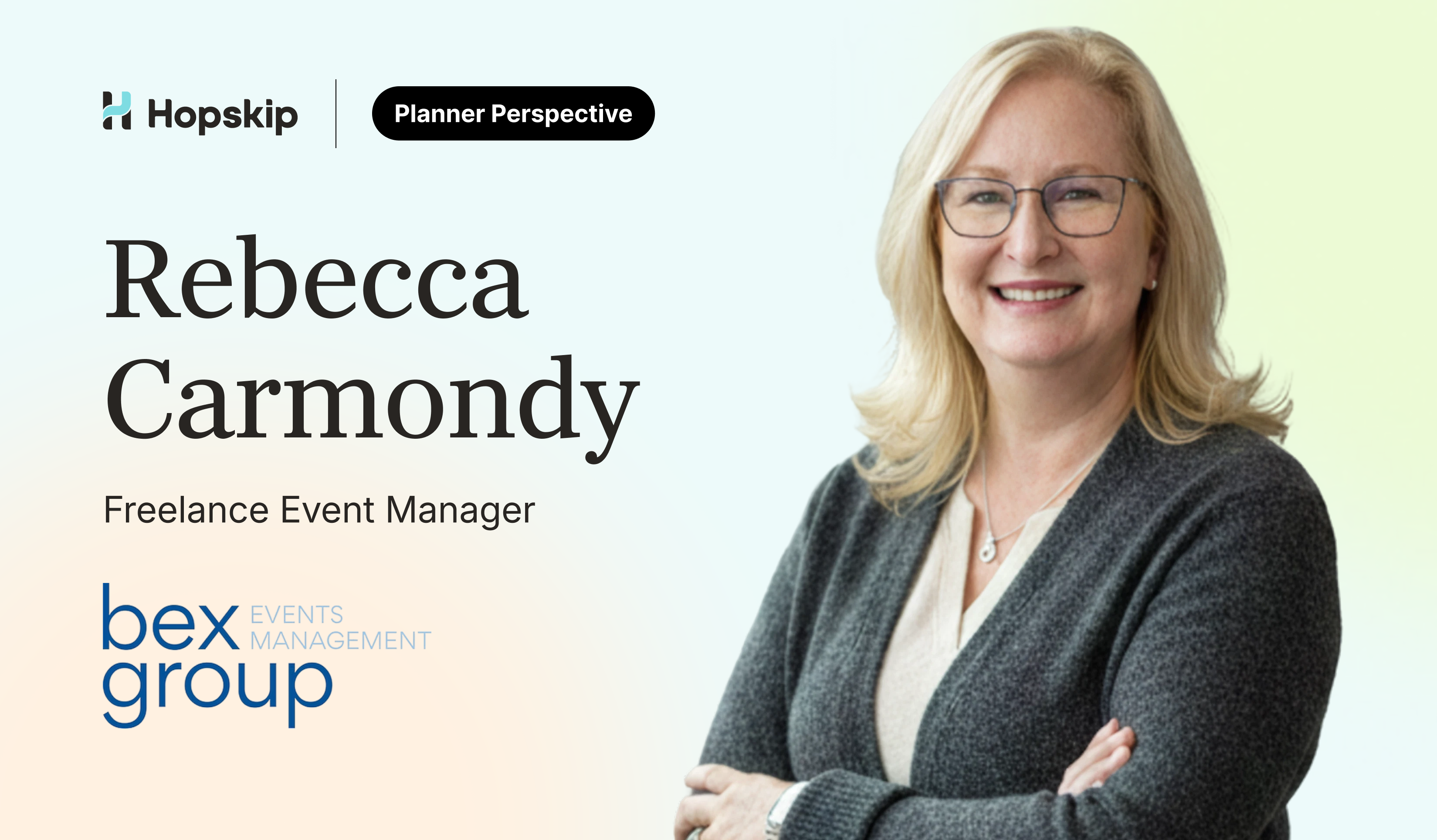
Twenty-four years ago, Rebecca Carmody walked into a job interview for an event manager role and was asked how her friends would describe her. Her answer: "Anal retentive, Type A personality." She got the job on the spot.
That single moment, more than any degree or certification, sums up what it takes to succeed in corporate event planning. Rebecca spent 14 years in cosmetology before a client tipped her off to an opening running a corporate briefing center in San Mateo, California. She's been planning events for technology companies ever since, and today she runs Bex Events Management Group, a consulting firm specializing in corporate events for tech clients ranging from quarterly business reviews to multi-day user conferences.
Her career has spanned mocktail bars, a nut allergy scare in Thailand, and enough spreadsheets to fill a server room. Here's what she's learned along the way, and what any planner (or anyone who works with one) can take from it.
Choosing a Venue Is Part Detective Work, Part Gut Check
Rebecca doesn't start with a spreadsheet. She starts with reviews.
Reviews are always her starting point, she says, because they tell you what the sales team won't. From there, she moves to the venue's website to evaluate meeting space capabilities, how walkable the property is for attendees, and whether the overall feel matches the group she's planning for. Price comes last, not because it doesn't matter, but because a venue that isn't transparent about cost from the start rarely gets more transparent later.
Pro tip: Treat vague pricing during the proposal stage as a preview of the entire relationship. If a property won't itemize costs upfront, that's valuable information before a contract is ever signed.
The RFP Process Looks Different Depending on the Size of the Room
For smaller events, Rebecca picks up the phone. A direct conversation with a venue's sales team early on, she's found, builds the kind of personal connection that pays off later in the process. For larger events, she takes a different route entirely, submitting RFPs to multiple properties at once through a search portal so she can compare initial proposals side by side before presenting recommendations to clients.
That shift, from relationship-first to volume-first depending on event size, is a distinction a lot of newer planners miss. Smaller doesn't mean less formal; it means a different channel is more efficient.
Pro tip: Match your outreach method to the size of the ask. A single call works for a 20-person offsite. A 500-person conference needs comparable proposals from multiple properties, which usually means an RFP tool built for it.
Budgets Break in the Same Few Places, Every Time
Ask any planner what keeps them up at night financially and the answer is rarely the big line items. It's the hidden ones: resort fees, AV markups, service charges, and price increases that surface after a contract is signed. Attrition and cancellation penalties round out the list, especially for tech companies where headcount on an attendee list can shift right up until the week of the event.
Rebecca's approach is to get ahead of all of it during the RFP and contract phase. She requests fully itemized proposals that break out every fee, negotiates attrition clauses with meaningful flexibility on room blocks, and builds contingency into every budget from day one. Cancellation timelines get defined clearly, in writing, before anyone signs.
Pro tip: A venue's willingness to itemize pricing during the proposal stage is often the clearest early signal of how transparent they'll be once the contract is signed.
The Tech Stack Doesn't Need to Be Flashy, It Needs to Work
Rebecca's event tech stack isn't built around the newest software on the market. It's built around what holds up under pressure: spreadsheets and email as the backbone for tracking details and follow-through, project management tools like Monday, Asana, or Wrike depending on what a given client already uses, JotForm for registrations and post-event surveys, and Cvent when a client's existing workflow calls for it.
The common thread across all of it is organization that doesn't create more work than it solves. Frameworks matter too. For trade shows, she relies on a detailed event planning checklist that pulls the right details from marketing teams early, so nothing stalls the planning timeline. For other event types, budget trackers, venue comparison matrices, and standardized RFP templates keep her from rebuilding the wheel every time. She's also folded AI tools into her process for research, document drafting, and cost analysis.
Pro tip: Build a lightweight toolkit before you need it. Templates and checklists created between events are the ones that save a planner during them.
Communication Is the Real Insurance Policy
When asked how she keeps clients and stakeholders aligned throughout a planning process, Rebecca's answer wasn't a tool. It was a cadence. Regular check-ins, scheduled as often as a client wants them, whether that's weekly or daily as an event approaches, do more to prevent surprises than any single piece of software. Being reachable on the same channel a client already uses, whether that's Slack or Teams, shortens the time between a question and an answer from days to minutes.
The same instinct shows up in how she plans for emergencies. Rather than treating safety planning as an afterthought, she brings it up deliberately during the planning process, even though it's not a popular topic, and makes sure roles and responsibilities are defined before anyone needs them. She follows the Event Safety Alliance, a nonprofit focused on event and entertainment safety, for ongoing training and updates.
Pro tip: Define who owns what in an emergency before the event, not during it. The minute it takes to assign responsibility in advance can save the ten minutes it takes to figure it out live, and those minutes matter most when something's actually wrong.
Good Events Are Built From Knowing the Room
Attendee experience, in Rebecca's view, comes down to specificity. That might mean offering mocktails alongside a full bar because a group's preferences have shifted, or building a schedule that starts later because a particular crowd does its best networking after dark. Customization only works when a planner actually understands who's in the room.
That same instinct drives how she approaches networking. As a self-described introvert, she remembers exactly what it feels like to walk into an unfamiliar room and feel either welcomed or invisible. Onsite, she'll go out of her way to introduce attendees she thinks would connect well. For group activities, she favors dine-arounds, but reshuffles the groups intentionally so people aren't stuck with the same faces all night. For virtual events, she pushes clients toward an open networking room during breaks, giving attendees a natural space to connect without a scripted icebreaker forcing the issue.
Pro tip: Small, specific accommodations, the ones that show a planner was paying attention, tend to be what attendees remember and talk about after an event ends.
When the Plan Meets Reality: A Nut Allergy in Thailand
A few years ago, Rebecca was planning a non-profit event in Thailand when she learned that one of the keynote speakers had a severe nut allergy. In a cuisine where nuts are a staple in nearly every dish, that discovery meant reworking menus across every venue and tour operator involved, not just for the main event meals, but for every offsite activity and group tour on the itinerary.
The twist: that speaker never actually joined a single offsite or group tour. The work happened anyway, because attendee safety isn't conditional on whether someone shows up to every activity. It's the kind of story that sounds like overkill until it's the one detail that got missed.
Advice for Planners Just Starting Out
Rebecca's advice for anyone entering the field is refreshingly unglamorous: be curious, be detail-oriented, and don't be afraid to ask questions, even the ones that feel obvious. This industry runs on relationships, so invest in them early. Get to know vendors, venues, and stakeholders on a personal level, because those relationships are what save a planner when things go sideways, and eventually, they will.
Her other piece of advice is about mindset. No two events are the same, and the ability to adapt quickly separates good planners from great ones. And whatever systems get built along the way, checklists, templates, frameworks, are worth documenting. Future events go faster when a planner isn't starting from scratch every time.
Where Hopskip Fits In
A lot of what Rebecca described, chasing down initial proposals, comparing venues side by side, and building an accurate budget before a client ever sees a number, is exactly the kind of manual, spreadsheet-heavy work that eats into a planner's week. Hopskip exists to take that friction out of venue sourcing, giving planners a single place to send RFPs, compare proposals, and manage hotel relationships without the back-and-forth of a dozen separate email threads.
Planners on Hopskip save 30+ hours per RFP, get cleaner proposals faster, and have all the information they need to make confident venue decisions. The best part? It's free to start for planners. Book a demo today to get started.
Sources:
Curabitur bibendum ad viverra eu fringilla ad eu. Eget placerat ultricies quis amet mattis himenaeos ullamcorper facilisi volutpat.
Start for free
Send your first one for free.

From the Salon Chair to the Ballroom Floor: A Corporate Event Planner's Playbook for Venues, Budgets, and Nut-Free Buffets
A veteran corporate event planner shares real-world lessons on venue selection, budgeting, vendor communication, and handling on-site emergencies with confidence.
Twenty-four years ago, Rebecca Carmody walked into a job interview for an event manager role and was asked how her friends would describe her. Her answer: "Anal retentive, Type A personality." She got the job on the spot.
That single moment, more than any degree or certification, sums up what it takes to succeed in corporate event planning. Rebecca spent 14 years in cosmetology before a client tipped her off to an opening running a corporate briefing center in San Mateo, California. She's been planning events for technology companies ever since, and today she runs Bex Events Management Group, a consulting firm specializing in corporate events for tech clients ranging from quarterly business reviews to multi-day user conferences.
Her career has spanned mocktail bars, a nut allergy scare in Thailand, and enough spreadsheets to fill a server room. Here's what she's learned along the way, and what any planner (or anyone who works with one) can take from it.
Choosing a Venue Is Part Detective Work, Part Gut Check
Rebecca doesn't start with a spreadsheet. She starts with reviews.
Reviews are always her starting point, she says, because they tell you what the sales team won't. From there, she moves to the venue's website to evaluate meeting space capabilities, how walkable the property is for attendees, and whether the overall feel matches the group she's planning for. Price comes last, not because it doesn't matter, but because a venue that isn't transparent about cost from the start rarely gets more transparent later.
Pro tip: Treat vague pricing during the proposal stage as a preview of the entire relationship. If a property won't itemize costs upfront, that's valuable information before a contract is ever signed.
The RFP Process Looks Different Depending on the Size of the Room
For smaller events, Rebecca picks up the phone. A direct conversation with a venue's sales team early on, she's found, builds the kind of personal connection that pays off later in the process. For larger events, she takes a different route entirely, submitting RFPs to multiple properties at once through a search portal so she can compare initial proposals side by side before presenting recommendations to clients.
That shift, from relationship-first to volume-first depending on event size, is a distinction a lot of newer planners miss. Smaller doesn't mean less formal; it means a different channel is more efficient.
Pro tip: Match your outreach method to the size of the ask. A single call works for a 20-person offsite. A 500-person conference needs comparable proposals from multiple properties, which usually means an RFP tool built for it.
Budgets Break in the Same Few Places, Every Time
Ask any planner what keeps them up at night financially and the answer is rarely the big line items. It's the hidden ones: resort fees, AV markups, service charges, and price increases that surface after a contract is signed. Attrition and cancellation penalties round out the list, especially for tech companies where headcount on an attendee list can shift right up until the week of the event.
Rebecca's approach is to get ahead of all of it during the RFP and contract phase. She requests fully itemized proposals that break out every fee, negotiates attrition clauses with meaningful flexibility on room blocks, and builds contingency into every budget from day one. Cancellation timelines get defined clearly, in writing, before anyone signs.
Pro tip: A venue's willingness to itemize pricing during the proposal stage is often the clearest early signal of how transparent they'll be once the contract is signed.
The Tech Stack Doesn't Need to Be Flashy, It Needs to Work
Rebecca's event tech stack isn't built around the newest software on the market. It's built around what holds up under pressure: spreadsheets and email as the backbone for tracking details and follow-through, project management tools like Monday, Asana, or Wrike depending on what a given client already uses, JotForm for registrations and post-event surveys, and Cvent when a client's existing workflow calls for it.
The common thread across all of it is organization that doesn't create more work than it solves. Frameworks matter too. For trade shows, she relies on a detailed event planning checklist that pulls the right details from marketing teams early, so nothing stalls the planning timeline. For other event types, budget trackers, venue comparison matrices, and standardized RFP templates keep her from rebuilding the wheel every time. She's also folded AI tools into her process for research, document drafting, and cost analysis.
Pro tip: Build a lightweight toolkit before you need it. Templates and checklists created between events are the ones that save a planner during them.
Communication Is the Real Insurance Policy
When asked how she keeps clients and stakeholders aligned throughout a planning process, Rebecca's answer wasn't a tool. It was a cadence. Regular check-ins, scheduled as often as a client wants them, whether that's weekly or daily as an event approaches, do more to prevent surprises than any single piece of software. Being reachable on the same channel a client already uses, whether that's Slack or Teams, shortens the time between a question and an answer from days to minutes.
The same instinct shows up in how she plans for emergencies. Rather than treating safety planning as an afterthought, she brings it up deliberately during the planning process, even though it's not a popular topic, and makes sure roles and responsibilities are defined before anyone needs them. She follows the Event Safety Alliance, a nonprofit focused on event and entertainment safety, for ongoing training and updates.
Pro tip: Define who owns what in an emergency before the event, not during it. The minute it takes to assign responsibility in advance can save the ten minutes it takes to figure it out live, and those minutes matter most when something's actually wrong.
Good Events Are Built From Knowing the Room
Attendee experience, in Rebecca's view, comes down to specificity. That might mean offering mocktails alongside a full bar because a group's preferences have shifted, or building a schedule that starts later because a particular crowd does its best networking after dark. Customization only works when a planner actually understands who's in the room.
That same instinct drives how she approaches networking. As a self-described introvert, she remembers exactly what it feels like to walk into an unfamiliar room and feel either welcomed or invisible. Onsite, she'll go out of her way to introduce attendees she thinks would connect well. For group activities, she favors dine-arounds, but reshuffles the groups intentionally so people aren't stuck with the same faces all night. For virtual events, she pushes clients toward an open networking room during breaks, giving attendees a natural space to connect without a scripted icebreaker forcing the issue.
Pro tip: Small, specific accommodations, the ones that show a planner was paying attention, tend to be what attendees remember and talk about after an event ends.
When the Plan Meets Reality: A Nut Allergy in Thailand
A few years ago, Rebecca was planning a non-profit event in Thailand when she learned that one of the keynote speakers had a severe nut allergy. In a cuisine where nuts are a staple in nearly every dish, that discovery meant reworking menus across every venue and tour operator involved, not just for the main event meals, but for every offsite activity and group tour on the itinerary.
The twist: that speaker never actually joined a single offsite or group tour. The work happened anyway, because attendee safety isn't conditional on whether someone shows up to every activity. It's the kind of story that sounds like overkill until it's the one detail that got missed.
Advice for Planners Just Starting Out
Rebecca's advice for anyone entering the field is refreshingly unglamorous: be curious, be detail-oriented, and don't be afraid to ask questions, even the ones that feel obvious. This industry runs on relationships, so invest in them early. Get to know vendors, venues, and stakeholders on a personal level, because those relationships are what save a planner when things go sideways, and eventually, they will.
Her other piece of advice is about mindset. No two events are the same, and the ability to adapt quickly separates good planners from great ones. And whatever systems get built along the way, checklists, templates, frameworks, are worth documenting. Future events go faster when a planner isn't starting from scratch every time.
Where Hopskip Fits In
A lot of what Rebecca described, chasing down initial proposals, comparing venues side by side, and building an accurate budget before a client ever sees a number, is exactly the kind of manual, spreadsheet-heavy work that eats into a planner's week. Hopskip exists to take that friction out of venue sourcing, giving planners a single place to send RFPs, compare proposals, and manage hotel relationships without the back-and-forth of a dozen separate email threads.
Planners on Hopskip save 30+ hours per RFP, get cleaner proposals faster, and have all the information they need to make confident venue decisions. The best part? It's free to start for planners. Book a demo today to get started.
Sources:

.svg)