.svg)
Fifteen Years on the Floor: What the Banquet Order Never Tells You

A Philadelphia Bar Association event manager with 15 years in the industry on staffing realities, stakeholder communication, guest experience, and what it really takes to pull off 70+ events a year.
Some people fall into the events industry. Allie Hooven got pushed in by a textbook bill.
In 2011, during her freshman year at Penn State, she took a job as a banquet server. "What started as a way to pay for textbooks and fund a very average college diet quickly turned into a 15 year career." She went on to earn a degree in Psychology, which turned out to be more relevant than anyone would guess: event planning, as she puts it, "is really about understanding people, how they think, communicate, react under pressure, and connect with experiences."
Before moving into management, Allie learned event operations from the ground up, and spent plenty of time in the trenches. She expo'd entrées out of hot boxes, cut wedding cake at midnight, learned the hard way that dinner table votives can send hot wax down your arm, packed dirty table linens into laundry bags, and carefully navigated tableside wine service with a glass of Cabernet, desperately trying not to baptize someone's expensive gown or fur while perfecting that three finger pour.
“I think every event professional should spend some time in the trenches. Be covered in wedding cake at midnight. Pack dirty table linens into a laundry bag. Work the shift that was supposed to end at 10pm and somehow ends at 2am when you have to be back at 7am for the breakfast shift. You understand the job, and your team, a lot differently after that.”
Before events became the career, Allie had considered becoming an industrial-organizational psychologist or a sports psychologist, fields centered around understanding people, performance, communication, behavior, and how individuals and teams respond under pressure. Instead, she found herself applying many of those same principles to event operations: managing teams, reading a room, keeping people motivated under pressure, and figuring out what needs to happen next before anyone else realizes it needs to happen.
From there, her career progressed from event operations into event operations management and eventually sales, giving her experience on nearly every side of the event business. Today, she is the Meetings and Special Events Manager for the Philadelphia Bar Association, the oldest association of lawyers in the United States. She works within a larger nonprofit organization as its only dedicated event professional, managing 70 events a year from initial request through execution, often with multiple events moving simultaneously.
When the Resources Don't Match the Ambition
Ask Allie about her hardest moments and she does not reach for a broken sound system. She reaches for the years right after in-person events came back.
The industry had shed enormous numbers of experienced professionals, and expectations had not moved an inch. “Clients and event stakeholders still expected full-scale, white-glove experiences without realizing the staffing infrastructure and resources simply had not recovered yet.” She remembers delivering an extremely high-touch event with less than half the usual team. “Standards that once called for one server per 15 guests suddenly became one server per 25 and a prayer.”
This is not nostalgia, it is still the operating environment. In a February 2026 survey of 246 hotel owners and operators, the American Hotel & Lodging Association found that more than half of hoteliers describe themselves as somewhat or severely understaffed, with 42% naming workforce shortages as an active financial pain point.
So when a venue says service levels have changed, that is structural reality, not a negotiating tactic. Allie's response was not to lower standards but to get honest earlier. “Sometimes part of the job is having uncomfortable conversations and helping people understand what's realistically achievable with the resources, sometimes limited, available.”
Pro tip: have the staffing conversation during sourcing, not during the final walkthrough. Ask for actual service ratios in writing before you sign, and set stakeholder expectations against that number rather than against the event you ran in 2019.
Translating Complexity Into Clarity
Allie calls stakeholder communication “the golden question.”
“Not everyone involved in an event fully understands what it takes behind the scenes to bring it to life and honestly, they shouldn't have to.”
That second half matters. Plenty of planners treat visibility as validation, flooding stakeholders with detail to prove how hard the work is. Allie does the opposite. Her job, as she describes it, is “translating complexity into clarity” — filtering constant pivots, vendor emails, and someone suddenly wanting to add a stage into clean updates about progress, decisions, and anything affecting the guest experience. Her framing of why is the part worth stealing: “strong communication is really about protecting people's time, attention, and blood pressure.”
Events come to Allie in all shapes and forms, from just about every direction. Some arrive with a date, budget, headcount and a fairly complete vision. Others arrive with a date and a prayer. Some begin as a fully formed event concept; others start with a much more optimistic version of “Can we do something here?”
That means one of the first parts of the job is figuring out what the event actually is before figuring out how to execute it. The challenge isn't simply gathering information — it's knowing which questions need to be asked, which details can wait, and which missing pieces could become very expensive later.
Pro tip: give stakeholders one intake form instead of your inbox. A single structured request captures budget, dates, headcount, and purpose up front, and it ends the weeks of prompting that quietly eat your calendar.
Designing for Attention Spans That Have Already Left
“Attention spans are shorter than ever,” Allie says. “People don't want to sit through endless blocks of content anymore. They want to connect, engage, and feel like their time mattered.”
The data agrees. Freeman's 2024 Attendee Intent and Behavior report found only 44% of attendees preferred classroom-style sessions, down 12 points year over year, while 52% said they wanted to bond with peers over shared professional challenges — a very different thing from wanting a networking hour.
Allie's approach to networking is structural rather than programmatic. She builds shorter content blocks, real transition points, and receptions with breathing room instead of a hard cut into the next session, then leans on speaker selection and a relatable theme so conversation happens on its own. “The best networking usually starts before guests even realize they're networking.” She is describing scheduling, not icebreakers. Timing “matters more than people realize.”
Allie's approach to creating memorable event experiences is less about adding more programming and more about creating the right conditions for people to engage. She looks at the event as a whole: how long guests are sitting, where natural breaks occur, and whether the reception feels like an afterthought or an intentional part of the experience.
Pro tip: before adding a networking activity, audit your agenda for whitespace. Most connection problems are calendar problems, and a fifteen-minute buffer usually outperforms a structured mixer.
A Venue Has to Do More Than Hold People
Allie evaluates venues from the parking lot inward.
“After a long workday, nobody wants attending an event to feel like the second leg of a scavenger hunt.” Parking, transit, nearby hotels, walkability: all core criteria, not logistics trivia. “If getting there feels stressful, guests are already mentally checked out before cocktail hour even starts.”
The industry has caught up to her. In Cvent's 2026 Global Planner Sourcing Report, based on 1,650 planners, 74% said they are prioritizing accessibility more than in previous years, and 63% now cite attendee engagement as their leading measure of success.
Her second test is narrative fit. “A great venue does more than hold people and serve chicken. It helps tell the story.” When space, audience, and tone align, “people feel it immediately.”
Even when confident about a venue she looks at two or three options, specifically so she is “not just falling in love with pretty lighting and a nice lobby scent,” and insists on a walkthrough with fresh eyes even in rooms she knows well. With a new venue team she evaluates the partnership as much as the property: “A strong venue team can save your event. A bad one can age you seven years in a weekend.”
Pro tip: score accessibility as a line item on your comparison grid, with real numbers for transit distance and parking cost. It stops a beautiful, unreachable venue from winning on photographs alone.
Documentation, and the Financial Reality Underneath It
“Events run on documentation and paper trails,” Allie says, and her stack is unglamorous on purpose: timelines, BEOs, run of shows, COIs, contracts, vendor agreements, plus her own tracking for guest counts, AV changes, and deposits. The point is not tidiness, it is liability. Real-time documentation “helps avoid those terrifying Wait, who was handling that? moments on event day.” Her rule is blunt: “If it isn't written down somewhere, it becomes a group problem very quickly.”
That paper trail is also the only defense against the budget math. “Events are basically organized chaos with invoices attached.” Guest count changes, surprise AV requests, and program adjustments are the usual suspects, but she flags attrition as the one that escalates fastest when contracted minimums are missed. Hopskip's guide to hotel attrition clauses covers what to negotiate before signing.
Then there is the expectation gap. “A lot of organizations want to recreate the exact same event they hosted five years ago without realizing the budget landscape has completely shifted.” Cvent's 2026 report found 72% of planners expect event costs to rise and 35% named staying within budget as their biggest concern, with Maritz projecting a further 2-4% through 2026. Her answer is not a bigger number: “Sometimes creativity matters more than throwing money at something.”
Pro tip: model attrition exposure as a dollar figure before you sign, not after guest counts wobble. A clause you can quantify is a clause you can negotiate.
Measuring It, and Surviving It
Allie grades events on two axes: operational execution and the atmosphere in the room. Operationally, she watches budget adherence, guest count accuracy, and how cleanly the team absorbed changes. “In events, something always changes, so a big KPI is how seamlessly those pivots are managed in real time.”
The human read is less measurable and more honest. Were people engaged, or “quietly calculating how quickly they could get out of the parking garage?” Her favorite signal: “Sometimes the biggest sign of a successful event is when people linger afterward because they genuinely don't want the night to end yet.”
When things break, her emergency plan starts with her own face. “If the planner starts panicking, everyone else usually follows and suddenly you've got two problems instead of one.” She triages for what actually affects guests, on the theory that “most event emergencies are really just last minute changes with a flair for theatrics” — a dead microphone five minutes before remarks, seating changes from nowhere, a keynote who decides post-rehearsal that they do not love the stage.
“Guests and your team take their emotional cues from the planner.” Or, more concisely: “Never let them see you sweat.”
Pro tip: run the debrief within 48 hours and write down friction, not just outcomes. The detail you will want next year is the thing that annoyed you, and that fades fastest.
For Anyone Just Starting
Allie does not soften it. “This industry will humble you quickly. You will absolutely have moments where you question every life decision you've ever made.” Then: “Stick with it anyway.”
Her final advice is about people, which tracks for someone who studied psychology and stayed. “Build your village, grow your network, and take care of those relationships.” Having people to learn from, collaborate with, vent to, and occasionally send a help text to is, in her words, invaluable. “Because at some point, you'll always know someone who knows someone who can make something happen.”
Pro tip: treat your network as infrastructure, not networking. The contact who saves an event is almost never someone you met that week.
About Hopskip
Hopskip is hotel and venue sourcing software built around the planner rather than the supplier. Create an RFP once, send it to any hotel worldwide, and get proposals back in a format that compares side by side. In Cvent's 2026 report, 97% of planners said a structured RFP and sourcing process saves both time and money. Structure is not bureaucracy, it is leverage.
And on Allie's wish for a tool that might “reduce the number of tabs I have open during event week” — that is roughly the entire product thesis.
Planners on Hopskip save 30+ hours per RFP, get cleaner proposals faster, and have all the information they need to make confident venue decisions. The best part? It's free to start for planners. Book a demo today to get started.
Sources
- 2026 Cvent Global Planner Sourcing Report, based on 1,650 planners surveyed
- American Hotel & Lodging Association survey of 246 hotel owners and operators, February 2026, via Business Travel News
- Freeman Trends Report: 2024 Attendee Intent and Behavior, via PCMA
- Meetings and Events Industry Forecast 2026, Northstar Meetings Group (Maritz Industry Trends, September 2025)
- Hotel Attrition Clause: What Event Planners Need to Know, Hopskip
Curabitur bibendum ad viverra eu fringilla ad eu. Eget placerat ultricies quis amet mattis himenaeos ullamcorper facilisi volutpat.
Start for free
Send your first one for free.

Fifteen Years on the Floor: What the Banquet Order Never Tells You
A Philadelphia Bar Association event manager with 15 years in the industry on staffing realities, stakeholder communication, guest experience, and what it really takes to pull off 70+ events a year.
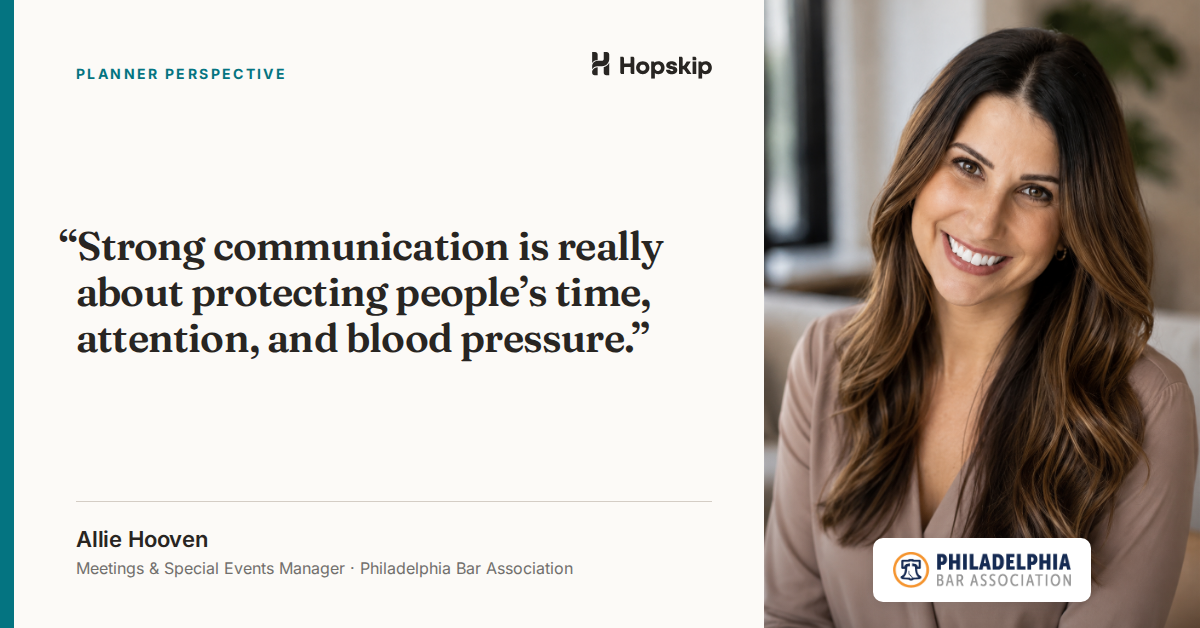
Some people fall into the events industry. Allie Hooven got pushed in by a textbook bill.
In 2011, during her freshman year at Penn State, she took a job as a banquet server. "What started as a way to pay for textbooks and fund a very average college diet quickly turned into a 15 year career." She went on to earn a degree in Psychology, which turned out to be more relevant than anyone would guess: event planning, as she puts it, "is really about understanding people, how they think, communicate, react under pressure, and connect with experiences."
Before moving into management, Allie learned event operations from the ground up, and spent plenty of time in the trenches. She expo'd entrées out of hot boxes, cut wedding cake at midnight, learned the hard way that dinner table votives can send hot wax down your arm, packed dirty table linens into laundry bags, and carefully navigated tableside wine service with a glass of Cabernet, desperately trying not to baptize someone's expensive gown or fur while perfecting that three finger pour.
“I think every event professional should spend some time in the trenches. Be covered in wedding cake at midnight. Pack dirty table linens into a laundry bag. Work the shift that was supposed to end at 10pm and somehow ends at 2am when you have to be back at 7am for the breakfast shift. You understand the job, and your team, a lot differently after that.”
Before events became the career, Allie had considered becoming an industrial-organizational psychologist or a sports psychologist, fields centered around understanding people, performance, communication, behavior, and how individuals and teams respond under pressure. Instead, she found herself applying many of those same principles to event operations: managing teams, reading a room, keeping people motivated under pressure, and figuring out what needs to happen next before anyone else realizes it needs to happen.
From there, her career progressed from event operations into event operations management and eventually sales, giving her experience on nearly every side of the event business. Today, she is the Meetings and Special Events Manager for the Philadelphia Bar Association, the oldest association of lawyers in the United States. She works within a larger nonprofit organization as its only dedicated event professional, managing 70 events a year from initial request through execution, often with multiple events moving simultaneously.
When the Resources Don't Match the Ambition
Ask Allie about her hardest moments and she does not reach for a broken sound system. She reaches for the years right after in-person events came back.
The industry had shed enormous numbers of experienced professionals, and expectations had not moved an inch. “Clients and event stakeholders still expected full-scale, white-glove experiences without realizing the staffing infrastructure and resources simply had not recovered yet.” She remembers delivering an extremely high-touch event with less than half the usual team. “Standards that once called for one server per 15 guests suddenly became one server per 25 and a prayer.”
This is not nostalgia, it is still the operating environment. In a February 2026 survey of 246 hotel owners and operators, the American Hotel & Lodging Association found that more than half of hoteliers describe themselves as somewhat or severely understaffed, with 42% naming workforce shortages as an active financial pain point.
So when a venue says service levels have changed, that is structural reality, not a negotiating tactic. Allie's response was not to lower standards but to get honest earlier. “Sometimes part of the job is having uncomfortable conversations and helping people understand what's realistically achievable with the resources, sometimes limited, available.”
Pro tip: have the staffing conversation during sourcing, not during the final walkthrough. Ask for actual service ratios in writing before you sign, and set stakeholder expectations against that number rather than against the event you ran in 2019.
Translating Complexity Into Clarity
Allie calls stakeholder communication “the golden question.”
“Not everyone involved in an event fully understands what it takes behind the scenes to bring it to life and honestly, they shouldn't have to.”
That second half matters. Plenty of planners treat visibility as validation, flooding stakeholders with detail to prove how hard the work is. Allie does the opposite. Her job, as she describes it, is “translating complexity into clarity” — filtering constant pivots, vendor emails, and someone suddenly wanting to add a stage into clean updates about progress, decisions, and anything affecting the guest experience. Her framing of why is the part worth stealing: “strong communication is really about protecting people's time, attention, and blood pressure.”
Events come to Allie in all shapes and forms, from just about every direction. Some arrive with a date, budget, headcount and a fairly complete vision. Others arrive with a date and a prayer. Some begin as a fully formed event concept; others start with a much more optimistic version of “Can we do something here?”
That means one of the first parts of the job is figuring out what the event actually is before figuring out how to execute it. The challenge isn't simply gathering information — it's knowing which questions need to be asked, which details can wait, and which missing pieces could become very expensive later.
Pro tip: give stakeholders one intake form instead of your inbox. A single structured request captures budget, dates, headcount, and purpose up front, and it ends the weeks of prompting that quietly eat your calendar.
Designing for Attention Spans That Have Already Left
“Attention spans are shorter than ever,” Allie says. “People don't want to sit through endless blocks of content anymore. They want to connect, engage, and feel like their time mattered.”
The data agrees. Freeman's 2024 Attendee Intent and Behavior report found only 44% of attendees preferred classroom-style sessions, down 12 points year over year, while 52% said they wanted to bond with peers over shared professional challenges — a very different thing from wanting a networking hour.
Allie's approach to networking is structural rather than programmatic. She builds shorter content blocks, real transition points, and receptions with breathing room instead of a hard cut into the next session, then leans on speaker selection and a relatable theme so conversation happens on its own. “The best networking usually starts before guests even realize they're networking.” She is describing scheduling, not icebreakers. Timing “matters more than people realize.”
Allie's approach to creating memorable event experiences is less about adding more programming and more about creating the right conditions for people to engage. She looks at the event as a whole: how long guests are sitting, where natural breaks occur, and whether the reception feels like an afterthought or an intentional part of the experience.
Pro tip: before adding a networking activity, audit your agenda for whitespace. Most connection problems are calendar problems, and a fifteen-minute buffer usually outperforms a structured mixer.
A Venue Has to Do More Than Hold People
Allie evaluates venues from the parking lot inward.
“After a long workday, nobody wants attending an event to feel like the second leg of a scavenger hunt.” Parking, transit, nearby hotels, walkability: all core criteria, not logistics trivia. “If getting there feels stressful, guests are already mentally checked out before cocktail hour even starts.”
The industry has caught up to her. In Cvent's 2026 Global Planner Sourcing Report, based on 1,650 planners, 74% said they are prioritizing accessibility more than in previous years, and 63% now cite attendee engagement as their leading measure of success.
Her second test is narrative fit. “A great venue does more than hold people and serve chicken. It helps tell the story.” When space, audience, and tone align, “people feel it immediately.”
Even when confident about a venue she looks at two or three options, specifically so she is “not just falling in love with pretty lighting and a nice lobby scent,” and insists on a walkthrough with fresh eyes even in rooms she knows well. With a new venue team she evaluates the partnership as much as the property: “A strong venue team can save your event. A bad one can age you seven years in a weekend.”
Pro tip: score accessibility as a line item on your comparison grid, with real numbers for transit distance and parking cost. It stops a beautiful, unreachable venue from winning on photographs alone.
Documentation, and the Financial Reality Underneath It
“Events run on documentation and paper trails,” Allie says, and her stack is unglamorous on purpose: timelines, BEOs, run of shows, COIs, contracts, vendor agreements, plus her own tracking for guest counts, AV changes, and deposits. The point is not tidiness, it is liability. Real-time documentation “helps avoid those terrifying Wait, who was handling that? moments on event day.” Her rule is blunt: “If it isn't written down somewhere, it becomes a group problem very quickly.”
That paper trail is also the only defense against the budget math. “Events are basically organized chaos with invoices attached.” Guest count changes, surprise AV requests, and program adjustments are the usual suspects, but she flags attrition as the one that escalates fastest when contracted minimums are missed. Hopskip's guide to hotel attrition clauses covers what to negotiate before signing.
Then there is the expectation gap. “A lot of organizations want to recreate the exact same event they hosted five years ago without realizing the budget landscape has completely shifted.” Cvent's 2026 report found 72% of planners expect event costs to rise and 35% named staying within budget as their biggest concern, with Maritz projecting a further 2-4% through 2026. Her answer is not a bigger number: “Sometimes creativity matters more than throwing money at something.”
Pro tip: model attrition exposure as a dollar figure before you sign, not after guest counts wobble. A clause you can quantify is a clause you can negotiate.
Measuring It, and Surviving It
Allie grades events on two axes: operational execution and the atmosphere in the room. Operationally, she watches budget adherence, guest count accuracy, and how cleanly the team absorbed changes. “In events, something always changes, so a big KPI is how seamlessly those pivots are managed in real time.”
The human read is less measurable and more honest. Were people engaged, or “quietly calculating how quickly they could get out of the parking garage?” Her favorite signal: “Sometimes the biggest sign of a successful event is when people linger afterward because they genuinely don't want the night to end yet.”
When things break, her emergency plan starts with her own face. “If the planner starts panicking, everyone else usually follows and suddenly you've got two problems instead of one.” She triages for what actually affects guests, on the theory that “most event emergencies are really just last minute changes with a flair for theatrics” — a dead microphone five minutes before remarks, seating changes from nowhere, a keynote who decides post-rehearsal that they do not love the stage.
“Guests and your team take their emotional cues from the planner.” Or, more concisely: “Never let them see you sweat.”
Pro tip: run the debrief within 48 hours and write down friction, not just outcomes. The detail you will want next year is the thing that annoyed you, and that fades fastest.
For Anyone Just Starting
Allie does not soften it. “This industry will humble you quickly. You will absolutely have moments where you question every life decision you've ever made.” Then: “Stick with it anyway.”
Her final advice is about people, which tracks for someone who studied psychology and stayed. “Build your village, grow your network, and take care of those relationships.” Having people to learn from, collaborate with, vent to, and occasionally send a help text to is, in her words, invaluable. “Because at some point, you'll always know someone who knows someone who can make something happen.”
Pro tip: treat your network as infrastructure, not networking. The contact who saves an event is almost never someone you met that week.
About Hopskip
Hopskip is hotel and venue sourcing software built around the planner rather than the supplier. Create an RFP once, send it to any hotel worldwide, and get proposals back in a format that compares side by side. In Cvent's 2026 report, 97% of planners said a structured RFP and sourcing process saves both time and money. Structure is not bureaucracy, it is leverage.
And on Allie's wish for a tool that might “reduce the number of tabs I have open during event week” — that is roughly the entire product thesis.
Planners on Hopskip save 30+ hours per RFP, get cleaner proposals faster, and have all the information they need to make confident venue decisions. The best part? It's free to start for planners. Book a demo today to get started.
Sources
- 2026 Cvent Global Planner Sourcing Report, based on 1,650 planners surveyed
- American Hotel & Lodging Association survey of 246 hotel owners and operators, February 2026, via Business Travel News
- Freeman Trends Report: 2024 Attendee Intent and Behavior, via PCMA
- Meetings and Events Industry Forecast 2026, Northstar Meetings Group (Maritz Industry Trends, September 2025)
- Hotel Attrition Clause: What Event Planners Need to Know, Hopskip


.svg)