.svg)
The Return on Relationships: How a Layoff Became an Agency

After being laid off following two decades in corporate events, one planner built her own agency around a simple idea: return on relationships. Here's what she's learned since.
For over two decades, Hadley Schafer's career ran on a simple formula: work for an organization, get stability and health insurance in return. Then, for the first time in her career, she got laid off. What happened next became the foundation of HMS Event Operations.
Here's how that pivot, and the concept she calls "return on relationships," built an agency in under two years.
The Layoff That Became a Launch
Schafer's first instinct after losing her job was to keep going, to find another organization that could provide the stability and health insurance she'd always relied on. But she stopped herself: losing that job proved organizational stability wasn't actually as stable as she'd assumed. She got health insurance through her husband instead, which freed her to think differently about what came next.
Two women entrepreneurs, both published authors, both deep in the grit of building their own businesses, reached out for contract work. They saw something in Schafer that she hadn't yet seen in herself. She decided to take over two decades of operational experience and apply it to her own agency, where she could choose her clients, choose her work, and choose who she worked alongside.
Pro tip: if a layoff forces you to reconsider your safety net, take the moment seriously rather than rushing back to whatever felt stable before. The people who reach out to you during that transition often see potential you haven't recognized in yourself yet.
The Mistake: Saying Yes Before Understanding the Consequences
Schafer's formative mistake happened early in her agency's life. She said yes to a client description that included services outside her actual expertise, marketing campaign creation, because she believed entrepreneurs simply had to pick things up on the fly no matter what. She lost that client because she didn't have deep experience creating marketing campaigns, and just as importantly, she didn't have passion for learning it.
That experience reshaped her entire approach. Her business became "holistic meeting strategies" not just because she wanted clients to think holistically about their events, but because she wanted to be holistic in her own approach: focused on what she actually does well and genuinely enjoys, rather than stretching into everything a client might ask for.
Pro tip: before saying yes to a scope item outside your expertise, ask whether you're excited to learn it or just willing to grind through it. Willingness without genuine interest is usually where quality erodes first.
Relationships as the Actual Business Model
Asked how many times a vendor relationship has saved an event, Schafer's answer is simple: too many to count. The return on relationships, what she calls ROR, is the concept her entire business was built on, and it's what drives her to create new opportunities.
Her relationships with vendors and venues don't just help her choose the right partners for a given event. They've carried her through tricky situations where she isn't the expert on a given topic, because she has experts in her pocket she can call on. That network is also directly responsible for two of her biggest clients, both of whom came through outreach to people who believed in her and whose work and reputation she respected in return.
Pro tip: treat relationship-building as a growth channel with its own deliberate strategy, not something that happens passively in the background. Schafer's biggest clients came from active outreach to her existing circle, not cold prospecting.
Attendee Experience Built on Choice
Schafer's approach to attendee experience rejects the straight, forced agenda that marches every attendee through the same rooms at the same time. Instead, she builds in options: choices of topics, rooms, relaxation areas, and meeting areas, so attendees can shape their own experience rather than follow a single predetermined path.
Pro tip: audit your next event's agenda for forced simultaneity, moments where every attendee is funneled into the same room regardless of interest. Even one optional breakout track can meaningfully improve how attendees experience the rest of the program.
Differentiating Through Honesty and Humor
Schafer describes her differentiator as the ability to build big and build new, delivered with honesty, humor, and open communication. When something isn't working as expected, she meets it head-on with a solution rather than pretending everything is fine and hoping it resolves itself.
That directness extends to keeping everyone aligned on expectations throughout a project, rather than letting small issues accumulate silently until they become large ones.
Pro tip: the moment you notice yourself avoiding telling a client about a problem because you're hoping it resolves on its own, that's the exact moment to raise it instead. Early, honest flags are almost always easier conversations than late, unavoidable ones.
Client Expectations Built on Transparency and Taking the Blame
From the first conversation, Schafer listens closely to client needs and creates space for them to share concerns openly. She's fully transparent throughout, and she treats clients the way she managed teams at previous organizations: she takes the blame and passes along the praise.
She describes loving her position as "the woman behind the curtain," where the client gets the glory when their event, conference, or convention succeeds. That's a genuine philosophy, not just a service description: her success is measured by her client's visible success, not her own credit.
Pro tip: if you want stronger client loyalty, practice visibly deflecting credit to the client in front of their own stakeholders during a successful event. It costs you nothing and builds trust that outlasts any single project.
The Trend Worth Watching: Talking to Audiences Differently
Schafer's read on the industry's biggest shift centers on how planners talk to their audiences. The game for conferences and events started changing well before 2020, and then shifted dramatically. Attendees want something different now. They need a genuine reason to attend, they want choices, they want real opportunities to network, and they need all of it to be easy.
Pro tip: before finalizing your next event's messaging, ask what specific reason you're giving attendees to choose your event over simply staying at their desk. "Because it's our annual conference" isn't a reason anymore.
Figure It Out, Find the Right Sources, Figure It Out
Schafer's go-to plan for emergencies is refreshingly blunt: figure it out, find the right sources, figure it out. It's less a formal framework than a mindset of relentless problem-solving paired with a willingness to lean on her network of experts when she doesn't have the answer herself.
Pro tip: build a mental list of two or three people you can call for expertise you personally lack, before you're in a crisis that requires it. "Figure it out" works far better when you already know who to call.
The $150,000 Negotiation Over a Few Missing Name Badges
Since HMS Event Operations has only been running for a year and a half, Schafer says she hasn't had a truly "crazy" story yet from her own agency. But she offers one from a previous job that captures her whole philosophy on respect and professionalism.
A sound system glitch caused a few name badges to be left off during registration, an error that had nothing to do with Schafer. Her CEO at the time told her to go ask the AV company, whose equipment was valued at $150,000, to provide their services for free over the minor mistake. Schafer refused to make that ask; it felt disproportionate to what had actually gone wrong. Instead, she spoke to the AV vendor respectfully, transparently, and kindly. She walked away with a 15% discount, and just as importantly, she calmed her CEO down in the process.
About Hopskip
Hopskip is a sourcing platform that connects event planners directly with hotels and DMOs through streamlined RFP management, cutting the manual back-and-forth out of finding the right venue partner.
Planners on Hopskip save 30+ hours per RFP, get cleaner proposals faster, and have all the information they need to make confident venue decisions. The best part? It's free to start for planners. Book a demo today to get started.
Sources
- General industry commentary on evolving attendee expectations in conferences and events post-2020
- General workforce reporting on career pivots following unexpected layoffs
Curabitur bibendum ad viverra eu fringilla ad eu. Eget placerat ultricies quis amet mattis himenaeos ullamcorper facilisi volutpat.
Start for free
Send your first one for free.

The Return on Relationships: How a Layoff Became an Agency
After being laid off following two decades in corporate events, one planner built her own agency around a simple idea: return on relationships. Here's what she's learned since.
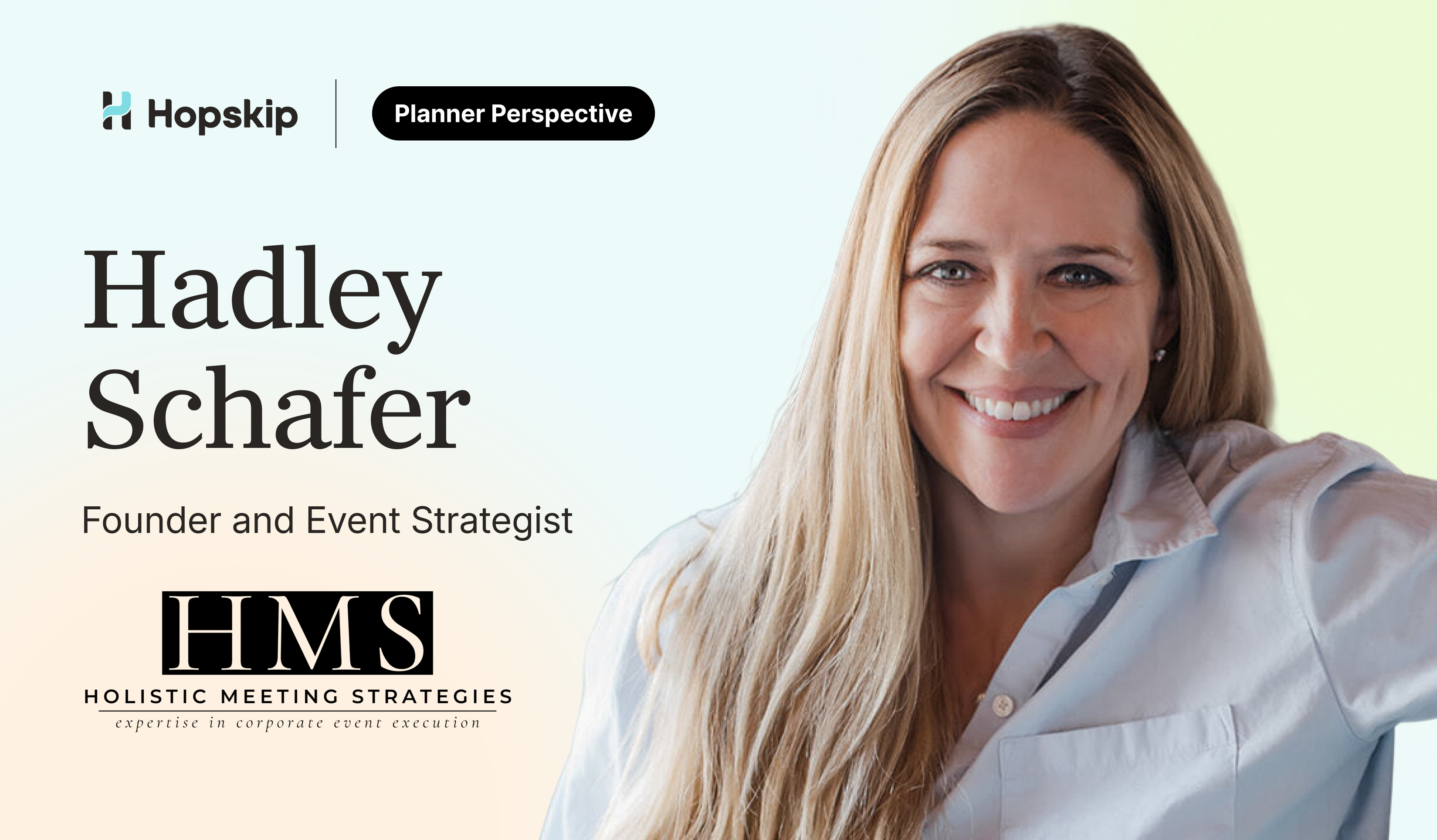
For over two decades, Hadley Schafer's career ran on a simple formula: work for an organization, get stability and health insurance in return. Then, for the first time in her career, she got laid off. What happened next became the foundation of HMS Event Operations.
Here's how that pivot, and the concept she calls "return on relationships," built an agency in under two years.
The Layoff That Became a Launch
Schafer's first instinct after losing her job was to keep going, to find another organization that could provide the stability and health insurance she'd always relied on. But she stopped herself: losing that job proved organizational stability wasn't actually as stable as she'd assumed. She got health insurance through her husband instead, which freed her to think differently about what came next.
Two women entrepreneurs, both published authors, both deep in the grit of building their own businesses, reached out for contract work. They saw something in Schafer that she hadn't yet seen in herself. She decided to take over two decades of operational experience and apply it to her own agency, where she could choose her clients, choose her work, and choose who she worked alongside.
Pro tip: if a layoff forces you to reconsider your safety net, take the moment seriously rather than rushing back to whatever felt stable before. The people who reach out to you during that transition often see potential you haven't recognized in yourself yet.
The Mistake: Saying Yes Before Understanding the Consequences
Schafer's formative mistake happened early in her agency's life. She said yes to a client description that included services outside her actual expertise, marketing campaign creation, because she believed entrepreneurs simply had to pick things up on the fly no matter what. She lost that client because she didn't have deep experience creating marketing campaigns, and just as importantly, she didn't have passion for learning it.
That experience reshaped her entire approach. Her business became "holistic meeting strategies" not just because she wanted clients to think holistically about their events, but because she wanted to be holistic in her own approach: focused on what she actually does well and genuinely enjoys, rather than stretching into everything a client might ask for.
Pro tip: before saying yes to a scope item outside your expertise, ask whether you're excited to learn it or just willing to grind through it. Willingness without genuine interest is usually where quality erodes first.
Relationships as the Actual Business Model
Asked how many times a vendor relationship has saved an event, Schafer's answer is simple: too many to count. The return on relationships, what she calls ROR, is the concept her entire business was built on, and it's what drives her to create new opportunities.
Her relationships with vendors and venues don't just help her choose the right partners for a given event. They've carried her through tricky situations where she isn't the expert on a given topic, because she has experts in her pocket she can call on. That network is also directly responsible for two of her biggest clients, both of whom came through outreach to people who believed in her and whose work and reputation she respected in return.
Pro tip: treat relationship-building as a growth channel with its own deliberate strategy, not something that happens passively in the background. Schafer's biggest clients came from active outreach to her existing circle, not cold prospecting.
Attendee Experience Built on Choice
Schafer's approach to attendee experience rejects the straight, forced agenda that marches every attendee through the same rooms at the same time. Instead, she builds in options: choices of topics, rooms, relaxation areas, and meeting areas, so attendees can shape their own experience rather than follow a single predetermined path.
Pro tip: audit your next event's agenda for forced simultaneity, moments where every attendee is funneled into the same room regardless of interest. Even one optional breakout track can meaningfully improve how attendees experience the rest of the program.
Differentiating Through Honesty and Humor
Schafer describes her differentiator as the ability to build big and build new, delivered with honesty, humor, and open communication. When something isn't working as expected, she meets it head-on with a solution rather than pretending everything is fine and hoping it resolves itself.
That directness extends to keeping everyone aligned on expectations throughout a project, rather than letting small issues accumulate silently until they become large ones.
Pro tip: the moment you notice yourself avoiding telling a client about a problem because you're hoping it resolves on its own, that's the exact moment to raise it instead. Early, honest flags are almost always easier conversations than late, unavoidable ones.
Client Expectations Built on Transparency and Taking the Blame
From the first conversation, Schafer listens closely to client needs and creates space for them to share concerns openly. She's fully transparent throughout, and she treats clients the way she managed teams at previous organizations: she takes the blame and passes along the praise.
She describes loving her position as "the woman behind the curtain," where the client gets the glory when their event, conference, or convention succeeds. That's a genuine philosophy, not just a service description: her success is measured by her client's visible success, not her own credit.
Pro tip: if you want stronger client loyalty, practice visibly deflecting credit to the client in front of their own stakeholders during a successful event. It costs you nothing and builds trust that outlasts any single project.
The Trend Worth Watching: Talking to Audiences Differently
Schafer's read on the industry's biggest shift centers on how planners talk to their audiences. The game for conferences and events started changing well before 2020, and then shifted dramatically. Attendees want something different now. They need a genuine reason to attend, they want choices, they want real opportunities to network, and they need all of it to be easy.
Pro tip: before finalizing your next event's messaging, ask what specific reason you're giving attendees to choose your event over simply staying at their desk. "Because it's our annual conference" isn't a reason anymore.
Figure It Out, Find the Right Sources, Figure It Out
Schafer's go-to plan for emergencies is refreshingly blunt: figure it out, find the right sources, figure it out. It's less a formal framework than a mindset of relentless problem-solving paired with a willingness to lean on her network of experts when she doesn't have the answer herself.
Pro tip: build a mental list of two or three people you can call for expertise you personally lack, before you're in a crisis that requires it. "Figure it out" works far better when you already know who to call.
The $150,000 Negotiation Over a Few Missing Name Badges
Since HMS Event Operations has only been running for a year and a half, Schafer says she hasn't had a truly "crazy" story yet from her own agency. But she offers one from a previous job that captures her whole philosophy on respect and professionalism.
A sound system glitch caused a few name badges to be left off during registration, an error that had nothing to do with Schafer. Her CEO at the time told her to go ask the AV company, whose equipment was valued at $150,000, to provide their services for free over the minor mistake. Schafer refused to make that ask; it felt disproportionate to what had actually gone wrong. Instead, she spoke to the AV vendor respectfully, transparently, and kindly. She walked away with a 15% discount, and just as importantly, she calmed her CEO down in the process.
About Hopskip
Hopskip is a sourcing platform that connects event planners directly with hotels and DMOs through streamlined RFP management, cutting the manual back-and-forth out of finding the right venue partner.
Planners on Hopskip save 30+ hours per RFP, get cleaner proposals faster, and have all the information they need to make confident venue decisions. The best part? It's free to start for planners. Book a demo today to get started.
Sources
- General industry commentary on evolving attendee expectations in conferences and events post-2020
- General workforce reporting on career pivots following unexpected layoffs


.svg)