The 11-Day Relocation (And Other Lessons in Strategic Event Planning)

A corporate event agency founder shares how a safety-driven relocation, a parking garage takeover, and a shift toward quality over volume shaped her strategic approach to events.
Some event emergencies give planners weeks of runway. Tara Wylie, President and Founder of Elevate Meeting & Event Solutions, once had eleven days to relocate an entire incentive trip to a new destination for safety reasons.
More on how that went shortly. First, how a marketing background and a frustration with unmeasurable ROI shaped an entire agency's approach to corporate events.
Founded to Close a Strategy Gap
Wylie started Elevate after recognizing a specific gap in the corporate events space: the need for strategic, well-executed experiences that actually align with business objectives. Plenty of organizations were hosting events, she noticed, without leveraging them as real tools for engagement, brand positioning, or measurable impact.
She wanted to build an agency that combined operational excellence with a clear understanding of client goals, delivering events that are seamless, yes, but also genuinely purposeful.
Pro tip: before your next event, write down the one business objective it's actually meant to serve, brand positioning, engagement, pipeline, retention, whatever it is. If you can't name it in one sentence, your client likely can't either, and that's worth fixing before the invitations go out.
The Mistake: Saying Yes to Almost Everything
Early on, Wylie said yes to nearly every opportunity that came her way, even when it wasn't the right fit. That led to projects that were harder than they needed to be, stretching her team and process well past what a mismatched client relationship should require.
The experience taught her the importance of qualifying clients, setting boundaries, and being honest upfront. The shift made the business healthier and the results stronger. Her philosophy now: always aim to please, but be honest about expectations from the very start.
Pro tip: build a short qualifying checklist you review before accepting any new client, covering fit, budget realism, and timeline feasibility. A five-minute check before signing saves weeks of friction later.
When the GSO Network Became the Whole Plan
Wylie's standout vendor story involves relocating an incentive trip to an entirely new destination within just eleven days, due to safety considerations at the original location. Leveraging her Global Sales Office network and expertise, she was able to quickly identify an alternative that matched the key attributes of the original program.
The GSO's extensive reach secured an exceptional property that demonstrated outstanding flexibility, service, and understanding under serious time pressure, ensuring a seamless transition without compromising the overall experience the client had originally signed up for.
Pro tip: build a relationship with at least one Global Sales Office contact before you need a rapid relocation. Their network reach during a genuine emergency is difficult to replicate through your own research alone, no matter how good your usual venue relationships are.
Attendee Experience as Intentional Hosting
Wylie's approach to attendee experience centers on intentional design and personalization. That starts with understanding the audience and aligning the experience with both their expectations and the client's objectives. From there, her team examines every touchpoint, registration, flow, content, and environment, to ensure it feels seamless, engaging, and welcoming.
Her planners are trained to take on the role of host or hostess, offering assistance before attendees have to ask for it. That forethought about what's needed, rather than reactive service, is what creates an experience that feels both professional and genuinely personal.
Pro tip: train your on-site team to scan for needs proactively rather than waiting to be approached. Offering help before it's requested reads as genuine hospitality in a way reactive service never quite matches.
Differentiating With a Business-First Approach
As a corporate planner with a marketing background, Wylie always struggled with the unmeasurable ROI of events, and that frustration became her differentiator. Rather than focusing solely on logistics, Elevate aligns every event with a client's actual objectives, whether that's brand positioning, employee engagement, or measurable return on investment.
Stakeholders, she's found, value not just flawless execution but the level of professionalism and strategic insight brought to every project. Logistics get you a well-run event. Strategy gets you a client who understands why the event mattered.
Pro tip: when pitching a new client, ask what metric they'll use to judge the event's success before you propose a single logistical detail. Starting with the metric keeps your entire plan oriented toward a result they'll actually recognize as success.
The Advice She'd Give Herself: Join Associations Sooner
Wylie's advice to other planners is to join industry associations sooner rather than later. Connections with suppliers, she stresses, are just as important as connections with clients, and associations offer strong value for both education and networking.
Pro tip: if cost is holding you back from an association membership, look specifically at their supplier-facing events first. Vendor relationships built through association networking often pay for the membership through better rates and faster emergency response alone.
The Trend Worth Watching: Data-Driven, Experience-Focused Events
Wylie sees rising demand for data-driven and experience-focused events. Clients are no longer satisfied with a simply well-run event. They want measurable engagement and insights, which means leveraging technology for attendee tracking, personalization, and post-event analytics.
At the same time, there's a growing expectation for meaningful, curated experiences that reflect company culture and values rather than generic formats. Days packed with back-to-back sessions are becoming stale. Wellness breaks, interactive components, and activations are increasingly the expectation, not the exception.
Pro tip: if your next agenda is still built entirely around back-to-back sessions, add one interactive or wellness-oriented break deliberately. It's often the easiest, lowest-cost upgrade to attendee satisfaction available.
The Devil Is in the Details, But Flexibility Is the Backup Plan
Wylie's core philosophy on planning is that success comes from strong foundations, clear timelines, defined roles, and consistent communication, but that things don't always go as planned regardless of preparation. Attention to fine details matters, but so does being prepared to change direction when needed.
Her guiding principle: you can't control what you can't control, but you can be ready and waiting when it shifts anyway.
Pro tip: build explicit decision-points into your planning timeline where you deliberately ask "has anything changed that requires a pivot?" rather than only reacting to changes as they surface unprompted.
Setting Expectations Through Transparency and Collaboration
From the first conversation, Wylie focuses on being transparent and detailed. She walks clients through what the planning process actually looks like, what's realistically achievable within their budget and timeline, and how communication will flow throughout. She also emphasizes collaboration explicitly: what she'll handle, and what she'll need from the client in return.
Setting these expectations early ensures there are no surprises later, and lets the team build an event that genuinely reflects the client's vision rather than a generic template.
Pro tip: state explicitly in your first client conversation what you need from them (approvals, content, decisions by certain dates), not just what you'll deliver. Clients rarely anticipate their own responsibilities unless you name them directly.
A Deep Breath, Then Quick Decisions
Asked about her go-to plan for emergencies, Wylie's honest answer starts with a big, deliberate deep breath, something she's specifically trained herself to do. No one wants an over-reactor managing a crisis, and her approach is rooted in experience from handling multiple issues throughout her career.
From there: clear communication and quick decision-making. Every event includes contingency planning for key risk areas, along with clear roles and escalation protocols for the team, including partners. During the event, her team stays closely connected with vendors and stakeholders through group chats, allowing real-time response. The priority is always resolving issues quickly and discreetly, minimizing impact on the attendee experience.
Pro tip: practice the physical pause, a breath, a beat, before responding to a crisis, in low-stakes situations first. It becomes far easier to access under real pressure once it's already a habit.
The Turning Point: Choosing Alignment Over Volume
The biggest turning point for Elevate came when Wylie decided to focus on a specific style and standard of experience rather than taking on every possible project. Showcasing that best work started attracting clients who genuinely valued quality and creativity, and referral business has been fantastic ever since, a direct testament to how showcasing strong work pays off.
That shift was sparked by realizing growth comes from alignment, not just volume, and that the right clients elevate both the work itself and the business behind it.
Pro tip: audit your portfolio for the projects you're proudest of, then ask whether your current marketing actually leads with those. Many agencies bury their best work behind a broader, more generic portfolio meant to appeal to everyone.
The City Takeover That Started as a Parking Garage
Wylie's most unconventional project began as a problem: a client's event outgrew its space entirely, with ticket sales far exceeding expectations. Rather than turning people away, her team worked with the venue to clear out the parking garage and build a fully immersive "city takeover" experience, complete with themed décor, interactive stations, food trucks, and a live performance.
At first, it seemed impossible. But thanks to a trusted vendor network, the team coordinated every element down to the smallest detail. Attendees were fully engaged, the client was thrilled, and the event delivered a unique, high-impact experience that attendees assumed had been the plan from the very start.
About Hopskip
Hopskip is a sourcing platform that connects event planners directly with hotels and DMOs through streamlined RFP management, cutting the manual back-and-forth out of finding the right venue, even under a tight deadline.
Planners on Hopskip save 30+ hours per RFP, get cleaner proposals faster, and have all the information they need to make confident venue decisions. The best part? It's free to start for planners. Book a demo today to get started.
Sources
- General industry commentary on demand for data-driven and experience-focused corporate events
- General reporting on trends away from back-to-back conference formats toward wellness and interactive programming
Curabitur bibendum ad viverra eu fringilla ad eu. Eget placerat ultricies quis amet mattis himenaeos ullamcorper facilisi volutpat.
Start for free
Send your first one for free.

The 11-Day Relocation (And Other Lessons in Strategic Event Planning)
A corporate event agency founder shares how a safety-driven relocation, a parking garage takeover, and a shift toward quality over volume shaped her strategic approach to events.
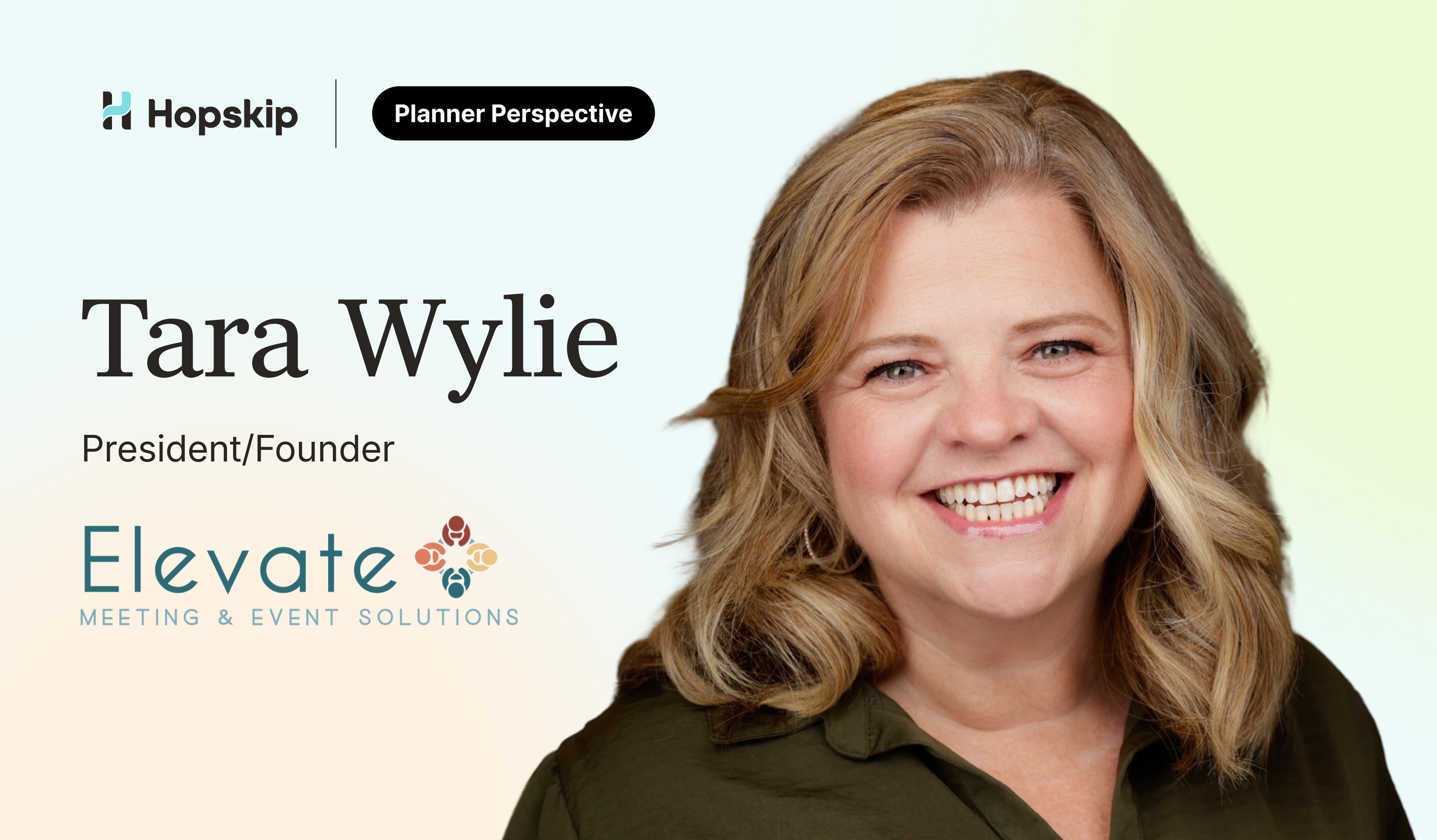
Some event emergencies give planners weeks of runway. Tara Wylie, President and Founder of Elevate Meeting & Event Solutions, once had eleven days to relocate an entire incentive trip to a new destination for safety reasons.
More on how that went shortly. First, how a marketing background and a frustration with unmeasurable ROI shaped an entire agency's approach to corporate events.
Founded to Close a Strategy Gap
Wylie started Elevate after recognizing a specific gap in the corporate events space: the need for strategic, well-executed experiences that actually align with business objectives. Plenty of organizations were hosting events, she noticed, without leveraging them as real tools for engagement, brand positioning, or measurable impact.
She wanted to build an agency that combined operational excellence with a clear understanding of client goals, delivering events that are seamless, yes, but also genuinely purposeful.
Pro tip: before your next event, write down the one business objective it's actually meant to serve, brand positioning, engagement, pipeline, retention, whatever it is. If you can't name it in one sentence, your client likely can't either, and that's worth fixing before the invitations go out.
The Mistake: Saying Yes to Almost Everything
Early on, Wylie said yes to nearly every opportunity that came her way, even when it wasn't the right fit. That led to projects that were harder than they needed to be, stretching her team and process well past what a mismatched client relationship should require.
The experience taught her the importance of qualifying clients, setting boundaries, and being honest upfront. The shift made the business healthier and the results stronger. Her philosophy now: always aim to please, but be honest about expectations from the very start.
Pro tip: build a short qualifying checklist you review before accepting any new client, covering fit, budget realism, and timeline feasibility. A five-minute check before signing saves weeks of friction later.
When the GSO Network Became the Whole Plan
Wylie's standout vendor story involves relocating an incentive trip to an entirely new destination within just eleven days, due to safety considerations at the original location. Leveraging her Global Sales Office network and expertise, she was able to quickly identify an alternative that matched the key attributes of the original program.
The GSO's extensive reach secured an exceptional property that demonstrated outstanding flexibility, service, and understanding under serious time pressure, ensuring a seamless transition without compromising the overall experience the client had originally signed up for.
Pro tip: build a relationship with at least one Global Sales Office contact before you need a rapid relocation. Their network reach during a genuine emergency is difficult to replicate through your own research alone, no matter how good your usual venue relationships are.
Attendee Experience as Intentional Hosting
Wylie's approach to attendee experience centers on intentional design and personalization. That starts with understanding the audience and aligning the experience with both their expectations and the client's objectives. From there, her team examines every touchpoint, registration, flow, content, and environment, to ensure it feels seamless, engaging, and welcoming.
Her planners are trained to take on the role of host or hostess, offering assistance before attendees have to ask for it. That forethought about what's needed, rather than reactive service, is what creates an experience that feels both professional and genuinely personal.
Pro tip: train your on-site team to scan for needs proactively rather than waiting to be approached. Offering help before it's requested reads as genuine hospitality in a way reactive service never quite matches.
Differentiating With a Business-First Approach
As a corporate planner with a marketing background, Wylie always struggled with the unmeasurable ROI of events, and that frustration became her differentiator. Rather than focusing solely on logistics, Elevate aligns every event with a client's actual objectives, whether that's brand positioning, employee engagement, or measurable return on investment.
Stakeholders, she's found, value not just flawless execution but the level of professionalism and strategic insight brought to every project. Logistics get you a well-run event. Strategy gets you a client who understands why the event mattered.
Pro tip: when pitching a new client, ask what metric they'll use to judge the event's success before you propose a single logistical detail. Starting with the metric keeps your entire plan oriented toward a result they'll actually recognize as success.
The Advice She'd Give Herself: Join Associations Sooner
Wylie's advice to other planners is to join industry associations sooner rather than later. Connections with suppliers, she stresses, are just as important as connections with clients, and associations offer strong value for both education and networking.
Pro tip: if cost is holding you back from an association membership, look specifically at their supplier-facing events first. Vendor relationships built through association networking often pay for the membership through better rates and faster emergency response alone.
The Trend Worth Watching: Data-Driven, Experience-Focused Events
Wylie sees rising demand for data-driven and experience-focused events. Clients are no longer satisfied with a simply well-run event. They want measurable engagement and insights, which means leveraging technology for attendee tracking, personalization, and post-event analytics.
At the same time, there's a growing expectation for meaningful, curated experiences that reflect company culture and values rather than generic formats. Days packed with back-to-back sessions are becoming stale. Wellness breaks, interactive components, and activations are increasingly the expectation, not the exception.
Pro tip: if your next agenda is still built entirely around back-to-back sessions, add one interactive or wellness-oriented break deliberately. It's often the easiest, lowest-cost upgrade to attendee satisfaction available.
The Devil Is in the Details, But Flexibility Is the Backup Plan
Wylie's core philosophy on planning is that success comes from strong foundations, clear timelines, defined roles, and consistent communication, but that things don't always go as planned regardless of preparation. Attention to fine details matters, but so does being prepared to change direction when needed.
Her guiding principle: you can't control what you can't control, but you can be ready and waiting when it shifts anyway.
Pro tip: build explicit decision-points into your planning timeline where you deliberately ask "has anything changed that requires a pivot?" rather than only reacting to changes as they surface unprompted.
Setting Expectations Through Transparency and Collaboration
From the first conversation, Wylie focuses on being transparent and detailed. She walks clients through what the planning process actually looks like, what's realistically achievable within their budget and timeline, and how communication will flow throughout. She also emphasizes collaboration explicitly: what she'll handle, and what she'll need from the client in return.
Setting these expectations early ensures there are no surprises later, and lets the team build an event that genuinely reflects the client's vision rather than a generic template.
Pro tip: state explicitly in your first client conversation what you need from them (approvals, content, decisions by certain dates), not just what you'll deliver. Clients rarely anticipate their own responsibilities unless you name them directly.
A Deep Breath, Then Quick Decisions
Asked about her go-to plan for emergencies, Wylie's honest answer starts with a big, deliberate deep breath, something she's specifically trained herself to do. No one wants an over-reactor managing a crisis, and her approach is rooted in experience from handling multiple issues throughout her career.
From there: clear communication and quick decision-making. Every event includes contingency planning for key risk areas, along with clear roles and escalation protocols for the team, including partners. During the event, her team stays closely connected with vendors and stakeholders through group chats, allowing real-time response. The priority is always resolving issues quickly and discreetly, minimizing impact on the attendee experience.
Pro tip: practice the physical pause, a breath, a beat, before responding to a crisis, in low-stakes situations first. It becomes far easier to access under real pressure once it's already a habit.
The Turning Point: Choosing Alignment Over Volume
The biggest turning point for Elevate came when Wylie decided to focus on a specific style and standard of experience rather than taking on every possible project. Showcasing that best work started attracting clients who genuinely valued quality and creativity, and referral business has been fantastic ever since, a direct testament to how showcasing strong work pays off.
That shift was sparked by realizing growth comes from alignment, not just volume, and that the right clients elevate both the work itself and the business behind it.
Pro tip: audit your portfolio for the projects you're proudest of, then ask whether your current marketing actually leads with those. Many agencies bury their best work behind a broader, more generic portfolio meant to appeal to everyone.
The City Takeover That Started as a Parking Garage
Wylie's most unconventional project began as a problem: a client's event outgrew its space entirely, with ticket sales far exceeding expectations. Rather than turning people away, her team worked with the venue to clear out the parking garage and build a fully immersive "city takeover" experience, complete with themed décor, interactive stations, food trucks, and a live performance.
At first, it seemed impossible. But thanks to a trusted vendor network, the team coordinated every element down to the smallest detail. Attendees were fully engaged, the client was thrilled, and the event delivered a unique, high-impact experience that attendees assumed had been the plan from the very start.
About Hopskip
Hopskip is a sourcing platform that connects event planners directly with hotels and DMOs through streamlined RFP management, cutting the manual back-and-forth out of finding the right venue, even under a tight deadline.
Planners on Hopskip save 30+ hours per RFP, get cleaner proposals faster, and have all the information they need to make confident venue decisions. The best part? It's free to start for planners. Book a demo today to get started.
Sources
- General industry commentary on demand for data-driven and experience-focused corporate events
- General reporting on trends away from back-to-back conference formats toward wellness and interactive programming