.svg)
Why Great Event Planners Trust Their Gut and Always Have a Backup Plan

Agency founder Tessa Lavoie shares how vendor trust, attendee-first design, contingency planning, and trusting your instincts build calmer, stronger events, backed by data.
Some event planners fall into the industry. Tessa Lavoie clawed her way out of a cubicle to build one.
After leading an award-nominated conference for a not-for-profit and then being told to sit tight and start planning next year's from the same 9-to-5 desk, Tessa decided she had outgrown the box. She launched Strategic Event Management Ltd. with a business partner, went all in, and then watched COVID cancel her entire calendar within weeks of taking the leap. Eight years later, the agency is still standing, and Tessa has opinions worth borrowing. Here is what nearly a decade of running the show has taught her about vendors, attendees, risk, and trusting the one thing most new planners ignore: their own instincts.
Treat Vendors Like Partners, Not Line Items
Ask Tessa about the closest she has come to a disaster, and she tells a story about a tent. A tent company the client specifically wanted pulled out at the last minute, taking a key piece of the event with it and leaving no easy replacement.
What saved the day was not luck. It was a decade of honest, transparent relationships. "I was able to pick up the phone and call someone I trust, and who trusts me," Tessa explains. "I explained the situation openly, no fluff, no finger pointing, just the reality of what we were dealing with." They stepped in and made it happen. That kind of favor, she is quick to point out, does not come from a last-minute ask. It comes from consistently treating vendors as true partners over years.
The data backs her up. In 2025, 85% of companies that invested in vendor relationships reported stronger partnerships, 72% of vendors said they were more likely to keep working with companies that treated them well, and 48% said that recognition made them more open to offering discounts. Meanwhile, nearly 30% of procurement leaders cite rising vendor costs as a top obstacle. Translation: the planners with real relationships get the callbacks, the flexibility, and the better rates. Everyone else gets voicemail.
Pro tip: Build the relationship before you need it. The favor you will one day desperately need is earned in all the ordinary interactions where you were honest, paid on time, and treated the vendor like a human. Bank that goodwill early, because you cannot cram for it the week of the event.
Attendee Experience Is a Mindset, Not a Feature
Tessa does not have an "attendee experience strategy" tucked into a slide deck somewhere. For her, it is baked into how every part of an event gets planned. "I'm always asking, will this make sense to someone walking in for the first time, will they know where to go, will the timing feel right, will anything cause friction?"
Her real skill is anticipating needs before they become problems: clear signage, realistic timelines, smooth transitions, and the right information delivered at the right moment. When the machinery hums quietly in the background, attendees stop thinking about logistics and simply stay present and engaged. "It's more a mindset of being thoughtful, practical, and always thinking a few steps ahead," she says.
That instinct maps neatly onto where the industry is heading. Attendees now expect experiences tailored to them rather than a single track everyone marches through, and personalized agenda planning ranks among attendees' top priorities in recent surveys. Yet many organizations still struggle to deliver it, often because attendee data sits scattered across disconnected systems and no one can see the full picture. Tessa's low-tech version of personalization, thinking carefully about how a real person moves through a real day, is a reminder that thoughtful design usually beats a flashy tool.
Pro tip: Walk the event as a first-time attendee, not as the planner who built it. Start in the parking lot and follow the exact path a guest will take. The friction you feel on that walk is the friction they will feel too, and it is a lot cheaper to fix a day early than in real time.
Watch the World, Not Just the Trend Reports
When asked about trends, Tessa pushes back on the premise. "Honestly, I wouldn't even call it a trend, it's more the reality we're operating in right now." Her answer is the geopolitical climate, and its knock-on effects on travel, pricing, supply chains, and the overall stability of international events.
She is reading the room correctly. Heading into 2026, 79% of business travel professionals name geopolitical instability as a top risk, and 56% of buyers said their organization changed its meetings or events strategy in a single quarter, with 26% shifting some events to virtual formats and others relocating to different markets entirely. Airfare, vendor costs, border considerations, and even attendee comfort with travel have all become far less predictable than they used to be.
Tessa's response is not to panic, but to plan differently: more flexibility, stronger contingency plans, and earlier, more honest conversations with clients about risk and budget fluctuations. It also reinforces the value of strong local networks. When plans shift, the right people on the ground make all the difference.
Pro tip: Have the uncomfortable "what if things change" conversation with your client at the start, not the middle. Building flexibility and contingency into the contract when everyone is calm is far easier than renegotiating when a border closes or a price spikes.
Trust Your Gut, Then Give It a Backup Plan
If there is one thread running through everything Tessa says, it is instinct. Her biggest early mistake was not a botched event. It was second-guessing the very gut that made her good at the job. "I would get a feeling that something might shift, a client might pull back, a scope might creep, or that we needed a backup plan in place, but I didn't always trust it."
Now she treats that instinct as an early-warning system. If something feels off, she digs in. If she senses a contract risk, she addresses it early rather than waiting for it to detonate. And she pairs the instinct with structure: vendor backups, weather plans, venue emergency protocols, and crystal-clear roles for her team when something needs to be actioned fast. During the event itself, she stays visibly calm, because clients should never feel the stress of what is being handled behind the scenes.
There is a reason this matters so much. Event planning consistently ranks among the most stressful jobs in the world, with O*NET rating the required stress tolerance at 95 out of 100, higher than many first responders. The single best antidote the research keeps pointing to is preparation. Knowing you have thought through the hiccups is what lets you stay composed when one actually arrives.
Pro tip: When your gut flags something, write it down and assign it a backup plan on the spot. The instinct is only half the value. The other half is doing something about it before the feeling proves itself right at the worst possible moment.
Lead With the "Why," and Take Yourself Seriously
Tessa sets client expectations the same way she manages vendors: with honesty from the first conversation. She refuses to overpromise to win the work, preferring to be upfront about what is realistic and where challenges might surface. The secret weapon is explaining the reasoning. "When people understand the why, it builds trust quickly," she says. Sponsors and stakeholders get walked through the logic behind a decision rather than a generic deflection.
Her advice to newer planners is more personal, and a little pointed. This is a real career, she insists, even if people still reduce it to "oh, you plan parties." "There is a professional behind it making it all happen," she says, and the sooner planners stop downplaying their own expertise, the sooner they show up with the confidence that makes them genuinely good. "Trust that, and you make clearer decisions, you communicate with more confidence, and you lead your clients and teams more effectively."
Which brings the whole thing full circle. The founder who once second-guessed her instinct now runs an eight-year-old agency that survived a pandemic by pivoting to virtual events overnight, learning the format from scratch, and treating the crisis as an opportunity rather than a setback. The turning point, she notes, was never COVID itself. It was the decision to adapt. "Being flexible isn't just a reaction, it's a strategy."
Pro tip: The next time someone calls your work "party planning," resist the urge to shrink. Name the strategy, the budgets, and the risk management involved. How seriously you treat your role quietly trains everyone around you to treat it seriously too.
Start Your Venue Search on Hopskip
Tessa's whole philosophy rests on trust, transparency, and having the right information to make confident decisions. That is exactly the problem Hopskip was built to solve.
Planners on Hopskip save 30+ hours per RFP, get cleaner proposals faster, and have all the information they need to make confident venue decisions. The best part? It's free to start for planners. Book a demo today to get started.
Sources
- Amra & Elma: Top 20 Vendor Party Marketing Statistics 2025
- Precoro: Vendor Relations, Strategies to Build Lasting Partnerships
- GBTA: Global Business Travel Continues but Confidence Drops Sharply for 2026
- Bizzabo: The Ultimate Guide to Event Personalization in 2025 & Beyond
- Eventcombo: Event Attendee Journey Personalization Guide 2026
- Convene: Event Planning Is One of the Most Stressful Jobs in the World
- Cvent: Event Coordinators Have the 5th Most Stressful Job in America
Curabitur bibendum ad viverra eu fringilla ad eu. Eget placerat ultricies quis amet mattis himenaeos ullamcorper facilisi volutpat.
Start for free
Send your first one for free.

Why Great Event Planners Trust Their Gut and Always Have a Backup Plan
Agency founder Tessa Lavoie shares how vendor trust, attendee-first design, contingency planning, and trusting your instincts build calmer, stronger events, backed by data.
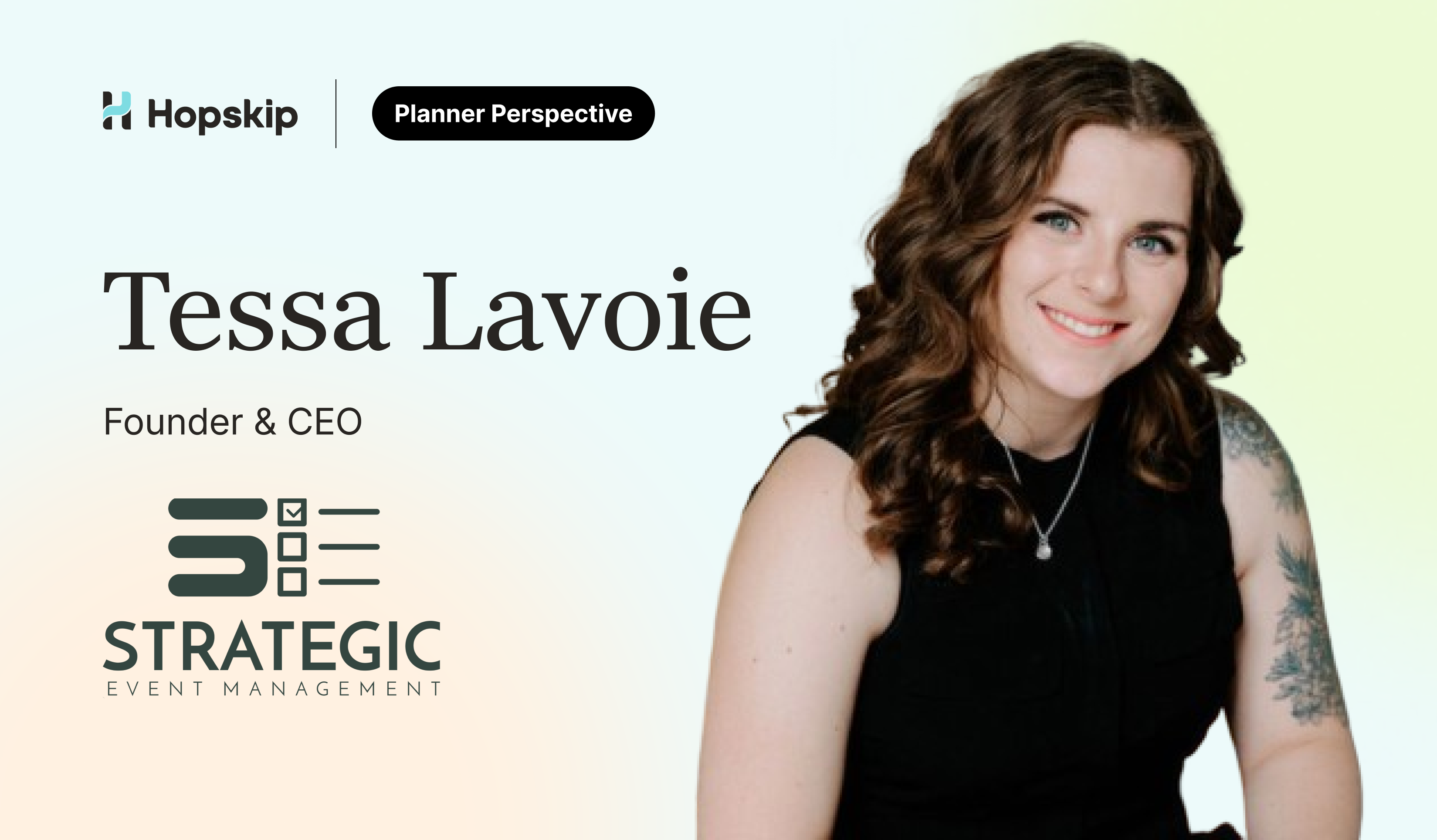
Some event planners fall into the industry. Tessa Lavoie clawed her way out of a cubicle to build one.
After leading an award-nominated conference for a not-for-profit and then being told to sit tight and start planning next year's from the same 9-to-5 desk, Tessa decided she had outgrown the box. She launched Strategic Event Management Ltd. with a business partner, went all in, and then watched COVID cancel her entire calendar within weeks of taking the leap. Eight years later, the agency is still standing, and Tessa has opinions worth borrowing. Here is what nearly a decade of running the show has taught her about vendors, attendees, risk, and trusting the one thing most new planners ignore: their own instincts.
Treat Vendors Like Partners, Not Line Items
Ask Tessa about the closest she has come to a disaster, and she tells a story about a tent. A tent company the client specifically wanted pulled out at the last minute, taking a key piece of the event with it and leaving no easy replacement.
What saved the day was not luck. It was a decade of honest, transparent relationships. "I was able to pick up the phone and call someone I trust, and who trusts me," Tessa explains. "I explained the situation openly, no fluff, no finger pointing, just the reality of what we were dealing with." They stepped in and made it happen. That kind of favor, she is quick to point out, does not come from a last-minute ask. It comes from consistently treating vendors as true partners over years.
The data backs her up. In 2025, 85% of companies that invested in vendor relationships reported stronger partnerships, 72% of vendors said they were more likely to keep working with companies that treated them well, and 48% said that recognition made them more open to offering discounts. Meanwhile, nearly 30% of procurement leaders cite rising vendor costs as a top obstacle. Translation: the planners with real relationships get the callbacks, the flexibility, and the better rates. Everyone else gets voicemail.
Pro tip: Build the relationship before you need it. The favor you will one day desperately need is earned in all the ordinary interactions where you were honest, paid on time, and treated the vendor like a human. Bank that goodwill early, because you cannot cram for it the week of the event.
Attendee Experience Is a Mindset, Not a Feature
Tessa does not have an "attendee experience strategy" tucked into a slide deck somewhere. For her, it is baked into how every part of an event gets planned. "I'm always asking, will this make sense to someone walking in for the first time, will they know where to go, will the timing feel right, will anything cause friction?"
Her real skill is anticipating needs before they become problems: clear signage, realistic timelines, smooth transitions, and the right information delivered at the right moment. When the machinery hums quietly in the background, attendees stop thinking about logistics and simply stay present and engaged. "It's more a mindset of being thoughtful, practical, and always thinking a few steps ahead," she says.
That instinct maps neatly onto where the industry is heading. Attendees now expect experiences tailored to them rather than a single track everyone marches through, and personalized agenda planning ranks among attendees' top priorities in recent surveys. Yet many organizations still struggle to deliver it, often because attendee data sits scattered across disconnected systems and no one can see the full picture. Tessa's low-tech version of personalization, thinking carefully about how a real person moves through a real day, is a reminder that thoughtful design usually beats a flashy tool.
Pro tip: Walk the event as a first-time attendee, not as the planner who built it. Start in the parking lot and follow the exact path a guest will take. The friction you feel on that walk is the friction they will feel too, and it is a lot cheaper to fix a day early than in real time.
Watch the World, Not Just the Trend Reports
When asked about trends, Tessa pushes back on the premise. "Honestly, I wouldn't even call it a trend, it's more the reality we're operating in right now." Her answer is the geopolitical climate, and its knock-on effects on travel, pricing, supply chains, and the overall stability of international events.
She is reading the room correctly. Heading into 2026, 79% of business travel professionals name geopolitical instability as a top risk, and 56% of buyers said their organization changed its meetings or events strategy in a single quarter, with 26% shifting some events to virtual formats and others relocating to different markets entirely. Airfare, vendor costs, border considerations, and even attendee comfort with travel have all become far less predictable than they used to be.
Tessa's response is not to panic, but to plan differently: more flexibility, stronger contingency plans, and earlier, more honest conversations with clients about risk and budget fluctuations. It also reinforces the value of strong local networks. When plans shift, the right people on the ground make all the difference.
Pro tip: Have the uncomfortable "what if things change" conversation with your client at the start, not the middle. Building flexibility and contingency into the contract when everyone is calm is far easier than renegotiating when a border closes or a price spikes.
Trust Your Gut, Then Give It a Backup Plan
If there is one thread running through everything Tessa says, it is instinct. Her biggest early mistake was not a botched event. It was second-guessing the very gut that made her good at the job. "I would get a feeling that something might shift, a client might pull back, a scope might creep, or that we needed a backup plan in place, but I didn't always trust it."
Now she treats that instinct as an early-warning system. If something feels off, she digs in. If she senses a contract risk, she addresses it early rather than waiting for it to detonate. And she pairs the instinct with structure: vendor backups, weather plans, venue emergency protocols, and crystal-clear roles for her team when something needs to be actioned fast. During the event itself, she stays visibly calm, because clients should never feel the stress of what is being handled behind the scenes.
There is a reason this matters so much. Event planning consistently ranks among the most stressful jobs in the world, with O*NET rating the required stress tolerance at 95 out of 100, higher than many first responders. The single best antidote the research keeps pointing to is preparation. Knowing you have thought through the hiccups is what lets you stay composed when one actually arrives.
Pro tip: When your gut flags something, write it down and assign it a backup plan on the spot. The instinct is only half the value. The other half is doing something about it before the feeling proves itself right at the worst possible moment.
Lead With the "Why," and Take Yourself Seriously
Tessa sets client expectations the same way she manages vendors: with honesty from the first conversation. She refuses to overpromise to win the work, preferring to be upfront about what is realistic and where challenges might surface. The secret weapon is explaining the reasoning. "When people understand the why, it builds trust quickly," she says. Sponsors and stakeholders get walked through the logic behind a decision rather than a generic deflection.
Her advice to newer planners is more personal, and a little pointed. This is a real career, she insists, even if people still reduce it to "oh, you plan parties." "There is a professional behind it making it all happen," she says, and the sooner planners stop downplaying their own expertise, the sooner they show up with the confidence that makes them genuinely good. "Trust that, and you make clearer decisions, you communicate with more confidence, and you lead your clients and teams more effectively."
Which brings the whole thing full circle. The founder who once second-guessed her instinct now runs an eight-year-old agency that survived a pandemic by pivoting to virtual events overnight, learning the format from scratch, and treating the crisis as an opportunity rather than a setback. The turning point, she notes, was never COVID itself. It was the decision to adapt. "Being flexible isn't just a reaction, it's a strategy."
Pro tip: The next time someone calls your work "party planning," resist the urge to shrink. Name the strategy, the budgets, and the risk management involved. How seriously you treat your role quietly trains everyone around you to treat it seriously too.
Start Your Venue Search on Hopskip
Tessa's whole philosophy rests on trust, transparency, and having the right information to make confident decisions. That is exactly the problem Hopskip was built to solve.
Planners on Hopskip save 30+ hours per RFP, get cleaner proposals faster, and have all the information they need to make confident venue decisions. The best part? It's free to start for planners. Book a demo today to get started.
Sources
- Amra & Elma: Top 20 Vendor Party Marketing Statistics 2025
- Precoro: Vendor Relations, Strategies to Build Lasting Partnerships
- GBTA: Global Business Travel Continues but Confidence Drops Sharply for 2026
- Bizzabo: The Ultimate Guide to Event Personalization in 2025 & Beyond
- Eventcombo: Event Attendee Journey Personalization Guide 2026
- Convene: Event Planning Is One of the Most Stressful Jobs in the World
- Cvent: Event Coordinators Have the 5th Most Stressful Job in America


.svg)