.svg)
Design for Connection, Not Just Content: An Event Planner's Playbook

Event planner Alexis Dean of Two Roads Team Building shares how to design for connection, build vendor partnerships that prevent crises, and create events people actually remember.
Ask most people what they remember about a conference they attended last year, and they will not recite Slide 27. They will tell you about the person they met at lunch, the conversation that changed their thinking, or the moment a session finally felt like it was built for humans and not for a projector. That gap between what planners obsess over and what attendees actually keep is the throughline in the work of Alexis Dean, founder of Two Roads Team Building and Training, a Canadian agency that designs experiential leadership and team-building programs grounded in research on human behavior.
Dean's core philosophy is refreshingly blunt: design for connection as intentionally as you design for content. Below are the ideas from her playbook that any event planner can borrow, backed by a little data to prove she is onto something.
The Best Vendor Relationships Prevent Crises Rather Than Save Them
Dean is quick to admit she does not have a dramatic vendor rescue story involving a power outage or a missing keynote speaker. What she has instead is a long roster of venue partners, AV teams, coordinators, and caterers who quietly stop small issues from ever becoming big ones. In her view, that is precisely what a great partnership looks like. The vendors worth keeping are not the ones who heroically save the day; they are the ones who make sure the day never needs saving.
It is a useful reframe, because the industry loves a good disaster-averted anecdote. But the quiet, boring, nothing-went-wrong event is usually the product of relationships built long before the doors opened. Trust and communication do more heavy lifting than adrenaline ever will.
Pro tip: Score your vendors on how few surprises they create, not just how gracefully they handle them. The best partner is the one whose section of the run-of-show you never have to think about.
Design for Connection as Deliberately as You Design the Agenda
If there is one line to tattoo on the inside of every planner's binder, Dean would nominate this one: people rarely remember every slide or statistic, but they remember how an event made them feel and who they connected with along the way. Content matters, but connection is what survives the drive home.
The data backs her up emphatically. Roughly 83% of attendees say networking opportunities influence their decision to attend an event, and 87% of organizers rate networking as very important to an event's success. Yet only about 15% of organizers rate their own networking opportunities as very effective, which means most events are leaving their most memorable moments to chance.
Dean's fix is to treat connection as a design problem, not a coffee break. That means intentionally engineering moments for people to reflect, contribute, and collaborate, and paying close attention to energy, pacing, and psychological safety so attendees actually feel comfortable participating. How a session opens, how discussions are facilitated, and how quieter voices get invited into the room all shape whether real connection happens or whether everyone just checks their phones.
Pro tip: Build at least one structured connection moment into every block of your agenda. Unstructured "networking time" often becomes "everyone stands near the snacks looking at their inbox" time.
Trade Passive Consumption for Participation
Dean's programs are built on a simple observation about how adults actually learn: they do not absorb much by sitting still. Two Roads deliberately moves beyond "death by PowerPoint" toward experiences where participants learn by doing, reflecting, discussing, and applying. It is not a stylistic preference; it is a performance strategy.
The research on this is almost unfair to the lecture format. Studies on experiential learning have found retention rates of roughly 75% of concepts six months later, compared with about 20% for passive learning, and knowledge retention improvements of 68% versus 29% for traditional approaches. The Journal of Applied Psychology has found experiential methods roughly twice as effective at developing skills as passive ones. If your goal is for attendees to remember and use anything after the event, participation is not the fun extra; it is the whole point.
For planners, the takeaway extends well beyond training sessions. Panels, keynotes, and breakouts all get stickier when the audience has something to do besides nod.
Pro tip: For every session, ask, "What will attendees actually do here?" If the honest answer is "listen," find one place to swap consumption for contribution.
Prepare for Emergencies Before They Exist
Dean's approach to event-day chaos is almost anticlimactic: the best way to handle emergencies is to prepare for them before they happen. Two Roads maps the schedule, logistics, technology needs, and potential risks with clients and venues ahead of time, then shows up with backup plans, contingency activities, extra materials, and the flexibility to adapt. When something does go sideways, the team stays calm, communicates clearly, and solves it without radiating stress, because participants take their emotional cues from whoever is leading the room.
Seasoned planners will recognize this as basic risk hygiene, and the numbers support building it into the budget rather than hoping for the best. A common rule of thumb is to earmark roughly 10 to 15% of an event budget for contingencies, with clear communication channels and step-by-step responses mapped for the usual suspects: power outages, tech failures, transportation snags, and speaker cancellations. Preparation is not pessimism. It is what lets you look effortless.
Pro tip: Keep a one-page contingency sheet for the three failures most likely at your specific event. If you can hand it to a stranger and they could execute it, you are genuinely ready.
Grow by Trusting People and Building Systems
Dean is candid about the mistake that shaped how she runs Two Roads today: for years, she tried to do everything herself. Facilitator, salesperson, designer, project manager, marketer, and administrator all rolled into one. It worked in the early days and then became the bottleneck, as one-person dependencies always do. It took becoming a parent to force the reckoning and to reveal exactly where the business needed stronger systems, processes, and support.
Her advice to a younger version of herself, and to anyone building an agency, is to trust great people, delegate sooner, and spend more time working on the business rather than in it. Sustainable growth comes from repeatable systems and empowered people, not from heroics and a full inbox. It is a lesson that applies just as neatly to a solo planner drowning in spreadsheets as it does to an agency owner.
Pro tip: Audit where you are the single point of failure. Every task that only you can do is a cap on how much you can grow, and usually a candidate for a system or a smart hire.
The Trend Dean Says Planners Should Take Seriously
Asked what deserves planners' attention right now, Dean points to the growing hunger for meaningful human connection. In a world of remote work, hybrid teams, and constant notifications, people are craving authentic ways to build trust and belonging, not just more information to consume. She argues that successful events are increasingly measured by the quality of the connections and conversations they spark rather than by the polish of the speakers alone.
The market agrees. About 95% of professionals say face-to-face meetings are essential for building long-term business relationships, and two-thirds of attendees report a better impression of a brand after meeting in person. Technology and AI will keep advancing, but the ability to bring people together in a room and make it matter is becoming more valuable, not less. For planners willing to design for it, that is a genuine competitive edge.
Pro tip: Make connection a measurable event goal. Survey attendees on the relationships and ideas they took away, not only their satisfaction score, and design next year around what you learn.
Key Takeaways for Event Planners
The best vendor partners prevent problems rather than dramatically solve them, so choose for reliability over heroics. Connection outlasts content, so engineer moments for people to meet and engage as deliberately as you build the agenda. Participation beats passive consumption every time the goal is retention. Emergencies are best handled through preparation and a calm room, not improvisation. And sustainable growth comes from trusting people and building systems rather than doing it all yourself.
About Hopskip
Hopskip is the modern sourcing and RFP platform built for event planners. It helps planners find the right venues, send cleaner RFPs, and compare proposals side by side, so they can spend less time chasing paperwork and more time designing the connection-rich experiences Dean champions.
Planners on Hopskip save 30+ hours per RFP, get cleaner proposals faster, and have all the information they need to make confident venue decisions. The best part? It's free to start for planners. Book a demo today to get started.
Sources
- Bizzabo — 2026 Event Marketing Statistics, Trends, and Benchmarks
- Bizzabo — The Future of Event Networking
- Wave Connect — Networking Statistics 2025
- Gitnux — Experiential Learning Statistics: Market Data Report 2026
- Yoodli — Why Experiential Learning Outperforms Passive Learning
- Growth Engineering — What Is Experiential Learning?
- Eventcombo — Contingency Planning and Risk Management in Events
- SafetyCulture — Event Risk Management: The Ultimate Guide
Curabitur bibendum ad viverra eu fringilla ad eu. Eget placerat ultricies quis amet mattis himenaeos ullamcorper facilisi volutpat.
Start for free
Send your first one for free.

Design for Connection, Not Just Content: An Event Planner's Playbook
Event planner Alexis Dean of Two Roads Team Building shares how to design for connection, build vendor partnerships that prevent crises, and create events people actually remember.
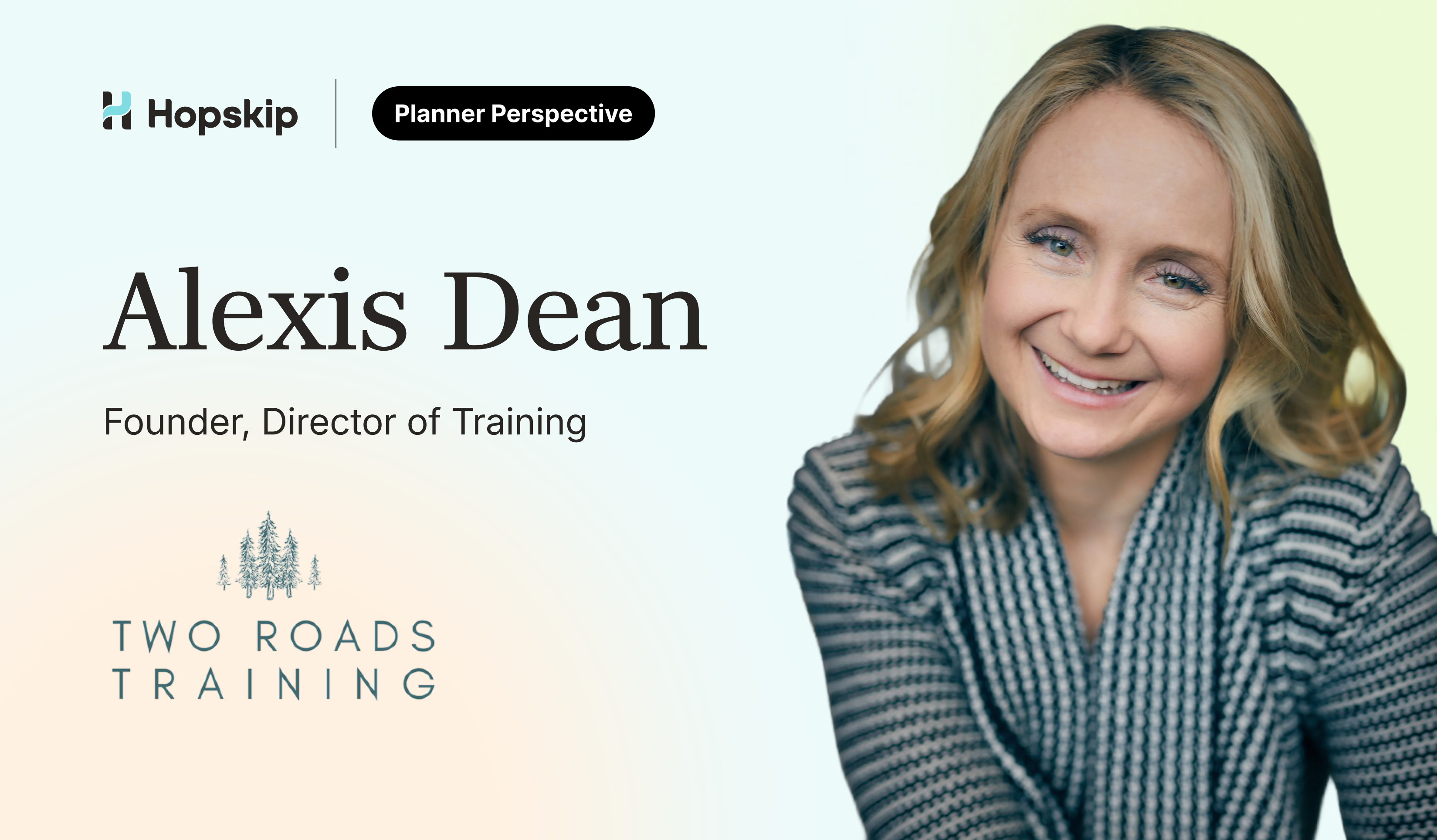
Ask most people what they remember about a conference they attended last year, and they will not recite Slide 27. They will tell you about the person they met at lunch, the conversation that changed their thinking, or the moment a session finally felt like it was built for humans and not for a projector. That gap between what planners obsess over and what attendees actually keep is the throughline in the work of Alexis Dean, founder of Two Roads Team Building and Training, a Canadian agency that designs experiential leadership and team-building programs grounded in research on human behavior.
Dean's core philosophy is refreshingly blunt: design for connection as intentionally as you design for content. Below are the ideas from her playbook that any event planner can borrow, backed by a little data to prove she is onto something.
The Best Vendor Relationships Prevent Crises Rather Than Save Them
Dean is quick to admit she does not have a dramatic vendor rescue story involving a power outage or a missing keynote speaker. What she has instead is a long roster of venue partners, AV teams, coordinators, and caterers who quietly stop small issues from ever becoming big ones. In her view, that is precisely what a great partnership looks like. The vendors worth keeping are not the ones who heroically save the day; they are the ones who make sure the day never needs saving.
It is a useful reframe, because the industry loves a good disaster-averted anecdote. But the quiet, boring, nothing-went-wrong event is usually the product of relationships built long before the doors opened. Trust and communication do more heavy lifting than adrenaline ever will.
Pro tip: Score your vendors on how few surprises they create, not just how gracefully they handle them. The best partner is the one whose section of the run-of-show you never have to think about.
Design for Connection as Deliberately as You Design the Agenda
If there is one line to tattoo on the inside of every planner's binder, Dean would nominate this one: people rarely remember every slide or statistic, but they remember how an event made them feel and who they connected with along the way. Content matters, but connection is what survives the drive home.
The data backs her up emphatically. Roughly 83% of attendees say networking opportunities influence their decision to attend an event, and 87% of organizers rate networking as very important to an event's success. Yet only about 15% of organizers rate their own networking opportunities as very effective, which means most events are leaving their most memorable moments to chance.
Dean's fix is to treat connection as a design problem, not a coffee break. That means intentionally engineering moments for people to reflect, contribute, and collaborate, and paying close attention to energy, pacing, and psychological safety so attendees actually feel comfortable participating. How a session opens, how discussions are facilitated, and how quieter voices get invited into the room all shape whether real connection happens or whether everyone just checks their phones.
Pro tip: Build at least one structured connection moment into every block of your agenda. Unstructured "networking time" often becomes "everyone stands near the snacks looking at their inbox" time.
Trade Passive Consumption for Participation
Dean's programs are built on a simple observation about how adults actually learn: they do not absorb much by sitting still. Two Roads deliberately moves beyond "death by PowerPoint" toward experiences where participants learn by doing, reflecting, discussing, and applying. It is not a stylistic preference; it is a performance strategy.
The research on this is almost unfair to the lecture format. Studies on experiential learning have found retention rates of roughly 75% of concepts six months later, compared with about 20% for passive learning, and knowledge retention improvements of 68% versus 29% for traditional approaches. The Journal of Applied Psychology has found experiential methods roughly twice as effective at developing skills as passive ones. If your goal is for attendees to remember and use anything after the event, participation is not the fun extra; it is the whole point.
For planners, the takeaway extends well beyond training sessions. Panels, keynotes, and breakouts all get stickier when the audience has something to do besides nod.
Pro tip: For every session, ask, "What will attendees actually do here?" If the honest answer is "listen," find one place to swap consumption for contribution.
Prepare for Emergencies Before They Exist
Dean's approach to event-day chaos is almost anticlimactic: the best way to handle emergencies is to prepare for them before they happen. Two Roads maps the schedule, logistics, technology needs, and potential risks with clients and venues ahead of time, then shows up with backup plans, contingency activities, extra materials, and the flexibility to adapt. When something does go sideways, the team stays calm, communicates clearly, and solves it without radiating stress, because participants take their emotional cues from whoever is leading the room.
Seasoned planners will recognize this as basic risk hygiene, and the numbers support building it into the budget rather than hoping for the best. A common rule of thumb is to earmark roughly 10 to 15% of an event budget for contingencies, with clear communication channels and step-by-step responses mapped for the usual suspects: power outages, tech failures, transportation snags, and speaker cancellations. Preparation is not pessimism. It is what lets you look effortless.
Pro tip: Keep a one-page contingency sheet for the three failures most likely at your specific event. If you can hand it to a stranger and they could execute it, you are genuinely ready.
Grow by Trusting People and Building Systems
Dean is candid about the mistake that shaped how she runs Two Roads today: for years, she tried to do everything herself. Facilitator, salesperson, designer, project manager, marketer, and administrator all rolled into one. It worked in the early days and then became the bottleneck, as one-person dependencies always do. It took becoming a parent to force the reckoning and to reveal exactly where the business needed stronger systems, processes, and support.
Her advice to a younger version of herself, and to anyone building an agency, is to trust great people, delegate sooner, and spend more time working on the business rather than in it. Sustainable growth comes from repeatable systems and empowered people, not from heroics and a full inbox. It is a lesson that applies just as neatly to a solo planner drowning in spreadsheets as it does to an agency owner.
Pro tip: Audit where you are the single point of failure. Every task that only you can do is a cap on how much you can grow, and usually a candidate for a system or a smart hire.
The Trend Dean Says Planners Should Take Seriously
Asked what deserves planners' attention right now, Dean points to the growing hunger for meaningful human connection. In a world of remote work, hybrid teams, and constant notifications, people are craving authentic ways to build trust and belonging, not just more information to consume. She argues that successful events are increasingly measured by the quality of the connections and conversations they spark rather than by the polish of the speakers alone.
The market agrees. About 95% of professionals say face-to-face meetings are essential for building long-term business relationships, and two-thirds of attendees report a better impression of a brand after meeting in person. Technology and AI will keep advancing, but the ability to bring people together in a room and make it matter is becoming more valuable, not less. For planners willing to design for it, that is a genuine competitive edge.
Pro tip: Make connection a measurable event goal. Survey attendees on the relationships and ideas they took away, not only their satisfaction score, and design next year around what you learn.
Key Takeaways for Event Planners
The best vendor partners prevent problems rather than dramatically solve them, so choose for reliability over heroics. Connection outlasts content, so engineer moments for people to meet and engage as deliberately as you build the agenda. Participation beats passive consumption every time the goal is retention. Emergencies are best handled through preparation and a calm room, not improvisation. And sustainable growth comes from trusting people and building systems rather than doing it all yourself.
About Hopskip
Hopskip is the modern sourcing and RFP platform built for event planners. It helps planners find the right venues, send cleaner RFPs, and compare proposals side by side, so they can spend less time chasing paperwork and more time designing the connection-rich experiences Dean champions.
Planners on Hopskip save 30+ hours per RFP, get cleaner proposals faster, and have all the information they need to make confident venue decisions. The best part? It's free to start for planners. Book a demo today to get started.
Sources
- Bizzabo — 2026 Event Marketing Statistics, Trends, and Benchmarks
- Bizzabo — The Future of Event Networking
- Wave Connect — Networking Statistics 2025
- Gitnux — Experiential Learning Statistics: Market Data Report 2026
- Yoodli — Why Experiential Learning Outperforms Passive Learning
- Growth Engineering — What Is Experiential Learning?
- Eventcombo — Contingency Planning and Risk Management in Events
- SafetyCulture — Event Risk Management: The Ultimate Guide


.svg)