.svg)
How to Plan Large-Scale Trade Show Events: 15 Years of Lessons From the Market Floor

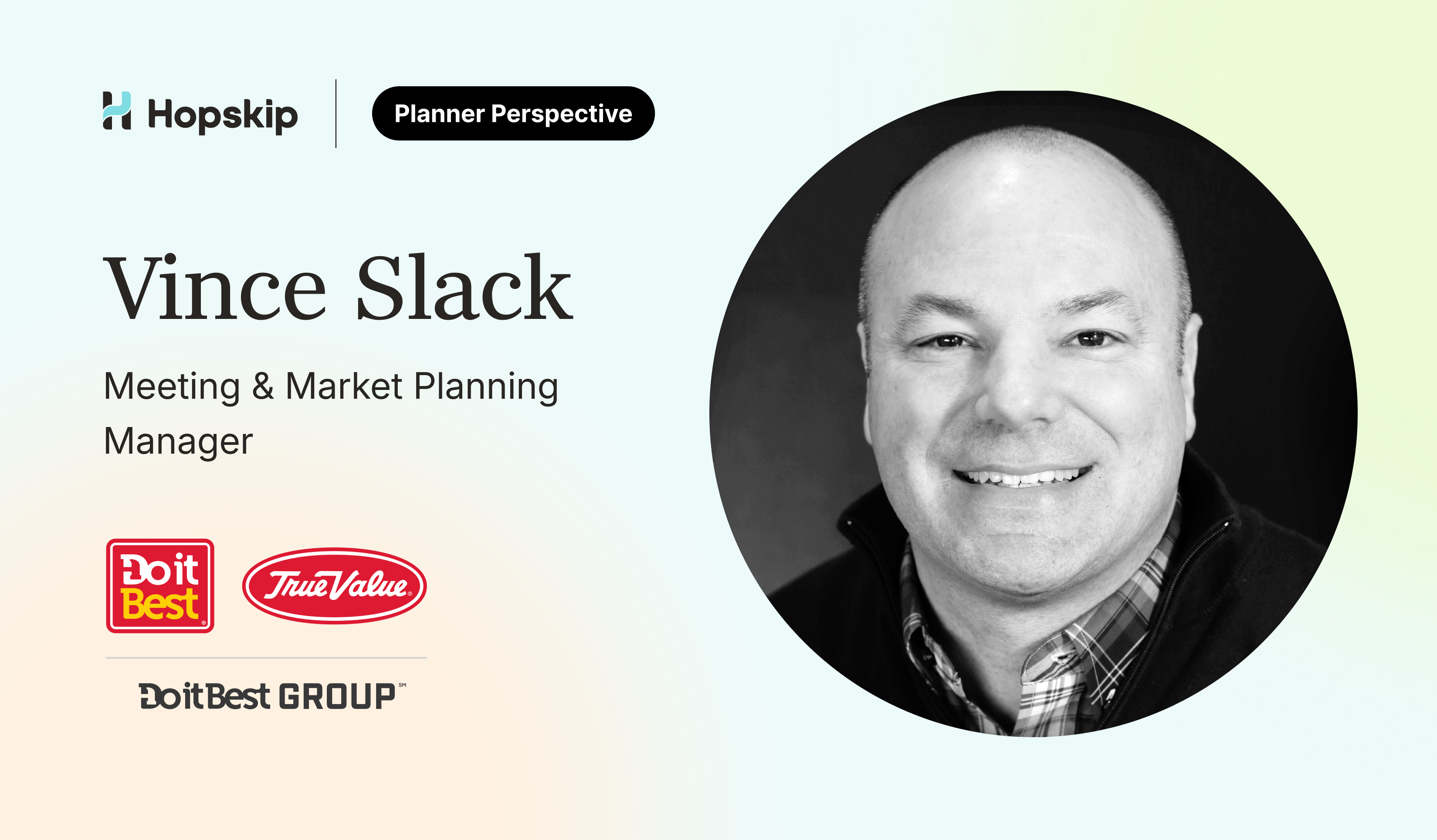
Vince Slack has spent 15 years planning Do it Best Group’s biannual Markets for tens of thousands of independent retailers. Here’s how he handles crises, builds vendor partnerships, and measures success at scale.
Most event planners spend their careers hoping to one day manage an event with 10,000 attendees. Vince Slack has been doing it twice a year for 15 years.
As Market Planning Manager at Do it Best Group — the world’s largest hardware, lumber, and building materials buying cooperative — Vince oversees the biannual Markets that bring together tens of thousands of independent retailers, vendors, and industry leaders for multi-day buying events spanning hundreds of thousands of square feet of exhibit space. These aren’t just conferences. They’re buying shows, education programs, general sessions, concerts, theme park nights, and networking receptions — all wrapped into a single event footprint.
Before Do it Best, Vince cut his teeth in Sports Marketing, leading the Group Sales Department for the Fort Wayne Wizards minor league baseball team. That’s where he learned to manage detail-oriented projects under pressure and build strong cross-functional teams. Both skills, he’ll tell you, have served him every single day since.
Here’s what 15 years of planning world-class Markets has taught him.
A Ceiling Collapsed the Night Before. Here’s What He Did.
Ask Vince about event crises and he doesn’t hesitate — he has plenty to choose from. Outdoor events rained out. Registration desks losing power with hundreds of people in line. A portion of a ballroom ceiling collapsing the evening before a major event.
His advice for handling all of it is the same: stay calm, cool, and collected.
“Lead by example so your team does not panic and so that attendees play off your calming influence and mirror your behavior,” he says. “Remain calm, cool and collected while managing the situation.”
The other half of crisis readiness is building the right team around you long before anything goes wrong. Vince is deliberate about knowing who to call — and making sure those relationships are warm before you need them. Your A/V partner, security, the convention center event coordinator, the general contractor — all of them become critical when something breaks. Knowing their names, their roles, and their direct lines isn’t a nice-to-have. It’s a requirement.
Pro tip: Map your crisis contacts before your event opens. A simple document with names, roles, and emergency numbers — shared with your core team — can shave critical minutes off your response time when things go sideways.
How Do You Make an Event Feel Like Something for Everyone?
Do it Best Markets aren’t a single event. They’re a collection of events that happen to run simultaneously. There’s the buying show on the exhibit floor, education sessions throughout the day, general sessions, evening receptions, concerts, and special events at local venues — including theme parks and puppy cuddling booths on the Market floor.
That breadth is intentional.
“One key strategy for enhancing the attendee experience is to offer a wide variety of options,” Vince explains. “There’s something for everyone, even including families with children of all ages.”
The goal isn’t just to fill a schedule. It’s to ensure that whether someone is a veteran retailer attending their fifteenth Market or a store owner’s teenage kid tagging along, they find something that holds their attention and makes the trip feel worthwhile.
Pro tip: When mapping your event program, identify your core audience segments and ask whether each one has at least one session, experience, or activation built specifically for them. If you find gaps, that’s your programming roadmap.
The Organizing System Behind Events of This Scale
Running a biannual event of this size requires more than a checklist. Vince’s team maintains two core documents: a detailed Timeline spreadsheet covering all tasks and deadlines across multiple divisions of the company, and a Market Planning-specific Task List that captures everything their department alone is responsible for before, during, and after each Market.
The Timeline isn’t just internal. It functions as a communication tool — a shared artifact that keeps the entire organization aligned on what’s happening and when.
For external stakeholders — members, retailers, and prospective attendees — the team uses a dedicated Market website and email communications to keep everyone informed about housing and registration openings, the agenda, and transportation options.
“We utilize the Timeline and Task List in addition to frequent meetings and constant communication,” Vince says.
Pro tip: If your planning tool only lives in one person’s inbox, it’s a liability. A shared, version-controlled timeline that every division can access and reference removes ambiguity and reduces the back-and-forth that slows teams down.
Creating Networking Moments at Scale
Networking at an event with 10,000+ attendees could easily become anonymous and transactional. Vince’s approach ensures it doesn’t.
The exhibit floor itself functions as a primary networking space — the nature of a buying show means members are constantly running into each other, rekindling relationships as they move between vendor booths. But Vince also designs structured receptions throughout each Market to give those interactions a more intentional setting.
“Food and beverage along with music is always a good tactic to facilitate networking,” he says. Multiple receptions across the event schedule give attendees repeated opportunities to connect in casual environments — not just one formal dinner that half the room misses.
Pro tip: Don’t rely on a single networking event to do all the work. Distribute informal, low-barrier opportunities across your agenda so attendees can connect on their own timeline, not just yours.
How Do it Best Selects Venues at This Scale
With events this large, venue selection isn’t browsing a website and sending an RFP. Vince’s team works with their long-time partner, BlueSkyz — a full-service meeting management technology company with over 35 years of experience in site selection, housing, and registration — to narrow their search efficiently.
“BlueSkyz knows our programs extremely well and is therefore able to help us narrow our search very quickly,” Vince says. The process starts with destination first, then moves to a curated pool of specific properties. From there, the team conducts in-person site visits to evaluate properties firsthand before committing.
The criteria aren’t just capacity and rates. Vince looks for properties that are familiar with the co-op business model, understand the specific needs of their group, and have demonstrated a willingness to be a genuine long-term partner.
“We love to take advantage of the relationships BlueSkyz has built as well as the ones we’ve developed over the years,” he adds.
Pro tip: If you’re planning events with complex housing and registration needs, partnering with a firm that already knows your program and your preferences saves significant time. The institutional knowledge a long-term partner carries is often worth more than the cost of switching.
The Tech Stack Running It All
For an event of this complexity, the technology infrastructure has to be equally sophisticated. Vince’s team uses BlueSkyz’s proprietary housing and registration software — a platform they’ve built long-term familiarity with — alongside Map Your Show for booth space sales, sponsorship management, and floorplan design.
Post-event, the team relies on hard data to close the loop. RFID-encoded badges capture actual attendance figures, and the team runs reports to verify registration numbers against attendance data. Every invoice gets reviewed line-by-line for accuracy before payment.
“As each final invoice comes in, we meticulously review them for accuracy prior to paying each one and reconciling the budget,” Vince says.
Pro tip: Build your invoice review process into your post-event timeline before the event happens. Knowing which vendors submit when — and who on your team is responsible for review — prevents the budget reconciliation scramble that hits most teams in the weeks after an event closes.
Measuring Success: The Two Numbers That Matter Most
For Do it Best Markets, success isn’t measured by net promoter scores or session ratings alone. Vince tracks two primary KPIs: attendance by existing members and retailers, and sales generated.
“We always like to see our numbers grow in regard to the number of stores attended, badges issued, and sales generated,” he says.
That clarity matters. When you’re planning an event of this scale, having two anchor KPIs makes it easier to make decisions — about programming investments, venue upgrades, and vendor partnerships — without losing the thread of why the event exists.
Pro tip: Before you finalize your event plan, write down the two or three numbers that will tell you the event succeeded. Then work backward from those numbers to identify which decisions actually move them.
Managing Budgets Without Compromising Quality
Budgetary constraints are a constant. Vince’s approach is to treat them not as a ceiling on quality, but as a reason to build better vendor relationships.
“We mitigate them by developing relationships with suppliers who become long-term trusted partners who help ensure doing business together is mutually beneficial,” he says. “There are always options for saving money and still hosting world-class events whether it’s tweaking the menu, the decor, the A/V, etc.”
The operative phrase is “mutually beneficial.” Partners who see value in the long-term relationship are more likely to bring creative cost solutions, offer flexibility when something changes, and go the extra mile when the event needs it.
Pro tip: Frame vendor conversations around the full relationship, not just the current event. Asking “what does this look like across both of our Markets over the next three years?” opens up a different kind of conversation than “how low can you go on this contract?”
Advice for Anyone Starting Out in Events
Vince’s message for people early in their careers is direct:
“Be patient, work hard, find a mentor and build key relationships. Make sure you’re doing it for the love of the profession and realize it’s a lot of long hours with no rest for the weary. You must truly have a love and obsession for the profession and the right mindset, or you may burn out quickly.”
That’s not a warning meant to discourage. It’s honesty from someone who has spent 15 years doing the work — and who clearly still loves it.
Planners on Hopskip save 30+ hours per RFP, get cleaner proposals faster, and have all the information they need to make confident venue decisions. The best part? It’s free to start for planners. Book a demo today to get started.
Curabitur bibendum ad viverra eu fringilla ad eu. Eget placerat ultricies quis amet mattis himenaeos ullamcorper facilisi volutpat.
Start for free
Send your first one for free.

How to Plan Large-Scale Trade Show Events: 15 Years of Lessons From the Market Floor
Vince Slack has spent 15 years planning Do it Best Group’s biannual Markets for tens of thousands of independent retailers. Here’s how he handles crises, builds vendor partnerships, and measures success at scale.
Most event planners spend their careers hoping to one day manage an event with 10,000 attendees. Vince Slack has been doing it twice a year for 15 years.
As Market Planning Manager at Do it Best Group — the world’s largest hardware, lumber, and building materials buying cooperative — Vince oversees the biannual Markets that bring together tens of thousands of independent retailers, vendors, and industry leaders for multi-day buying events spanning hundreds of thousands of square feet of exhibit space. These aren’t just conferences. They’re buying shows, education programs, general sessions, concerts, theme park nights, and networking receptions — all wrapped into a single event footprint.
Before Do it Best, Vince cut his teeth in Sports Marketing, leading the Group Sales Department for the Fort Wayne Wizards minor league baseball team. That’s where he learned to manage detail-oriented projects under pressure and build strong cross-functional teams. Both skills, he’ll tell you, have served him every single day since.
Here’s what 15 years of planning world-class Markets has taught him.
A Ceiling Collapsed the Night Before. Here’s What He Did.
Ask Vince about event crises and he doesn’t hesitate — he has plenty to choose from. Outdoor events rained out. Registration desks losing power with hundreds of people in line. A portion of a ballroom ceiling collapsing the evening before a major event.
His advice for handling all of it is the same: stay calm, cool, and collected.
“Lead by example so your team does not panic and so that attendees play off your calming influence and mirror your behavior,” he says. “Remain calm, cool and collected while managing the situation.”
The other half of crisis readiness is building the right team around you long before anything goes wrong. Vince is deliberate about knowing who to call — and making sure those relationships are warm before you need them. Your A/V partner, security, the convention center event coordinator, the general contractor — all of them become critical when something breaks. Knowing their names, their roles, and their direct lines isn’t a nice-to-have. It’s a requirement.
Pro tip: Map your crisis contacts before your event opens. A simple document with names, roles, and emergency numbers — shared with your core team — can shave critical minutes off your response time when things go sideways.
How Do You Make an Event Feel Like Something for Everyone?
Do it Best Markets aren’t a single event. They’re a collection of events that happen to run simultaneously. There’s the buying show on the exhibit floor, education sessions throughout the day, general sessions, evening receptions, concerts, and special events at local venues — including theme parks and puppy cuddling booths on the Market floor.
That breadth is intentional.
“One key strategy for enhancing the attendee experience is to offer a wide variety of options,” Vince explains. “There’s something for everyone, even including families with children of all ages.”
The goal isn’t just to fill a schedule. It’s to ensure that whether someone is a veteran retailer attending their fifteenth Market or a store owner’s teenage kid tagging along, they find something that holds their attention and makes the trip feel worthwhile.
Pro tip: When mapping your event program, identify your core audience segments and ask whether each one has at least one session, experience, or activation built specifically for them. If you find gaps, that’s your programming roadmap.
The Organizing System Behind Events of This Scale
Running a biannual event of this size requires more than a checklist. Vince’s team maintains two core documents: a detailed Timeline spreadsheet covering all tasks and deadlines across multiple divisions of the company, and a Market Planning-specific Task List that captures everything their department alone is responsible for before, during, and after each Market.
The Timeline isn’t just internal. It functions as a communication tool — a shared artifact that keeps the entire organization aligned on what’s happening and when.
For external stakeholders — members, retailers, and prospective attendees — the team uses a dedicated Market website and email communications to keep everyone informed about housing and registration openings, the agenda, and transportation options.
“We utilize the Timeline and Task List in addition to frequent meetings and constant communication,” Vince says.
Pro tip: If your planning tool only lives in one person’s inbox, it’s a liability. A shared, version-controlled timeline that every division can access and reference removes ambiguity and reduces the back-and-forth that slows teams down.
Creating Networking Moments at Scale
Networking at an event with 10,000+ attendees could easily become anonymous and transactional. Vince’s approach ensures it doesn’t.
The exhibit floor itself functions as a primary networking space — the nature of a buying show means members are constantly running into each other, rekindling relationships as they move between vendor booths. But Vince also designs structured receptions throughout each Market to give those interactions a more intentional setting.
“Food and beverage along with music is always a good tactic to facilitate networking,” he says. Multiple receptions across the event schedule give attendees repeated opportunities to connect in casual environments — not just one formal dinner that half the room misses.
Pro tip: Don’t rely on a single networking event to do all the work. Distribute informal, low-barrier opportunities across your agenda so attendees can connect on their own timeline, not just yours.
How Do it Best Selects Venues at This Scale
With events this large, venue selection isn’t browsing a website and sending an RFP. Vince’s team works with their long-time partner, BlueSkyz — a full-service meeting management technology company with over 35 years of experience in site selection, housing, and registration — to narrow their search efficiently.
“BlueSkyz knows our programs extremely well and is therefore able to help us narrow our search very quickly,” Vince says. The process starts with destination first, then moves to a curated pool of specific properties. From there, the team conducts in-person site visits to evaluate properties firsthand before committing.
The criteria aren’t just capacity and rates. Vince looks for properties that are familiar with the co-op business model, understand the specific needs of their group, and have demonstrated a willingness to be a genuine long-term partner.
“We love to take advantage of the relationships BlueSkyz has built as well as the ones we’ve developed over the years,” he adds.
Pro tip: If you’re planning events with complex housing and registration needs, partnering with a firm that already knows your program and your preferences saves significant time. The institutional knowledge a long-term partner carries is often worth more than the cost of switching.
The Tech Stack Running It All
For an event of this complexity, the technology infrastructure has to be equally sophisticated. Vince’s team uses BlueSkyz’s proprietary housing and registration software — a platform they’ve built long-term familiarity with — alongside Map Your Show for booth space sales, sponsorship management, and floorplan design.
Post-event, the team relies on hard data to close the loop. RFID-encoded badges capture actual attendance figures, and the team runs reports to verify registration numbers against attendance data. Every invoice gets reviewed line-by-line for accuracy before payment.
“As each final invoice comes in, we meticulously review them for accuracy prior to paying each one and reconciling the budget,” Vince says.
Pro tip: Build your invoice review process into your post-event timeline before the event happens. Knowing which vendors submit when — and who on your team is responsible for review — prevents the budget reconciliation scramble that hits most teams in the weeks after an event closes.
Measuring Success: The Two Numbers That Matter Most
For Do it Best Markets, success isn’t measured by net promoter scores or session ratings alone. Vince tracks two primary KPIs: attendance by existing members and retailers, and sales generated.
“We always like to see our numbers grow in regard to the number of stores attended, badges issued, and sales generated,” he says.
That clarity matters. When you’re planning an event of this scale, having two anchor KPIs makes it easier to make decisions — about programming investments, venue upgrades, and vendor partnerships — without losing the thread of why the event exists.
Pro tip: Before you finalize your event plan, write down the two or three numbers that will tell you the event succeeded. Then work backward from those numbers to identify which decisions actually move them.
Managing Budgets Without Compromising Quality
Budgetary constraints are a constant. Vince’s approach is to treat them not as a ceiling on quality, but as a reason to build better vendor relationships.
“We mitigate them by developing relationships with suppliers who become long-term trusted partners who help ensure doing business together is mutually beneficial,” he says. “There are always options for saving money and still hosting world-class events whether it’s tweaking the menu, the decor, the A/V, etc.”
The operative phrase is “mutually beneficial.” Partners who see value in the long-term relationship are more likely to bring creative cost solutions, offer flexibility when something changes, and go the extra mile when the event needs it.
Pro tip: Frame vendor conversations around the full relationship, not just the current event. Asking “what does this look like across both of our Markets over the next three years?” opens up a different kind of conversation than “how low can you go on this contract?”
Advice for Anyone Starting Out in Events
Vince’s message for people early in their careers is direct:
“Be patient, work hard, find a mentor and build key relationships. Make sure you’re doing it for the love of the profession and realize it’s a lot of long hours with no rest for the weary. You must truly have a love and obsession for the profession and the right mindset, or you may burn out quickly.”
That’s not a warning meant to discourage. It’s honesty from someone who has spent 15 years doing the work — and who clearly still loves it.
Planners on Hopskip save 30+ hours per RFP, get cleaner proposals faster, and have all the information they need to make confident venue decisions. The best part? It’s free to start for planners. Book a demo today to get started.


.svg)