.svg)
The Art of Saying No: How One Event Planner Built a Stronger Agency

Nicole Athanasopoulos of Nulink Events shares how selectivity, sensory design, and vendor relationships shaped a stronger event agency, backed by data every planner can use.
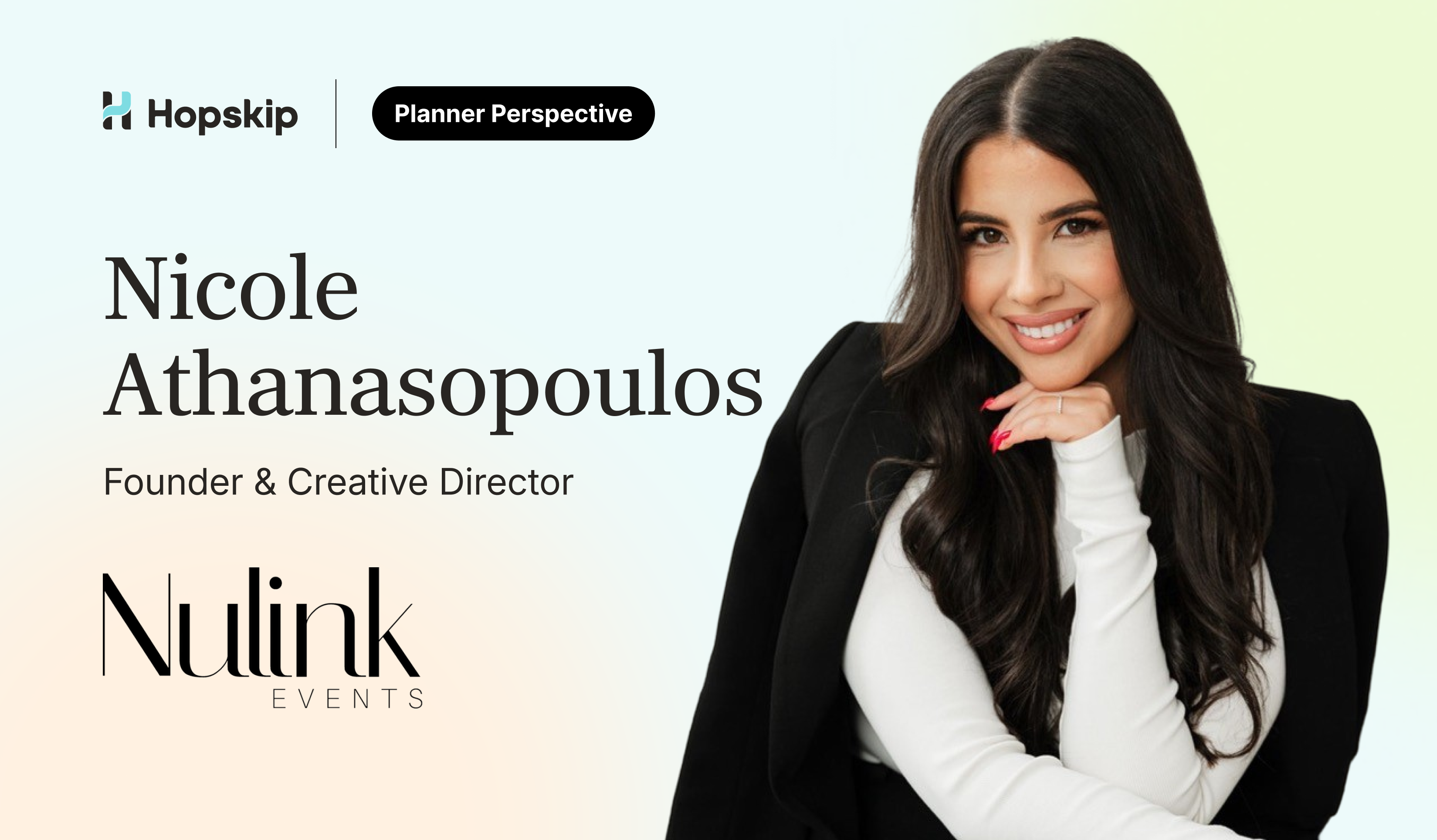
Most agencies grow by saying yes to everything. Nicole Athanasopoulos, Founder & Creative Director of Nulink Events, grew hers by learning exactly when to say no.
It's a counterintuitive lesson for anyone building a service business, but it's the one that reshaped Nulink's trajectory more than any single event, client, or campaign. Here's what she's learned about connection, contingency planning, and why the best events are designed, not just decorated.
Turning a Talent for Connection Into a Business
Nicole didn't set out to become an event planner so much as she noticed a pattern in herself. "I've always been drawn to bringing people together," she says. "Whether it was organizing gatherings, coordinating projects, or building partnerships, I realized my strength was in turning vision into experience."
Nulink Events became the formal expression of that instinct. Not just event logistics, but the harder, more interesting work of designing moments that move people and elevate brands. It's a distinction that matters: plenty of planners can execute a run of show, but far fewer are thinking about emotional impact from the first conversation.
Pro tip: If you're building an agency around a personal strength, name it specifically. "I'm good with people" is vague. "I turn vision into experience" is a positioning statement you can build a brand around.
The Mindset Shift That Changed Everything
Ask Nicole about Nulink's biggest turning point, and she won't point to a single flagship event. She points to a mindset shift: the agency stopped saying yes to everything and got intentional about which clients and experiences it aligned with.
That clarity did three things at once. It sharpened Nulink's brand. It justified higher pricing. And it attracted partnerships that actually reflected the agency's vision, instead of ones that just filled the calendar.
It's a pattern that shows up well beyond the events industry. Businesses that commit to a specific, well-defined audience consistently outperform generalist competitors on growth and customer acquisition efficiency, largely because a tighter product-market fit lets them charge more and market smarter instead of wider. Sellers and service providers who define their audience narrowly rather than broadly have also been shown to scale meaningfully faster than those still trying to be everything to everyone.
Nicole is candid that this lesson came from a mistake, not a strategy session. Early on, Nulink took on projects that didn't fully align with its long-term vision, mostly out of fear of missing opportunities. "Over time, I learned that alignment drives excellence," she says. "Now, we're intentional about the clients and experiences we take on."
Pro tip: If you're not sure whether your business has a "yes to everything" problem, look at your last five clients. If you can't articulate what they had in common, that's the tell.
Setting the Tone Before the Contract Is Signed
Nulink's client relationships don't start with a proposal. They start with a conversation designed to surface the why behind the ask, not just the ask itself.
"We focus on understanding not just what the client wants, but why they want it and the outcome they're aiming for," Nicole explains. From there, the agency is upfront about how it works, what it prioritizes, and the level of collaboration required. It's a small operational choice with an outsized effect: when clients understand the process upfront, the entire engagement gets smoother.
Pro tip: Build a short "how we work" conversation into your very first client call. Setting process expectations early prevents more scope-creep and miscommunication than any contract clause.
When a Vendor Relationship Saves the Event
Every planner has a story about the moment something almost went wrong. For Nicole, it was a last-minute logistics issue that threatened an event's entire setup timeline.
"Because we cultivate strong, respectful partnerships, we were able to make one call and secure immediate support," she says. "The client never saw the disruption, and that's the goal." It's a small anecdote with a big implication: crisis response in event planning is rarely improvised in the moment. It's a byproduct of relationship equity built long before anything goes wrong.
Industry guidance on event risk management backs this up directly. Vetting vendors and building contingency clauses into contracts during the planning phase, not after something breaks, is consistently identified as one of the highest-leverage moves a planner can make to prevent a minor hiccup from becoming a visible failure. The planners who never seem to have a bad day aren't the ones who avoid problems. They're the ones with a phone full of people who will pick up.
Pro tip: Rank your top five vendors by how fast they respond to a same-day request, not by price. That responsiveness is the actual insurance policy.
Standing Out in a Crowded Industry
Ask what differentiates Nulink from the dozens of other agencies competing for the same clients, and Nicole doesn't lead with production value. She leads with connection.
"We're not just producing events, we're engineering environments where relationships are built between brands and audiences, companies and stakeholders, people and opportunity," she says. That framing shapes how Nulink designs spaces, structures programming, and manages partnerships. It's less "what does the room look like" and more "what happens between the people in it."
Interaction Is the New Currency
If there's one trend Nicole thinks planners need to take seriously, it's this: after years of digital overload, the events that win are designed for interaction, not just presentation.
"People crave real connection, moments that spark engagement, collaboration, and dialogue," she says. "Events that facilitate meaningful connection will outperform traditional formats." The data backs her up emphatically. The vast majority of consumers report more positive feelings toward a brand after an in-person, participatory experience, and live activations continue to outperform passive formats on trust, recall, and purchase intent. Attendees who actively participate in a brand experience are also considerably more likely to convert than those who simply watch one unfold.
Networking, in particular, is an area where intention matters more than most planners realize. Only a minority of event organizers currently rate their networking programming as very effective, a number that has been declining as attendee expectations rise. Passive networking breaks, without structure or facilitation, are increasingly failing to deliver.
Pro tip: Audit your next event's agenda for passive stretches, unstructured breaks, long seated sessions, transitions with nothing happening, and replace at least one with a designed interaction: a facilitated conversation, a hands-on activity, anything that requires participation instead of attention.
Designing for the Senses, Not Just the Eye
Attendee experience, in Nicole's view, starts well before anyone notices the visuals. Nulink pays close attention to sensory details: lighting, sound design, spatial layout, pacing, even scent in some environments.
"These elements influence mood and energy more than people realize," she explains. "Experience is emotional before it's visual." When curated intentionally, an event feels elevated and cohesive rather than pieced together, even if a guest couldn't articulate exactly why.
This lines up with a broader shift in how the industry measures success. Event teams are increasingly moving away from counting impressions and attendance, and toward tracking dwell time, engagement quality, and post-event behavior, metrics that are far more sensitive to how an environment actually feels than to how it photographs.
Pro tip: Walk your venue with your eyes closed before doors open. If you can't tell what's happening in the room through sound and pacing alone, your sensory design has gaps.
Calm Under Pressure: Building Contingency Into Every Event
Every planner eventually deals with a genuine emergency. For Nicole, it was coordinating with venue security and local authorities when a protest was anticipated at an annual conference.
"Designated areas were established, additional security was present, and protocols were clearly defined," she recalls. The situation resolved peacefully. What made the difference wasn't crisis management theory in the moment, it was preparation thorough enough that the team could stay calm when it counted.
That same discipline shows up in Nulink's approach to routine contingencies: substitute options, program flexibility, and a clear emergency briefing at the top of every event covering medical situations, fire protocols, and evacuation processes. It sounds basic. Most events still skip it. Proactive risk assessment, conducted during planning rather than improvised during a crisis, remains one of the most consistently cited gaps in event execution across the industry.
Pro tip: Create a one-page emergency reference card for on-site staff at every event: venue contacts, roles, and key protocols. Brief it before doors open, not after something goes wrong.
Advice for Planners Just Starting Out
Nicole's advice for planners at the beginning of their careers doubles as a preview of what she'd do differently if she were starting Nulink today.
Looking back, she says she'd focus on brand positioning from day one. "Early on, like many founders, I concentrated on execution and building momentum," she reflects. "What I know now is that clarity in messaging, niche, and value proposition accelerates growth significantly." She'd define the lane, own it confidently, and build marketing around that identity immediately, rather than backfilling it years later.
Her single biggest piece of advice for any planner, though, is simpler and less about strategy: relationships are the real currency in this industry. "The vendors you respect, the clients you communicate clearly with, the teams you support, those relationships will carry you through growth and crisis alike."
Pro tip: Write your positioning statement before you write your services page. If you can't describe your niche in one sentence, your marketing will always feel scattered.
The Client Ask No One Saw Coming
Not every lesson comes from a crisis. Sometimes it comes from a client with a wild idea and a lot of trust in the team executing it.
One client proposed a surprise performance element requiring precise timing and hidden staging logistics, exciting, but risky if it wasn't executed flawlessly. Nulink mapped the reveal moment down to the second, coordinated rehearsals, built in backup plans, and confirmed safety compliance before greenlighting it.
"When the surprise happened, the energy in the room shifted completely," Nicole says. "It became the defining moment of the evening." It's a reminder that the riskiest ideas are often the ones worth the extra planning, as long as the planning actually happens.
Planners on Hopskip save 30+ hours per RFP, get cleaner proposals faster, and have all the information they need to make confident venue decisions. The best part? It's free to start for planners. Book a demo today to get started.
References & Sources
- The Strategy Institute. Niche Market Strategy: The Complete Approach to Dominating Your Segment.
- Podbase. (2026). 18 Profitable Niches in 2026.
- Eventcombo. Risk Management in Event Planning: Contingency Planning & Risk Management.
- Kande Photo Booths. (2026). Experiential Marketing Statistics 2026.
- Seeker. (2026). 26 Experiential Marketing Statistics Every Brand Should Know in 2026.
- Bizzabo. (2026). The Events Industry's Top Marketing Statistics, Trends, and Benchmarks for 2026.
- Eventcombo. (2026). How to Handle Event Management Crises: Planning, Response, and Safety Framework.
Curabitur bibendum ad viverra eu fringilla ad eu. Eget placerat ultricies quis amet mattis himenaeos ullamcorper facilisi volutpat.
Start for free
Send your first one for free.

The Art of Saying No: How One Event Planner Built a Stronger Agency
Nicole Athanasopoulos of Nulink Events shares how selectivity, sensory design, and vendor relationships shaped a stronger event agency, backed by data every planner can use.
Most agencies grow by saying yes to everything. Nicole Athanasopoulos, Founder & Creative Director of Nulink Events, grew hers by learning exactly when to say no.
It's a counterintuitive lesson for anyone building a service business, but it's the one that reshaped Nulink's trajectory more than any single event, client, or campaign. Here's what she's learned about connection, contingency planning, and why the best events are designed, not just decorated.
Turning a Talent for Connection Into a Business
Nicole didn't set out to become an event planner so much as she noticed a pattern in herself. "I've always been drawn to bringing people together," she says. "Whether it was organizing gatherings, coordinating projects, or building partnerships, I realized my strength was in turning vision into experience."
Nulink Events became the formal expression of that instinct. Not just event logistics, but the harder, more interesting work of designing moments that move people and elevate brands. It's a distinction that matters: plenty of planners can execute a run of show, but far fewer are thinking about emotional impact from the first conversation.
Pro tip: If you're building an agency around a personal strength, name it specifically. "I'm good with people" is vague. "I turn vision into experience" is a positioning statement you can build a brand around.
The Mindset Shift That Changed Everything
Ask Nicole about Nulink's biggest turning point, and she won't point to a single flagship event. She points to a mindset shift: the agency stopped saying yes to everything and got intentional about which clients and experiences it aligned with.
That clarity did three things at once. It sharpened Nulink's brand. It justified higher pricing. And it attracted partnerships that actually reflected the agency's vision, instead of ones that just filled the calendar.
It's a pattern that shows up well beyond the events industry. Businesses that commit to a specific, well-defined audience consistently outperform generalist competitors on growth and customer acquisition efficiency, largely because a tighter product-market fit lets them charge more and market smarter instead of wider. Sellers and service providers who define their audience narrowly rather than broadly have also been shown to scale meaningfully faster than those still trying to be everything to everyone.
Nicole is candid that this lesson came from a mistake, not a strategy session. Early on, Nulink took on projects that didn't fully align with its long-term vision, mostly out of fear of missing opportunities. "Over time, I learned that alignment drives excellence," she says. "Now, we're intentional about the clients and experiences we take on."
Pro tip: If you're not sure whether your business has a "yes to everything" problem, look at your last five clients. If you can't articulate what they had in common, that's the tell.
Setting the Tone Before the Contract Is Signed
Nulink's client relationships don't start with a proposal. They start with a conversation designed to surface the why behind the ask, not just the ask itself.
"We focus on understanding not just what the client wants, but why they want it and the outcome they're aiming for," Nicole explains. From there, the agency is upfront about how it works, what it prioritizes, and the level of collaboration required. It's a small operational choice with an outsized effect: when clients understand the process upfront, the entire engagement gets smoother.
Pro tip: Build a short "how we work" conversation into your very first client call. Setting process expectations early prevents more scope-creep and miscommunication than any contract clause.
When a Vendor Relationship Saves the Event
Every planner has a story about the moment something almost went wrong. For Nicole, it was a last-minute logistics issue that threatened an event's entire setup timeline.
"Because we cultivate strong, respectful partnerships, we were able to make one call and secure immediate support," she says. "The client never saw the disruption, and that's the goal." It's a small anecdote with a big implication: crisis response in event planning is rarely improvised in the moment. It's a byproduct of relationship equity built long before anything goes wrong.
Industry guidance on event risk management backs this up directly. Vetting vendors and building contingency clauses into contracts during the planning phase, not after something breaks, is consistently identified as one of the highest-leverage moves a planner can make to prevent a minor hiccup from becoming a visible failure. The planners who never seem to have a bad day aren't the ones who avoid problems. They're the ones with a phone full of people who will pick up.
Pro tip: Rank your top five vendors by how fast they respond to a same-day request, not by price. That responsiveness is the actual insurance policy.
Standing Out in a Crowded Industry
Ask what differentiates Nulink from the dozens of other agencies competing for the same clients, and Nicole doesn't lead with production value. She leads with connection.
"We're not just producing events, we're engineering environments where relationships are built between brands and audiences, companies and stakeholders, people and opportunity," she says. That framing shapes how Nulink designs spaces, structures programming, and manages partnerships. It's less "what does the room look like" and more "what happens between the people in it."
Interaction Is the New Currency
If there's one trend Nicole thinks planners need to take seriously, it's this: after years of digital overload, the events that win are designed for interaction, not just presentation.
"People crave real connection, moments that spark engagement, collaboration, and dialogue," she says. "Events that facilitate meaningful connection will outperform traditional formats." The data backs her up emphatically. The vast majority of consumers report more positive feelings toward a brand after an in-person, participatory experience, and live activations continue to outperform passive formats on trust, recall, and purchase intent. Attendees who actively participate in a brand experience are also considerably more likely to convert than those who simply watch one unfold.
Networking, in particular, is an area where intention matters more than most planners realize. Only a minority of event organizers currently rate their networking programming as very effective, a number that has been declining as attendee expectations rise. Passive networking breaks, without structure or facilitation, are increasingly failing to deliver.
Pro tip: Audit your next event's agenda for passive stretches, unstructured breaks, long seated sessions, transitions with nothing happening, and replace at least one with a designed interaction: a facilitated conversation, a hands-on activity, anything that requires participation instead of attention.
Designing for the Senses, Not Just the Eye
Attendee experience, in Nicole's view, starts well before anyone notices the visuals. Nulink pays close attention to sensory details: lighting, sound design, spatial layout, pacing, even scent in some environments.
"These elements influence mood and energy more than people realize," she explains. "Experience is emotional before it's visual." When curated intentionally, an event feels elevated and cohesive rather than pieced together, even if a guest couldn't articulate exactly why.
This lines up with a broader shift in how the industry measures success. Event teams are increasingly moving away from counting impressions and attendance, and toward tracking dwell time, engagement quality, and post-event behavior, metrics that are far more sensitive to how an environment actually feels than to how it photographs.
Pro tip: Walk your venue with your eyes closed before doors open. If you can't tell what's happening in the room through sound and pacing alone, your sensory design has gaps.
Calm Under Pressure: Building Contingency Into Every Event
Every planner eventually deals with a genuine emergency. For Nicole, it was coordinating with venue security and local authorities when a protest was anticipated at an annual conference.
"Designated areas were established, additional security was present, and protocols were clearly defined," she recalls. The situation resolved peacefully. What made the difference wasn't crisis management theory in the moment, it was preparation thorough enough that the team could stay calm when it counted.
That same discipline shows up in Nulink's approach to routine contingencies: substitute options, program flexibility, and a clear emergency briefing at the top of every event covering medical situations, fire protocols, and evacuation processes. It sounds basic. Most events still skip it. Proactive risk assessment, conducted during planning rather than improvised during a crisis, remains one of the most consistently cited gaps in event execution across the industry.
Pro tip: Create a one-page emergency reference card for on-site staff at every event: venue contacts, roles, and key protocols. Brief it before doors open, not after something goes wrong.
Advice for Planners Just Starting Out
Nicole's advice for planners at the beginning of their careers doubles as a preview of what she'd do differently if she were starting Nulink today.
Looking back, she says she'd focus on brand positioning from day one. "Early on, like many founders, I concentrated on execution and building momentum," she reflects. "What I know now is that clarity in messaging, niche, and value proposition accelerates growth significantly." She'd define the lane, own it confidently, and build marketing around that identity immediately, rather than backfilling it years later.
Her single biggest piece of advice for any planner, though, is simpler and less about strategy: relationships are the real currency in this industry. "The vendors you respect, the clients you communicate clearly with, the teams you support, those relationships will carry you through growth and crisis alike."
Pro tip: Write your positioning statement before you write your services page. If you can't describe your niche in one sentence, your marketing will always feel scattered.
The Client Ask No One Saw Coming
Not every lesson comes from a crisis. Sometimes it comes from a client with a wild idea and a lot of trust in the team executing it.
One client proposed a surprise performance element requiring precise timing and hidden staging logistics, exciting, but risky if it wasn't executed flawlessly. Nulink mapped the reveal moment down to the second, coordinated rehearsals, built in backup plans, and confirmed safety compliance before greenlighting it.
"When the surprise happened, the energy in the room shifted completely," Nicole says. "It became the defining moment of the evening." It's a reminder that the riskiest ideas are often the ones worth the extra planning, as long as the planning actually happens.
Planners on Hopskip save 30+ hours per RFP, get cleaner proposals faster, and have all the information they need to make confident venue decisions. The best part? It's free to start for planners. Book a demo today to get started.
References & Sources
- The Strategy Institute. Niche Market Strategy: The Complete Approach to Dominating Your Segment.
- Podbase. (2026). 18 Profitable Niches in 2026.
- Eventcombo. Risk Management in Event Planning: Contingency Planning & Risk Management.
- Kande Photo Booths. (2026). Experiential Marketing Statistics 2026.
- Seeker. (2026). 26 Experiential Marketing Statistics Every Brand Should Know in 2026.
- Bizzabo. (2026). The Events Industry's Top Marketing Statistics, Trends, and Benchmarks for 2026.
- Eventcombo. (2026). How to Handle Event Management Crises: Planning, Response, and Safety Framework.

.svg)