.svg)
The Art of the Pivot: How a DMC Senior Sales Manager Turns Chaos into Confidence

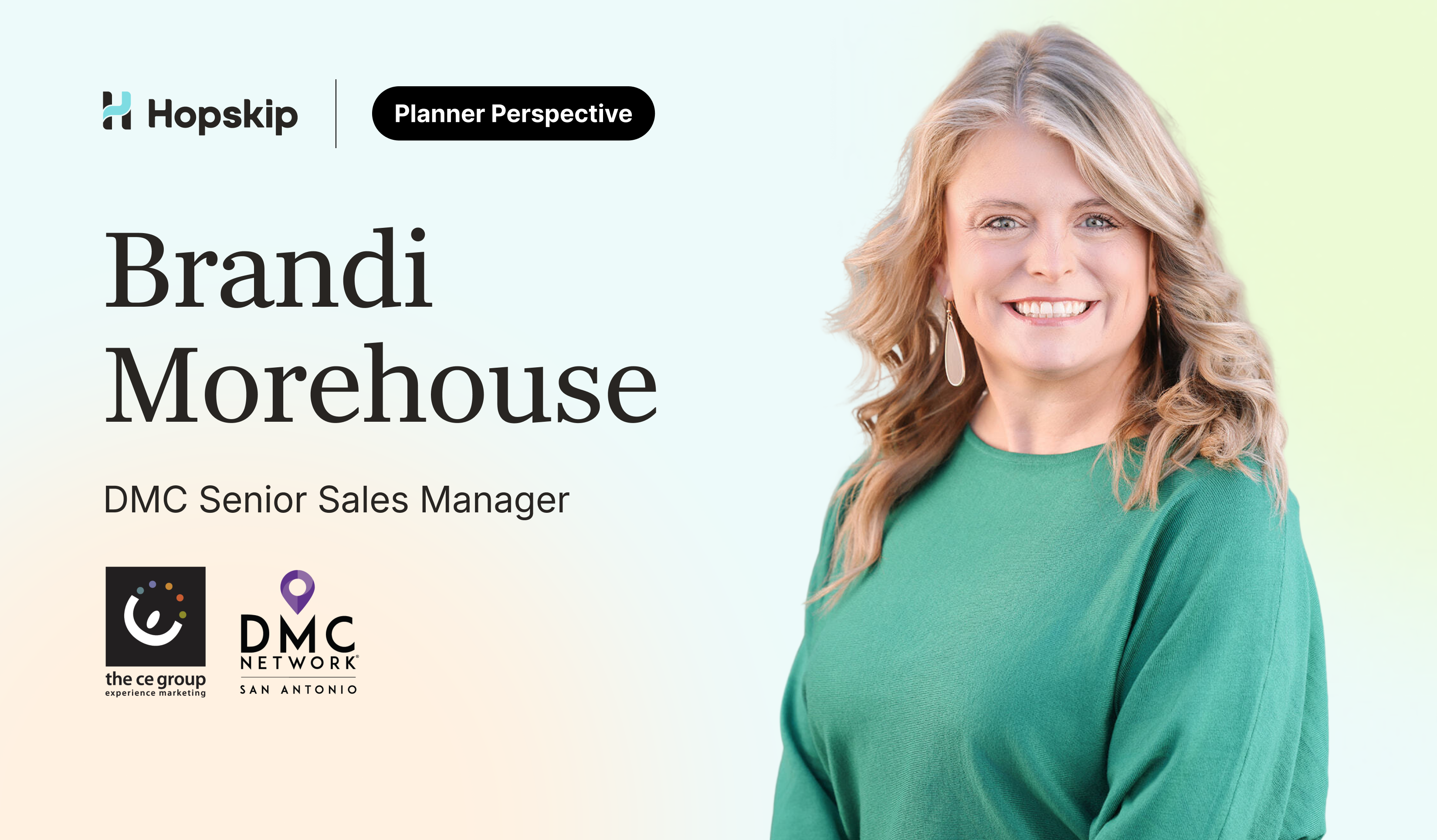
Brandi Morehouse of The CE Group has spent a decade turning last-minute pivots into seamless deliveries. Here's what a DMCP-certified Senior Sales Manager knows about vendor relationships, attendee experience, and building events that hold up when the plan changes three weeks out.
When Brandi Morehouse was in the fifth grade, she planned her teacher's baby shower. No budget. No venue sourcing tool. No run-of-show. She did it because she liked bringing people together, and she was apparently quite good at it.
These days, Brandi is a DMCP-certified Senior Sales Manager at The CE Group Inc. in San Antonio, Texas, with a decade of professional experience and a career that took a few unexpected turns to get here. She went to school for nursing (she was always going to have letters after her name — just not the ones she expected), pivoted to event production through a nannying gig that turned out to be for an event company in Seattle, and eventually followed her family to Texas, where she landed at one of the region's leading destination management companies.
What she's built along the way is something the events industry quietly depends on but rarely talks about directly: the ability to stay calm, stay solutions-oriented, and keep the whole thing moving when the plan you spent months building gets torn up three weeks before the event.
When the Client's New Teammate Changes Everything
Brandi has a story that will sound familiar to anyone who's managed complex events long enough.
A client had been locked in for four months. Contract signed. Program fully approved. A detailed opening performance developed collaboratively over weeks. Then, three weeks out, a new stakeholder joined the client-side team — and wanted to completely reimagine the opening experience.
There was no room to push back politely and wait it out. The timeline was already tight, the production constraints were real, and the budget wasn't moving. Brandi's team had to go back to zero on a major program element while everything else continued moving at full speed.
What happened next wasn't magic. It was method.
"We focused on being flexible and solution-oriented," Brandi says. "I worked closely with our vendor partners to quickly reimagine the entire opening program, ensuring it aligned with the new vision while still staying within budget and production constraints."
It worked. The client was thrilled. And the experience reinforced something Brandi already knew: the quality of your vendor relationships directly determines how much room you have to maneuver.
DMCs are increasingly indispensable for last-minute pivots, according to Global DMC Partners' Q3 2025 Pulse Survey. That's not because they're miracle workers. It's because seasoned DMC professionals have the supplier networks, the trust, and the on-the-ground flexibility to make major pivots happen at speed. That infrastructure takes years to build. When you need it, you really need it.
Pro tip: Before any major event, audit your vendor relationships honestly. Can you call your top five suppliers right now and ask for an urgent pivot? If the answer is no for any of them, that's the relationship to invest in before the next program kicks off.
Designing Experiences That Guests Actually Feel
Ask Brandi about attendee experience and she doesn't start with the décor budget or the app. She starts with arrival.
"I always start by thinking through the full guest journey, from arrival to departure, and identifying moments where we can make things feel seamless, engaging, and memorable."
Her core philosophy is that flow and ease are the invisible architecture of a great event. When transportation, check-in, and transitions between spaces feel effortless, guests stop thinking about logistics and start experiencing the event. That's the goal. The moment someone has to figure out where to go, the spell breaks a little.
From there, she layers in what she calls interactive elements or personalized touches — local elements, hands-on components, entertainment that gives people something to connect over. The goal isn't novelty for its own sake. It's creating environments where connection happens without anyone having to force it.
"For me, the best networking happens naturally," she says. "I focus on creating memorable moments and environments that encourage conversation rather than forcing it."
Sixty-four percent of event attendees say immersive experiences are the number one element for a positive event experience, according to industry research. And according to the Eventex 2025 Trends Report, personalization has moved from a nice-to-have to a must-have — attendees expect events that feel custom-made for them.
Brandi's approach addresses both. Effortless flow removes friction. Personalized moments create resonance. Together, they produce the thing clients actually want: an event people talk about after it's over.
Pro tip: Map the guest journey before you touch the program. Walk through arrival to departure and identify three places where friction is likely. Solving those three friction points will do more for attendee experience than any amount of entertainment layered on top.
The Framework Behind the Flexibility
One of the things that makes Brandi's adaptability possible is the fact that her team operates with a disciplined set of tools underneath all the creative flexibility. It sounds counterintuitive until you think about it for a minute.
"Having strong frameworks and templates in place is a huge part of how we stay organized and consistent," she says. "We use a full proposal template and detailed expense sheet to build out budgets and scope early on, which helps set clear expectations with our clients from the start."
On top of that foundation: run-of-show timelines, site maps, vendor coordination forms, and clear communication protocols. Not because the team can't function without them, but because they allow everyone to function at the same standard without constant hand-holding.
Research shows that 65% of event planners experience budget overruns, with an average overspend of 20% — a structural problem rooted in how most events are budgeted and tracked. Strong templates close that gap before it opens.
Brandi's alignment practices run the same logic: "I ensure alignment by setting clear expectations early, including roles, communication channels, and timelines. I keep all key information centralized and maintain consistent touchpoints with regular check-ins and clear recap updates."
When everyone knows where things live and who owns what, you get fewer dropped balls. And when the last-minute pivot hits, you have more bandwidth to handle it because your baseline operations aren't eating that bandwidth.
Pro tip: Build your run-of-show template once, properly, and reuse it obsessively. The return on that initial time investment compounds across every program you run.
The F&B Trap (And How to Avoid It)
Here's a financial challenge Brandi sees play out regularly — and it rarely gets enough airtime.
"One of the most common financial challenges I see comes down to food and beverage minimums that don't align with the actual needs of the program. Clients often commit to a minimum that's too high, which can lead to unnecessary spending or scrambling to add items just to meet it."
There's also the hidden cost side: "Additional costs that come up when bringing in outside vendors — many venues have fees or restrictions that can impact the overall budget."
F&B is typically the second-largest expense in corporate event budgets after AV, and hidden fees, minimums, and surprise charges can add up quickly. Whether the F&B minimum applies before or after taxes and gratuities can significantly affect your final budget, and many contracts are unclear on this point until you read the fine print.
Brandi's mitigation strategy: align venue and program early, making sure the F&B minimum realistically matches the group size and flow. Walk clients through what's included versus what's additional. Build flexibility into the plan strategically — whether that's recommending venues with more inclusive packages, negotiating concessions, or identifying areas where spend can be reallocated to maximize value.
"It's about being proactive, transparent, and setting the program up correctly from the beginning so we can avoid those challenges altogether."
Pro tip: During venue selection, ask specifically: does the F&B minimum apply before or after taxes and gratuities? The answer will change your math, and you want to know it before you're locked in.
On Venue Selection: It Starts With People
When Brandi evaluates a hotel or venue, the shortlist process starts somewhere most checklists don't capture.
"For me, selecting the right hotel or venue really starts with the people behind it. A strong, responsive team that's easy to work with can make or break an event, so I always look for partners who are collaborative, proactive, and solution-oriented."
Everything else follows: what's included, how the space functions for the program, the flexibility of the layout, how well it supports the guest experience, location, accessibility, and alignment with the client's goals and budget.
But the human element is the filter. A beautiful venue with a disorganized or unresponsive team is a risk that no amount of great layout can offset. The teams that communicate clearly during the sourcing process tend to execute the same way once the contract is signed.
"At the end of the day, it's about finding a space that not only looks great but also works seamlessly behind the scenes and has a team I trust to execute alongside us."
Pro tip: During the RFP and proposal phase, track how quickly and thoroughly a hotel responds. Responsiveness at the sales stage is one of the clearest predictors of what execution will look like later. A slow, incomplete proposal in sourcing is almost always a preview of things to come.
Advice for Anyone Just Starting Out
Brandi doesn't sugarcoat her advice for planners new to the industry, and the honesty is exactly what makes it worth reading.
"Take it one step at a time. This industry has a lot of moving pieces, and it's very easy to get overwhelmed or burnt out if you try to take on everything at once."
She also says this: mistakes are part of the job, and treating them as learning opportunities rather than failures is the thing that separates planners who burn out from planners who last.
And then there's this, which might be the most underrated advice in the entire field: "When you get to the end of a big program, take a moment to pause and really take it in. You did that. You made it happen — and that's something to be proud of."
In an industry where the debrief starts before the last guest leaves, building in even a brief moment of acknowledgment isn't a luxury. It's a sustainable practice.
Planners on Hopskip save 30+ hours per RFP, get cleaner proposals faster, and have all the information they need to make confident venue decisions. The best part? It's free to start for planners. Book a demo today to get started.
References & Sources
- Global DMC Partners. (2025). Q3 2025 Meetings & Events Pulse Survey.
- GoGather. (2026). 8 Steps to Managing F&B Costs of Your 2026 Corporate Event.
- Qondor. The Hidden Costs of Event Planning.
- Groups360. (2025). Food and Beverage Minimums: How to Maximize Your Event's Food Budget.
- Amra & Elma. (2025). Top Event Marketing Statistics 2025.
- Cort Events / Eventex. (2025). The New Era of Personalization in Events.
Curabitur bibendum ad viverra eu fringilla ad eu. Eget placerat ultricies quis amet mattis himenaeos ullamcorper facilisi volutpat.
Start for free
Send your first one for free.

The Art of the Pivot: How a DMC Senior Sales Manager Turns Chaos into Confidence
Brandi Morehouse of The CE Group has spent a decade turning last-minute pivots into seamless deliveries. Here's what a DMCP-certified Senior Sales Manager knows about vendor relationships, attendee experience, and building events that hold up when the plan changes three weeks out.
When Brandi Morehouse was in the fifth grade, she planned her teacher's baby shower. No budget. No venue sourcing tool. No run-of-show. She did it because she liked bringing people together, and she was apparently quite good at it.
These days, Brandi is a DMCP-certified Senior Sales Manager at The CE Group Inc. in San Antonio, Texas, with a decade of professional experience and a career that took a few unexpected turns to get here. She went to school for nursing (she was always going to have letters after her name — just not the ones she expected), pivoted to event production through a nannying gig that turned out to be for an event company in Seattle, and eventually followed her family to Texas, where she landed at one of the region's leading destination management companies.
What she's built along the way is something the events industry quietly depends on but rarely talks about directly: the ability to stay calm, stay solutions-oriented, and keep the whole thing moving when the plan you spent months building gets torn up three weeks before the event.
When the Client's New Teammate Changes Everything
Brandi has a story that will sound familiar to anyone who's managed complex events long enough.
A client had been locked in for four months. Contract signed. Program fully approved. A detailed opening performance developed collaboratively over weeks. Then, three weeks out, a new stakeholder joined the client-side team — and wanted to completely reimagine the opening experience.
There was no room to push back politely and wait it out. The timeline was already tight, the production constraints were real, and the budget wasn't moving. Brandi's team had to go back to zero on a major program element while everything else continued moving at full speed.
What happened next wasn't magic. It was method.
"We focused on being flexible and solution-oriented," Brandi says. "I worked closely with our vendor partners to quickly reimagine the entire opening program, ensuring it aligned with the new vision while still staying within budget and production constraints."
It worked. The client was thrilled. And the experience reinforced something Brandi already knew: the quality of your vendor relationships directly determines how much room you have to maneuver.
DMCs are increasingly indispensable for last-minute pivots, according to Global DMC Partners' Q3 2025 Pulse Survey. That's not because they're miracle workers. It's because seasoned DMC professionals have the supplier networks, the trust, and the on-the-ground flexibility to make major pivots happen at speed. That infrastructure takes years to build. When you need it, you really need it.
Pro tip: Before any major event, audit your vendor relationships honestly. Can you call your top five suppliers right now and ask for an urgent pivot? If the answer is no for any of them, that's the relationship to invest in before the next program kicks off.
Designing Experiences That Guests Actually Feel
Ask Brandi about attendee experience and she doesn't start with the décor budget or the app. She starts with arrival.
"I always start by thinking through the full guest journey, from arrival to departure, and identifying moments where we can make things feel seamless, engaging, and memorable."
Her core philosophy is that flow and ease are the invisible architecture of a great event. When transportation, check-in, and transitions between spaces feel effortless, guests stop thinking about logistics and start experiencing the event. That's the goal. The moment someone has to figure out where to go, the spell breaks a little.
From there, she layers in what she calls interactive elements or personalized touches — local elements, hands-on components, entertainment that gives people something to connect over. The goal isn't novelty for its own sake. It's creating environments where connection happens without anyone having to force it.
"For me, the best networking happens naturally," she says. "I focus on creating memorable moments and environments that encourage conversation rather than forcing it."
Sixty-four percent of event attendees say immersive experiences are the number one element for a positive event experience, according to industry research. And according to the Eventex 2025 Trends Report, personalization has moved from a nice-to-have to a must-have — attendees expect events that feel custom-made for them.
Brandi's approach addresses both. Effortless flow removes friction. Personalized moments create resonance. Together, they produce the thing clients actually want: an event people talk about after it's over.
Pro tip: Map the guest journey before you touch the program. Walk through arrival to departure and identify three places where friction is likely. Solving those three friction points will do more for attendee experience than any amount of entertainment layered on top.
The Framework Behind the Flexibility
One of the things that makes Brandi's adaptability possible is the fact that her team operates with a disciplined set of tools underneath all the creative flexibility. It sounds counterintuitive until you think about it for a minute.
"Having strong frameworks and templates in place is a huge part of how we stay organized and consistent," she says. "We use a full proposal template and detailed expense sheet to build out budgets and scope early on, which helps set clear expectations with our clients from the start."
On top of that foundation: run-of-show timelines, site maps, vendor coordination forms, and clear communication protocols. Not because the team can't function without them, but because they allow everyone to function at the same standard without constant hand-holding.
Research shows that 65% of event planners experience budget overruns, with an average overspend of 20% — a structural problem rooted in how most events are budgeted and tracked. Strong templates close that gap before it opens.
Brandi's alignment practices run the same logic: "I ensure alignment by setting clear expectations early, including roles, communication channels, and timelines. I keep all key information centralized and maintain consistent touchpoints with regular check-ins and clear recap updates."
When everyone knows where things live and who owns what, you get fewer dropped balls. And when the last-minute pivot hits, you have more bandwidth to handle it because your baseline operations aren't eating that bandwidth.
Pro tip: Build your run-of-show template once, properly, and reuse it obsessively. The return on that initial time investment compounds across every program you run.
The F&B Trap (And How to Avoid It)
Here's a financial challenge Brandi sees play out regularly — and it rarely gets enough airtime.
"One of the most common financial challenges I see comes down to food and beverage minimums that don't align with the actual needs of the program. Clients often commit to a minimum that's too high, which can lead to unnecessary spending or scrambling to add items just to meet it."
There's also the hidden cost side: "Additional costs that come up when bringing in outside vendors — many venues have fees or restrictions that can impact the overall budget."
F&B is typically the second-largest expense in corporate event budgets after AV, and hidden fees, minimums, and surprise charges can add up quickly. Whether the F&B minimum applies before or after taxes and gratuities can significantly affect your final budget, and many contracts are unclear on this point until you read the fine print.
Brandi's mitigation strategy: align venue and program early, making sure the F&B minimum realistically matches the group size and flow. Walk clients through what's included versus what's additional. Build flexibility into the plan strategically — whether that's recommending venues with more inclusive packages, negotiating concessions, or identifying areas where spend can be reallocated to maximize value.
"It's about being proactive, transparent, and setting the program up correctly from the beginning so we can avoid those challenges altogether."
Pro tip: During venue selection, ask specifically: does the F&B minimum apply before or after taxes and gratuities? The answer will change your math, and you want to know it before you're locked in.
On Venue Selection: It Starts With People
When Brandi evaluates a hotel or venue, the shortlist process starts somewhere most checklists don't capture.
"For me, selecting the right hotel or venue really starts with the people behind it. A strong, responsive team that's easy to work with can make or break an event, so I always look for partners who are collaborative, proactive, and solution-oriented."
Everything else follows: what's included, how the space functions for the program, the flexibility of the layout, how well it supports the guest experience, location, accessibility, and alignment with the client's goals and budget.
But the human element is the filter. A beautiful venue with a disorganized or unresponsive team is a risk that no amount of great layout can offset. The teams that communicate clearly during the sourcing process tend to execute the same way once the contract is signed.
"At the end of the day, it's about finding a space that not only looks great but also works seamlessly behind the scenes and has a team I trust to execute alongside us."
Pro tip: During the RFP and proposal phase, track how quickly and thoroughly a hotel responds. Responsiveness at the sales stage is one of the clearest predictors of what execution will look like later. A slow, incomplete proposal in sourcing is almost always a preview of things to come.
Advice for Anyone Just Starting Out
Brandi doesn't sugarcoat her advice for planners new to the industry, and the honesty is exactly what makes it worth reading.
"Take it one step at a time. This industry has a lot of moving pieces, and it's very easy to get overwhelmed or burnt out if you try to take on everything at once."
She also says this: mistakes are part of the job, and treating them as learning opportunities rather than failures is the thing that separates planners who burn out from planners who last.
And then there's this, which might be the most underrated advice in the entire field: "When you get to the end of a big program, take a moment to pause and really take it in. You did that. You made it happen — and that's something to be proud of."
In an industry where the debrief starts before the last guest leaves, building in even a brief moment of acknowledgment isn't a luxury. It's a sustainable practice.
Planners on Hopskip save 30+ hours per RFP, get cleaner proposals faster, and have all the information they need to make confident venue decisions. The best part? It's free to start for planners. Book a demo today to get started.
References & Sources
- Global DMC Partners. (2025). Q3 2025 Meetings & Events Pulse Survey.
- GoGather. (2026). 8 Steps to Managing F&B Costs of Your 2026 Corporate Event.
- Qondor. The Hidden Costs of Event Planning.
- Groups360. (2025). Food and Beverage Minimums: How to Maximize Your Event's Food Budget.
- Amra & Elma. (2025). Top Event Marketing Statistics 2025.
- Cort Events / Eventex. (2025). The New Era of Personalization in Events.


.svg)