.svg)
What 13 Years in Corporate Events Actually Teaches You (If You're Paying Attention)

Kelsey Dunn has spent 13 years planning corporate events, including a 1,100-person user conference with 30 sponsors. Here's what she's learned about attendee research, tech stacks, KPI frameworks, and keeping a budget aligned when everything around you is shifting.
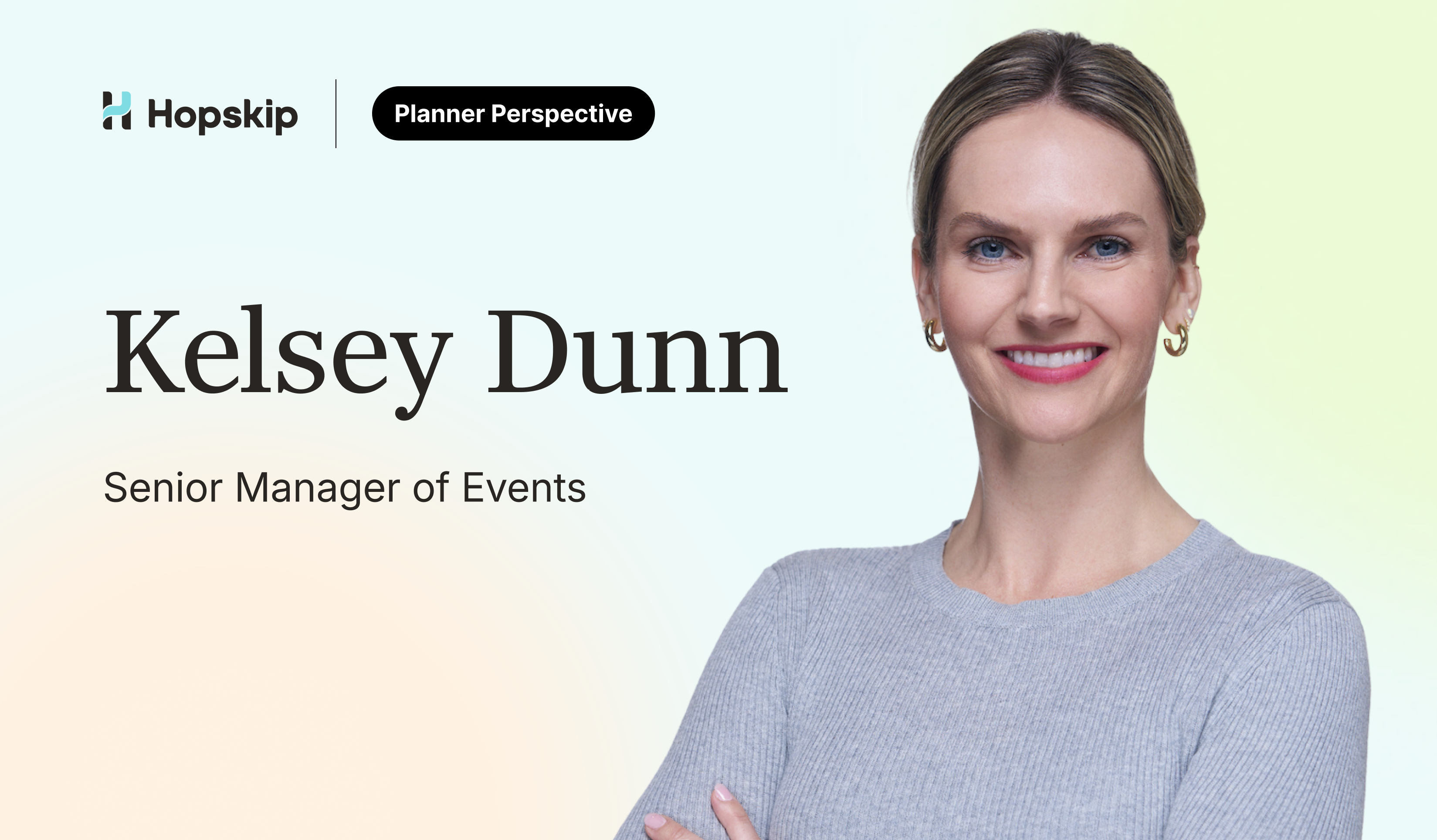
Kelsey Dunn didn't find the events industry. The events industry found her — via a recruiter, a pharmaceutical corporation, and a job description that sounded interesting enough to interview for.
That was 13 years ago. Since then, she's held supportive roles, individual contributor roles, and team leadership positions across corporate environments and two event agencies. She's planned a 1,100-person user conference with 30 sponsors, 2.5 days of programming, and enough moving parts to require a dedicated tech stack just to manage communications.
Her career has looked less like a straight line and more like what she describes as “the power chords of a rock song” — big shifts, unexpected turns, all of it building to something.
Here's what 13 years of paying attention gets you.
When Restructuring Happens Mid-Planning Cycle
Kelsey's most memorable challenge isn't a vendor who failed or a venue that flooded. It's more mundane, and precisely because of that, more instructive.
Her marketing team was deep into registration and planning for their annual customer conference when a company restructuring hit. Positions were eliminated. Human resources dried up. The responsibilities didn't.
"I immediately looked at our project timeline to see where our gaps would be. Then approached leadership to show where we had gaps in ownership and to provide my recommendation around what should be prioritized and which parts we could deprioritize so as to not stretch our team too thin."
No panic. No spiraling. A project timeline and a clear conversation with leadership.
The result: balls didn't get dropped. Friction stayed minimal. The conference moved forward.
What makes this story useful isn't just that she handled it — it's how quickly she moved from problem to proposed solution. The gap between discovering a problem and surfacing it to leadership with a recommendation is where most dropped balls live. Kelsey closed that gap before anything had a chance to fall through.
Compressed timelines and shifting approvals are increasingly common in corporate planning, making proactive stakeholder communication one of the most critical skills in the field.
Pro tip: When team capacity changes mid-cycle, don't just flag the problem — arrive with a prioritization recommendation. A list of “here's what we must do, here's what we can defer, here's what we should drop” is infinitely more useful than an email that just says things are getting tight.
Getting to Know Your Attendees Before You Plan for Them
Kelsey's approach to attendee experience is built on something that sounds simple but is harder to actually do: go find out what your attendees care about before you design anything.
"Get to know your attendees. Inquire through your colleagues, meet them at other industry events, do market research, and set up calls with attendees from a few different demographics — attended one year, three to five years, five-plus years."
That last part is the key. An attendee in their first year has completely different needs, levels of familiarity, and expectations than someone who's attended five consecutive conferences. Treating them the same produces an experience that works reasonably well for neither.
She also pushes planners to dig into the history before they touch the present. "Gain a deep understanding about the event strategy prior to you joining the company and/or program. Dig into the analytics, review all of the attendee surveys and internal debriefs, and ask questions. We can't improve if we don't know what happened before."
The Cvent 2025 Meetings & Events Trends Report underscores this: personalization works best when it's driven by real insights into attendee behavior, preferences, and engagement at every stage of the event — not assumptions.
The planners who skip this step and design from instinct often produce events that are technically well-run and emotionally inert. The planners who do the homework produce the ones attendees actually come back for.
Pro tip: Before your next event cycle starts, schedule three conversations with attendees from different tenure segments. Bring five open questions. Let them talk. What you hear will change what you build.
Tech Stack for a 1,100-Person Conference (What Actually Works)
Kelsey runs a sophisticated event operation, and her tech stack reflects it. Here's what's in rotation:
For internal collaboration: Asana, Slack, weekly Zoom calls, and Google Suite. For pre- and post-event communications: HubSpot for email campaigns and Instagram, Facebook, and LinkedIn for social. For the conference infrastructure itself: Zuddl handles registration, ticketing, the event website, badge printing, the onsite app, and sponsor lead capturing — all in one platform. Google Forms for pre- and post-event feedback. Sessionize for the call for speakers. And for analysis and copy, she uses Claude and Gemini.
That's a lot of tools. But notice what's in there: every platform has a specific job. There's no overlap for overlap's sake.
She also starts each planning cycle by going back to the prior year's project timeline and debrief notes, using AI to analyze where the team spent the most time and where gaps exist. That feedback loop between past and present is what keeps each conference incrementally better than the last.
AI adoption is climbing quickly among event professionals, with 62% now using AI in daily work, up 14% over the past year — with time savings in proposals, briefs, and client communications among the top cited benefits.
Pro tip: Before adding any new platform to your stack, map it to a specific job it will own. “We might need this” is not a job. If you can't write one sentence describing the specific problem this tool solves, it's not ready to join the stack.
Measuring Success Like a Strategist, Not Just an Operator
Ask Kelsey what KPIs she uses to evaluate event success and you get a genuinely useful answer — one that changes depending on what the event is actually for.
"The KPIs per event should be influenced by the kind of event you are hosting."
For their annual user conference: registered versus attended, NPS score, ticket and sponsorship revenue, social media reach lift, client retention, target accounts attended, and pipeline. For third-party industry events and sponsorships: brand impressions, social media lift, booth traffic, lead volume versus cost of sponsorship, and pipeline.
The through-line across both is pipeline. It's not just about who showed up and whether they had a good time — it's about whether the event moved the business forward in trackable ways.
According to Bizzabo's 2026 State of Events Benchmark Report, events are increasingly measured on pipeline influence, deal velocity, and customer retention — not just attendance or satisfaction scores. Kelsey's KPI framework is already there.
Her post-event practice matches the rigor of the measurement. She sends gratitude to everyone who attended and worked the event. She gets the survey out fast (either when the last session wraps or the morning after, to capture feedback while it's still fresh). She checks that systems captured all necessary information, starts transposing notes into shared documents to shape the postmortem, and ensures the sales and marketing ops team has updated information to track post-event behavior.
Budget reconciliation follows — within days for smaller events, over a month for large conferences — because accurate final reconciliation is how spend gets evaluated against ROI.
Pro tip: Set your KPIs before the event, not after. "What would success look like?" is a question for the kickoff meeting, not the debrief. Define the measures in advance, and your post-event review becomes a real evaluation rather than a highlights reel.
The Budget Alignment Conversation Nobody Wants to Skip
Kelsey's read on financial challenges in event planning is instructive: most of them don't start during planning. They start before it.
"The most financial challenges arise when there is a lack of insight and alignment while we are strategizing and budgeting prior to the planning phase."
Her mitigation: historical data, real-time budget tracking, and radical transparency with the finance team. "Our event planning agency and I keep the budget updated in real time so we can always see what we are anticipating to spend based on decisions we are making. Providing our finance team 100% visibility into each line item, as well as building rapport where we can discuss decisions in real time helps us build trust."
This is the kind of financial discipline that gets called “attention to detail” in performance reviews but is actually something more structural: it builds the organizational trust that gives event teams room to make fast decisions without requiring approval at every turn.
Tracking profit margins by comparing projected costs to actual spend, and reviewing historical financial data to identify recurring overruns, is one of the most effective ways to improve budgeting accuracy over time.
Pro tip: Build a shared budget tracker that your finance team can view at any time, without having to ask. Proactive visibility removes the friction from financial conversations — and you'll find that finance teams who trust you tend to approve things faster.
On Venue Selection: Logic Plus Feel
Kelsey's venue selection process is one of the more complete frameworks you'll encounter, and it's built around two distinct types of evaluation working together.
Quantitative: staying within budget, ensuring adequate space, room to expand if programming grows. Qualitative: does the space fit the company's culture and values, how does the location serve attendees' needs, what does accessibility look like, what do the public reviews say, and have any local team members been to an event there?
For larger events, she narrows to two or three finalist options and conducts site visits. The site visit isn't a formality — it's where she meets the hotel team, explores the space, and envisions how the program actually lives in that environment.
From there: "I walk through my venue recommendations with our leadership team to give my recommendations and the basis for these recommendations. Ensuring our leadership team is aligned with the venue and the rationale behind the selection is critical."
That final step — bringing leadership along on the reasoning, not just the conclusion — is what prevents the rework that happens when a venue gets approved and then quietly second-guessed.
Pro tip: When presenting venue options to leadership, don't just recommend a winner. Walk through the evaluation criteria and show where each venue landed. Decision-makers who understand the process trust the recommendation more than those who just got a slide with a name and a price.
What the Events Industry Gets Right (And What It Needs)
Kelsey's advice for new planners is generous and specific.
"Remember that we all started right where you are. Raise your hand to take on different tasks and projects. Ask lots of questions and stay curious. Introduce yourself to colleagues both in similar career positions as you, as well as those who have been in the industry longer than you have."
And then this: "The events industry is made up of stellar humans who create magic, and we want you to succeed."
It's not a platitude. For someone who found the industry through a recruiter and has spent 13 years learning it from the inside out — through agencies, corporate environments, and every kind of team role in between — it's an accurate description of what the profession is made of.
For emergencies, her philosophy is similarly clear: "Remember that everything is figureoutable." Have the venue's emergency plan. Know if there's a doctor on staff. Know where the nearest hospital and urgent care is. Have a weather plan. Stay vigilant about guest safety and regional situations. And be the duck on the water — calm on the surface, working hard underneath.
Planners on Hopskip save 30+ hours per RFP, get cleaner proposals faster, and have all the information they need to make confident venue decisions. The best part? It's free to start for planners. Book a demo today to get started.
References & Sources
- Global DMC Partners. (2025). Q3 2025 Meetings & Events Pulse Survey.
- Bizzabo. (2026). 2026 Event Marketing Statistics, Trends, and Benchmarks.
- Cort Events / Eventex. (2025). The New Era of Personalization in Events.
- Vendelux. (2025). Event Marketing KPIs That Prove Event ROI to the C-Suite.
- Josh Weidner. (2026). Understanding Your Corporate Event Budget: The Hidden Costs and How to Budget Smarter.
Curabitur bibendum ad viverra eu fringilla ad eu. Eget placerat ultricies quis amet mattis himenaeos ullamcorper facilisi volutpat.
Start for free
Send your first one for free.

What 13 Years in Corporate Events Actually Teaches You (If You're Paying Attention)
Kelsey Dunn has spent 13 years planning corporate events, including a 1,100-person user conference with 30 sponsors. Here's what she's learned about attendee research, tech stacks, KPI frameworks, and keeping a budget aligned when everything around you is shifting.
Kelsey Dunn didn't find the events industry. The events industry found her — via a recruiter, a pharmaceutical corporation, and a job description that sounded interesting enough to interview for.
That was 13 years ago. Since then, she's held supportive roles, individual contributor roles, and team leadership positions across corporate environments and two event agencies. She's planned a 1,100-person user conference with 30 sponsors, 2.5 days of programming, and enough moving parts to require a dedicated tech stack just to manage communications.
Her career has looked less like a straight line and more like what she describes as “the power chords of a rock song” — big shifts, unexpected turns, all of it building to something.
Here's what 13 years of paying attention gets you.
When Restructuring Happens Mid-Planning Cycle
Kelsey's most memorable challenge isn't a vendor who failed or a venue that flooded. It's more mundane, and precisely because of that, more instructive.
Her marketing team was deep into registration and planning for their annual customer conference when a company restructuring hit. Positions were eliminated. Human resources dried up. The responsibilities didn't.
"I immediately looked at our project timeline to see where our gaps would be. Then approached leadership to show where we had gaps in ownership and to provide my recommendation around what should be prioritized and which parts we could deprioritize so as to not stretch our team too thin."
No panic. No spiraling. A project timeline and a clear conversation with leadership.
The result: balls didn't get dropped. Friction stayed minimal. The conference moved forward.
What makes this story useful isn't just that she handled it — it's how quickly she moved from problem to proposed solution. The gap between discovering a problem and surfacing it to leadership with a recommendation is where most dropped balls live. Kelsey closed that gap before anything had a chance to fall through.
Compressed timelines and shifting approvals are increasingly common in corporate planning, making proactive stakeholder communication one of the most critical skills in the field.
Pro tip: When team capacity changes mid-cycle, don't just flag the problem — arrive with a prioritization recommendation. A list of “here's what we must do, here's what we can defer, here's what we should drop” is infinitely more useful than an email that just says things are getting tight.
Getting to Know Your Attendees Before You Plan for Them
Kelsey's approach to attendee experience is built on something that sounds simple but is harder to actually do: go find out what your attendees care about before you design anything.
"Get to know your attendees. Inquire through your colleagues, meet them at other industry events, do market research, and set up calls with attendees from a few different demographics — attended one year, three to five years, five-plus years."
That last part is the key. An attendee in their first year has completely different needs, levels of familiarity, and expectations than someone who's attended five consecutive conferences. Treating them the same produces an experience that works reasonably well for neither.
She also pushes planners to dig into the history before they touch the present. "Gain a deep understanding about the event strategy prior to you joining the company and/or program. Dig into the analytics, review all of the attendee surveys and internal debriefs, and ask questions. We can't improve if we don't know what happened before."
The Cvent 2025 Meetings & Events Trends Report underscores this: personalization works best when it's driven by real insights into attendee behavior, preferences, and engagement at every stage of the event — not assumptions.
The planners who skip this step and design from instinct often produce events that are technically well-run and emotionally inert. The planners who do the homework produce the ones attendees actually come back for.
Pro tip: Before your next event cycle starts, schedule three conversations with attendees from different tenure segments. Bring five open questions. Let them talk. What you hear will change what you build.
Tech Stack for a 1,100-Person Conference (What Actually Works)
Kelsey runs a sophisticated event operation, and her tech stack reflects it. Here's what's in rotation:
For internal collaboration: Asana, Slack, weekly Zoom calls, and Google Suite. For pre- and post-event communications: HubSpot for email campaigns and Instagram, Facebook, and LinkedIn for social. For the conference infrastructure itself: Zuddl handles registration, ticketing, the event website, badge printing, the onsite app, and sponsor lead capturing — all in one platform. Google Forms for pre- and post-event feedback. Sessionize for the call for speakers. And for analysis and copy, she uses Claude and Gemini.
That's a lot of tools. But notice what's in there: every platform has a specific job. There's no overlap for overlap's sake.
She also starts each planning cycle by going back to the prior year's project timeline and debrief notes, using AI to analyze where the team spent the most time and where gaps exist. That feedback loop between past and present is what keeps each conference incrementally better than the last.
AI adoption is climbing quickly among event professionals, with 62% now using AI in daily work, up 14% over the past year — with time savings in proposals, briefs, and client communications among the top cited benefits.
Pro tip: Before adding any new platform to your stack, map it to a specific job it will own. “We might need this” is not a job. If you can't write one sentence describing the specific problem this tool solves, it's not ready to join the stack.
Measuring Success Like a Strategist, Not Just an Operator
Ask Kelsey what KPIs she uses to evaluate event success and you get a genuinely useful answer — one that changes depending on what the event is actually for.
"The KPIs per event should be influenced by the kind of event you are hosting."
For their annual user conference: registered versus attended, NPS score, ticket and sponsorship revenue, social media reach lift, client retention, target accounts attended, and pipeline. For third-party industry events and sponsorships: brand impressions, social media lift, booth traffic, lead volume versus cost of sponsorship, and pipeline.
The through-line across both is pipeline. It's not just about who showed up and whether they had a good time — it's about whether the event moved the business forward in trackable ways.
According to Bizzabo's 2026 State of Events Benchmark Report, events are increasingly measured on pipeline influence, deal velocity, and customer retention — not just attendance or satisfaction scores. Kelsey's KPI framework is already there.
Her post-event practice matches the rigor of the measurement. She sends gratitude to everyone who attended and worked the event. She gets the survey out fast (either when the last session wraps or the morning after, to capture feedback while it's still fresh). She checks that systems captured all necessary information, starts transposing notes into shared documents to shape the postmortem, and ensures the sales and marketing ops team has updated information to track post-event behavior.
Budget reconciliation follows — within days for smaller events, over a month for large conferences — because accurate final reconciliation is how spend gets evaluated against ROI.
Pro tip: Set your KPIs before the event, not after. "What would success look like?" is a question for the kickoff meeting, not the debrief. Define the measures in advance, and your post-event review becomes a real evaluation rather than a highlights reel.
The Budget Alignment Conversation Nobody Wants to Skip
Kelsey's read on financial challenges in event planning is instructive: most of them don't start during planning. They start before it.
"The most financial challenges arise when there is a lack of insight and alignment while we are strategizing and budgeting prior to the planning phase."
Her mitigation: historical data, real-time budget tracking, and radical transparency with the finance team. "Our event planning agency and I keep the budget updated in real time so we can always see what we are anticipating to spend based on decisions we are making. Providing our finance team 100% visibility into each line item, as well as building rapport where we can discuss decisions in real time helps us build trust."
This is the kind of financial discipline that gets called “attention to detail” in performance reviews but is actually something more structural: it builds the organizational trust that gives event teams room to make fast decisions without requiring approval at every turn.
Tracking profit margins by comparing projected costs to actual spend, and reviewing historical financial data to identify recurring overruns, is one of the most effective ways to improve budgeting accuracy over time.
Pro tip: Build a shared budget tracker that your finance team can view at any time, without having to ask. Proactive visibility removes the friction from financial conversations — and you'll find that finance teams who trust you tend to approve things faster.
On Venue Selection: Logic Plus Feel
Kelsey's venue selection process is one of the more complete frameworks you'll encounter, and it's built around two distinct types of evaluation working together.
Quantitative: staying within budget, ensuring adequate space, room to expand if programming grows. Qualitative: does the space fit the company's culture and values, how does the location serve attendees' needs, what does accessibility look like, what do the public reviews say, and have any local team members been to an event there?
For larger events, she narrows to two or three finalist options and conducts site visits. The site visit isn't a formality — it's where she meets the hotel team, explores the space, and envisions how the program actually lives in that environment.
From there: "I walk through my venue recommendations with our leadership team to give my recommendations and the basis for these recommendations. Ensuring our leadership team is aligned with the venue and the rationale behind the selection is critical."
That final step — bringing leadership along on the reasoning, not just the conclusion — is what prevents the rework that happens when a venue gets approved and then quietly second-guessed.
Pro tip: When presenting venue options to leadership, don't just recommend a winner. Walk through the evaluation criteria and show where each venue landed. Decision-makers who understand the process trust the recommendation more than those who just got a slide with a name and a price.
What the Events Industry Gets Right (And What It Needs)
Kelsey's advice for new planners is generous and specific.
"Remember that we all started right where you are. Raise your hand to take on different tasks and projects. Ask lots of questions and stay curious. Introduce yourself to colleagues both in similar career positions as you, as well as those who have been in the industry longer than you have."
And then this: "The events industry is made up of stellar humans who create magic, and we want you to succeed."
It's not a platitude. For someone who found the industry through a recruiter and has spent 13 years learning it from the inside out — through agencies, corporate environments, and every kind of team role in between — it's an accurate description of what the profession is made of.
For emergencies, her philosophy is similarly clear: "Remember that everything is figureoutable." Have the venue's emergency plan. Know if there's a doctor on staff. Know where the nearest hospital and urgent care is. Have a weather plan. Stay vigilant about guest safety and regional situations. And be the duck on the water — calm on the surface, working hard underneath.
Planners on Hopskip save 30+ hours per RFP, get cleaner proposals faster, and have all the information they need to make confident venue decisions. The best part? It's free to start for planners. Book a demo today to get started.
References & Sources
- Global DMC Partners. (2025). Q3 2025 Meetings & Events Pulse Survey.
- Bizzabo. (2026). 2026 Event Marketing Statistics, Trends, and Benchmarks.
- Cort Events / Eventex. (2025). The New Era of Personalization in Events.
- Vendelux. (2025). Event Marketing KPIs That Prove Event ROI to the C-Suite.
- Josh Weidner. (2026). Understanding Your Corporate Event Budget: The Hidden Costs and How to Budget Smarter.

.svg)