.svg)
Why the Best Event Planners Build Ecosystems, Not Just Events

Event pro Kim Elpers of CorConnections shares how planners can build trusted vendor networks, design attendee journeys, and turn one-off events into scalable systems.
Most people think event planning is about picking a venue, ordering the tacos, and praying the AV works. Kim Elpers, Co-founder of CorConnections LLC, would gently disagree. For her, a great event is less like a fireworks show and more like an operating system: quietly powerful, endlessly scalable, and running long after the last attendee heads home.
CorConnections is a woman-led, minority-led, and family-owned full-service event production and fulfillment company that Kim built alongside her business partner and husband after the two met in the industry. What started organically, with a decade-deep network of trusted vendors and a phone that kept ringing, has become a blueprint for how modern planners can work smarter. Here is what other event professionals can borrow from her approach.
Your Vendor Network Is Your Real Product
Ask Kim what has protected her clients from disaster, and she does not point to a piece of software or a clever contract clause. She points to people. Over more than a decade, CorConnections has built a bench of vendors it trusts completely, partners who understand the company's standards and can be relied on under pressure.
That network is not just a feel-good asset. It is operational insurance. Kim recalls one event that was at risk of falling apart because of a last-minute production issue. Because of a long-standing relationship, she was able to immediately tap an alternate partner who stepped in, executed flawlessly, and saved the experience without the client ever noticing turbulence. As she puts it, "We're not just coordinating vendors, we're operating within a true ecosystem of trusted partners."
There is real data behind the instinct. Event professionals rank among the most stressed workers anywhere, with meeting and event planning listed as the third most stressful job in the world and a stress tolerance requirement of 95 out of 100, per O*NET. A deep vendor bench is one of the few things that reliably lowers that number, because it turns a five-alarm emergency into a quick phone call.
Pro tip: Treat your vendor relationships like a savings account. Deposit trust, communication, and repeat business during the calm seasons so you can make a withdrawal when everything is on fire.
Design the Attendee Experience as a Journey, Not a Highlight Reel
Kim's biggest strategy is deceptively simple: think about the attendee experience as a journey, not a series of isolated moments. The demographic and the objective guide the creative direction, but the goal is always to weave experiences throughout the entire flow so attendees are actively moving through a story rather than passively consuming content.
Sometimes that looks like a graffiti artist bringing key themes to life in real time. Other times it is a scavenger hunt or guided discovery layered into a multi-day conference. The point is that every touchpoint should feel intentional, so attendees remember not just what they learned but how it made them feel.
The numbers reward this thinking. Personalization now ranks among the most important event trends, with 40 percent of organizers citing personalized on-site activations as a top priority and 89 percent of decision-makers calling personalization essential to business success over the next three years. Experiential campaigns also generate roughly 40 percent more qualified leads than traditional marketing, and 85 percent of consumers say they are more likely to buy after attending a branded event.
Pro tip: Map your event like a road trip, not a parking lot. If an attendee cannot describe the "story" of your event in one sentence afterward, the plot needs another draft.
Consolidate the Chaos Into One Point of Contact
One of CorConnections' clearest differentiators is that it operates as a true full-service partner rather than a single-purpose vendor. Design, fabrication, and logistics all live under one roof, replacing what would normally be three separate vendors, three invoices, and three sets of headaches with one streamlined system and one clean monthly bill.
This obsession with simplification is not just good customer service, it is where the industry is heading. Kim sees a major push toward fewer vendors, more unified systems, and a stronger focus on data, efficiency, and ROI. That matters because 40 percent of organizers still report difficulty proving event ROI, and 56 percent of event leaders say post-event ROI data is their single biggest frustration. Fewer moving parts means cleaner data and fewer places for value to leak out.
Pro tip: Every vendor you add is another group text you have to manage at 11 p.m. Consolidate where you can. Your future self, and your phone battery, will thank you.
Stop Producing Events. Start Building Systems.
If Kim had to name one trend planners should take seriously right now, it is the shift from event execution to event systems and long-term experience design. Events are no longer one-off moments, she argues. They are becoming ongoing ecosystems that require scalability, personalization, and operational infrastructure behind them.
Clients increasingly want a repeatable, measurable experience that extends across multiple touchpoints throughout the year, which shows up in rising demand for micro-events, distributed kits, and year-round engagement. CorConnections learned this firsthand when the pandemic erased the traditional "marketing closet" overnight and companies suddenly needed to scale small, on-brand moments with no infrastructure to do it. The Event Fulfillment division Kim built in response, handling inventory storage, kitting, customization, and time-sensitive logistics, became one of the company's strongest growth drivers. What came out of necessity became a core part of the business.
Pro tip: Ask yourself whether what you are building could run again next quarter with minor tweaks. If every event starts from a blank page, you are not scaling, you are just re-enrolling in the same crash course.
Plan for the Unexpected Before It Happens
Calm event days are engineered, not lucky. CorConnections' approach is to plan for the unexpected before it ever occurs. During an in-person kickoff with the client, venue, and key vendors, the team aligns on the emergency plan: who is responsible for what, how communication flows, and how decisions get made under pressure.
Most venues already have safety and emergency protocols, so Kim makes sure her team is fully integrated into them and builds out anything missing as a group ahead of time. If something does go sideways during an event, the first move is always speed and alignment: assess quickly with the right stakeholders and respond as a unified team rather than reacting individually. "The goal is never to react individually," she says. "It's to respond cohesively, calmly, and in real time with everyone working from the same playbook."
Pro tip: Write the emergency plan while everyone is still sipping coffee at the kickoff, not while the fire alarm is going off. Panic is a terrible project manager.
Lead With Confidence, and Protect Your Energy
Two more lessons round out Kim's playbook, and they are as much about the planner as the event. The first is confidence. Having managed everyone from Co-founders to CMOs of multi-million dollar companies, she has learned that the best outcomes come from thinking for yourself, not just executing orders. She sets the expectation early that she will always speak up, whether that means challenging an idea or recommending a better approach, because that honesty creates stronger alignment and better decisions.
The second is sustainability. Her advice to newer planners is blunt: do not burn out trying to prove yourself in an industry that never slows down. Figure out your work-life balance early and protect it. The data backs her up, with 79 percent of event professionals saying their roles are more stressful than before the pandemic and work-life balance topping the list of burnout drivers. As Kim puts it, the best work does not come from exhaustion, it comes from clarity, creativity, and longevity.
Pro tip: "Always on" is a setting for your phone, not your personhood. Build a pace you can actually maintain, because a well-rested planner spots the problem the exhausted one walks right past.
Start With Hopskip
Kim's throughline is clear: the planners who win are the ones who build flexible, connected, scalable systems instead of scrambling event to event. The right tools make that far easier, which is where Hopskip comes in. Hopskip is a sourcing platform built to take the busywork out of finding and booking venues, so planners can spend less time chasing proposals and more time designing experiences that actually move people.
Planners on Hopskip save 30+ hours per RFP, get cleaner proposals faster, and have all the information they need to make confident venue decisions. The best part? It's free to start for planners. Book a demo today to get started.
Sources
- Bizzabo: Event Industry Trends 2026
- Bizzabo: Event Marketing Statistics, Trends, and Benchmarks for 2026
- Convene: Event Planning Is One of the Most Stressful Jobs in the World
- PCMA: Event Planning, The Third-Most Stressful Job in the World
- TeamTecna: Experiential Marketing Statistics
- Kande: Experiential Marketing Statistics 2026
- WBENC: Certification for Women-Owned Businesses
- Federal International: The Value and Impact of Women-Owned Businesses
Curabitur bibendum ad viverra eu fringilla ad eu. Eget placerat ultricies quis amet mattis himenaeos ullamcorper facilisi volutpat.
Start for free
Send your first one for free.

Why the Best Event Planners Build Ecosystems, Not Just Events
Event pro Kim Elpers of CorConnections shares how planners can build trusted vendor networks, design attendee journeys, and turn one-off events into scalable systems.
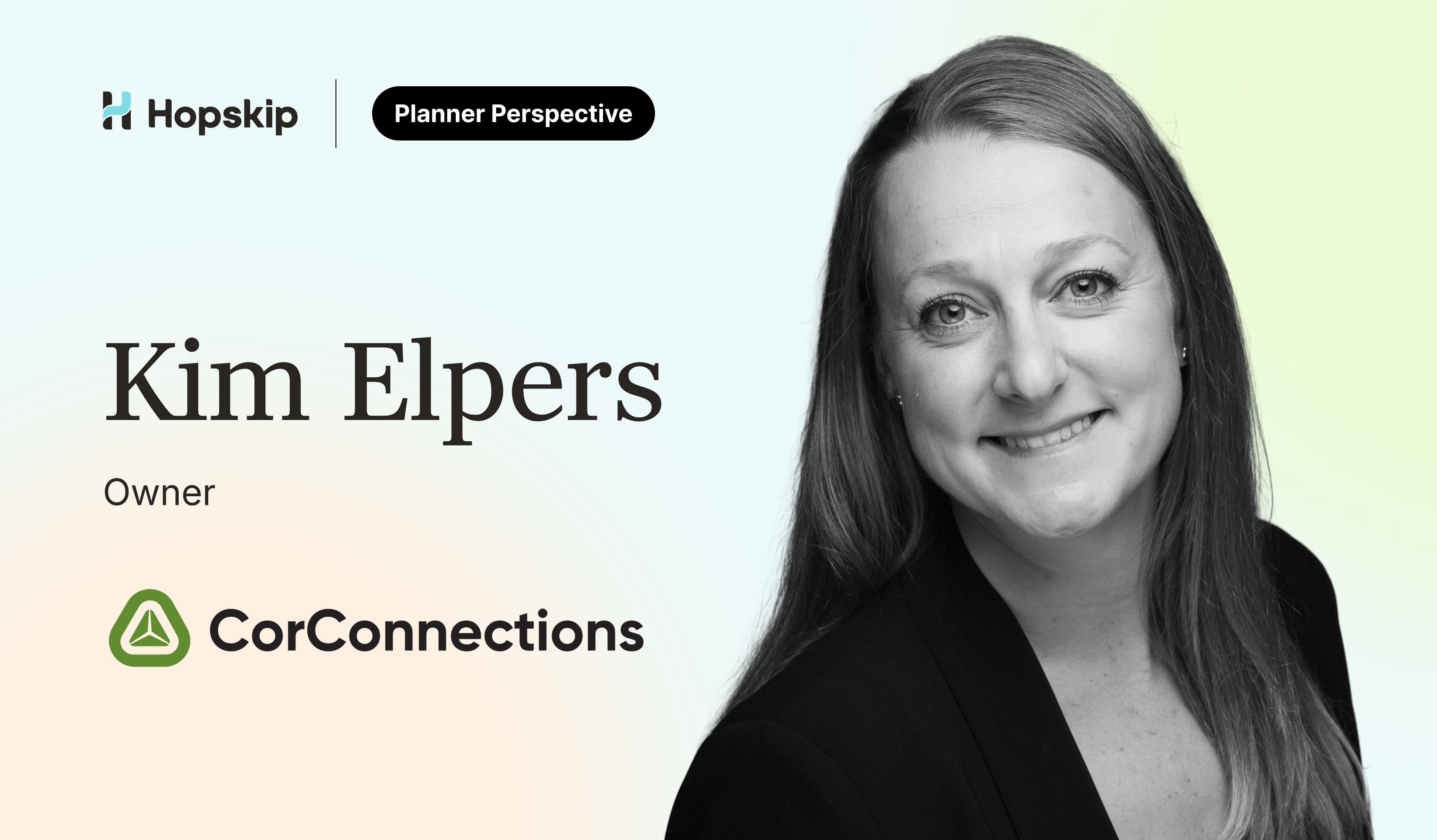
Most people think event planning is about picking a venue, ordering the tacos, and praying the AV works. Kim Elpers, Co-founder of CorConnections LLC, would gently disagree. For her, a great event is less like a fireworks show and more like an operating system: quietly powerful, endlessly scalable, and running long after the last attendee heads home.
CorConnections is a woman-led, minority-led, and family-owned full-service event production and fulfillment company that Kim built alongside her business partner and husband after the two met in the industry. What started organically, with a decade-deep network of trusted vendors and a phone that kept ringing, has become a blueprint for how modern planners can work smarter. Here is what other event professionals can borrow from her approach.
Your Vendor Network Is Your Real Product
Ask Kim what has protected her clients from disaster, and she does not point to a piece of software or a clever contract clause. She points to people. Over more than a decade, CorConnections has built a bench of vendors it trusts completely, partners who understand the company's standards and can be relied on under pressure.
That network is not just a feel-good asset. It is operational insurance. Kim recalls one event that was at risk of falling apart because of a last-minute production issue. Because of a long-standing relationship, she was able to immediately tap an alternate partner who stepped in, executed flawlessly, and saved the experience without the client ever noticing turbulence. As she puts it, "We're not just coordinating vendors, we're operating within a true ecosystem of trusted partners."
There is real data behind the instinct. Event professionals rank among the most stressed workers anywhere, with meeting and event planning listed as the third most stressful job in the world and a stress tolerance requirement of 95 out of 100, per O*NET. A deep vendor bench is one of the few things that reliably lowers that number, because it turns a five-alarm emergency into a quick phone call.
Pro tip: Treat your vendor relationships like a savings account. Deposit trust, communication, and repeat business during the calm seasons so you can make a withdrawal when everything is on fire.
Design the Attendee Experience as a Journey, Not a Highlight Reel
Kim's biggest strategy is deceptively simple: think about the attendee experience as a journey, not a series of isolated moments. The demographic and the objective guide the creative direction, but the goal is always to weave experiences throughout the entire flow so attendees are actively moving through a story rather than passively consuming content.
Sometimes that looks like a graffiti artist bringing key themes to life in real time. Other times it is a scavenger hunt or guided discovery layered into a multi-day conference. The point is that every touchpoint should feel intentional, so attendees remember not just what they learned but how it made them feel.
The numbers reward this thinking. Personalization now ranks among the most important event trends, with 40 percent of organizers citing personalized on-site activations as a top priority and 89 percent of decision-makers calling personalization essential to business success over the next three years. Experiential campaigns also generate roughly 40 percent more qualified leads than traditional marketing, and 85 percent of consumers say they are more likely to buy after attending a branded event.
Pro tip: Map your event like a road trip, not a parking lot. If an attendee cannot describe the "story" of your event in one sentence afterward, the plot needs another draft.
Consolidate the Chaos Into One Point of Contact
One of CorConnections' clearest differentiators is that it operates as a true full-service partner rather than a single-purpose vendor. Design, fabrication, and logistics all live under one roof, replacing what would normally be three separate vendors, three invoices, and three sets of headaches with one streamlined system and one clean monthly bill.
This obsession with simplification is not just good customer service, it is where the industry is heading. Kim sees a major push toward fewer vendors, more unified systems, and a stronger focus on data, efficiency, and ROI. That matters because 40 percent of organizers still report difficulty proving event ROI, and 56 percent of event leaders say post-event ROI data is their single biggest frustration. Fewer moving parts means cleaner data and fewer places for value to leak out.
Pro tip: Every vendor you add is another group text you have to manage at 11 p.m. Consolidate where you can. Your future self, and your phone battery, will thank you.
Stop Producing Events. Start Building Systems.
If Kim had to name one trend planners should take seriously right now, it is the shift from event execution to event systems and long-term experience design. Events are no longer one-off moments, she argues. They are becoming ongoing ecosystems that require scalability, personalization, and operational infrastructure behind them.
Clients increasingly want a repeatable, measurable experience that extends across multiple touchpoints throughout the year, which shows up in rising demand for micro-events, distributed kits, and year-round engagement. CorConnections learned this firsthand when the pandemic erased the traditional "marketing closet" overnight and companies suddenly needed to scale small, on-brand moments with no infrastructure to do it. The Event Fulfillment division Kim built in response, handling inventory storage, kitting, customization, and time-sensitive logistics, became one of the company's strongest growth drivers. What came out of necessity became a core part of the business.
Pro tip: Ask yourself whether what you are building could run again next quarter with minor tweaks. If every event starts from a blank page, you are not scaling, you are just re-enrolling in the same crash course.
Plan for the Unexpected Before It Happens
Calm event days are engineered, not lucky. CorConnections' approach is to plan for the unexpected before it ever occurs. During an in-person kickoff with the client, venue, and key vendors, the team aligns on the emergency plan: who is responsible for what, how communication flows, and how decisions get made under pressure.
Most venues already have safety and emergency protocols, so Kim makes sure her team is fully integrated into them and builds out anything missing as a group ahead of time. If something does go sideways during an event, the first move is always speed and alignment: assess quickly with the right stakeholders and respond as a unified team rather than reacting individually. "The goal is never to react individually," she says. "It's to respond cohesively, calmly, and in real time with everyone working from the same playbook."
Pro tip: Write the emergency plan while everyone is still sipping coffee at the kickoff, not while the fire alarm is going off. Panic is a terrible project manager.
Lead With Confidence, and Protect Your Energy
Two more lessons round out Kim's playbook, and they are as much about the planner as the event. The first is confidence. Having managed everyone from Co-founders to CMOs of multi-million dollar companies, she has learned that the best outcomes come from thinking for yourself, not just executing orders. She sets the expectation early that she will always speak up, whether that means challenging an idea or recommending a better approach, because that honesty creates stronger alignment and better decisions.
The second is sustainability. Her advice to newer planners is blunt: do not burn out trying to prove yourself in an industry that never slows down. Figure out your work-life balance early and protect it. The data backs her up, with 79 percent of event professionals saying their roles are more stressful than before the pandemic and work-life balance topping the list of burnout drivers. As Kim puts it, the best work does not come from exhaustion, it comes from clarity, creativity, and longevity.
Pro tip: "Always on" is a setting for your phone, not your personhood. Build a pace you can actually maintain, because a well-rested planner spots the problem the exhausted one walks right past.
Start With Hopskip
Kim's throughline is clear: the planners who win are the ones who build flexible, connected, scalable systems instead of scrambling event to event. The right tools make that far easier, which is where Hopskip comes in. Hopskip is a sourcing platform built to take the busywork out of finding and booking venues, so planners can spend less time chasing proposals and more time designing experiences that actually move people.
Planners on Hopskip save 30+ hours per RFP, get cleaner proposals faster, and have all the information they need to make confident venue decisions. The best part? It's free to start for planners. Book a demo today to get started.
Sources
- Bizzabo: Event Industry Trends 2026
- Bizzabo: Event Marketing Statistics, Trends, and Benchmarks for 2026
- Convene: Event Planning Is One of the Most Stressful Jobs in the World
- PCMA: Event Planning, The Third-Most Stressful Job in the World
- TeamTecna: Experiential Marketing Statistics
- Kande: Experiential Marketing Statistics 2026
- WBENC: Certification for Women-Owned Businesses
- Federal International: The Value and Impact of Women-Owned Businesses


.svg)