.svg)
A Firefighter's Guide to Planning Events That Don't Catch Fire

A former paramedic turned government event planner shares how he sources venues, stretches budgets, and keeps 500-person conferences from falling apart.
Some event planners fall into the job through hospitality school. Others fall into it through burning buildings.
Nicholas Stratton spent years as a full time paramedic and firefighter before building a second career as a state government meeting and event planner in Michigan. It sounds like an odd pivot until you actually watch him work. Calm under pressure, rapid decision-making, and a service-first mindset don't come from a marketing seminar. They come from responding to actual emergencies, which turns out to be excellent training for the actual emergency that is a 500-person conference with a broken buffet line (more on that shortly).
Stratton spent five years in the nonprofit sector running an annual conference for roughly 500 high school students, then four years planning events for the University of Michigan-Flint, learning to navigate departments, student groups, and outside partners. Today he oversees more than 50 events a year for statewide audiences as an event specialist at Kelley Cawthorne, and serves as President of the Michigan Chapter of the Society of Government Meeting Professionals. In other words: he has seen a lot of banquet halls, and he has opinions worth stealing.
How He Actually Picks a Venue
Ask Stratton how he chooses a hotel and he won't hand you a scoring rubric. He leans on the network he's built over years in the field, his deep knowledge of Convention and Visitors Bureaus (CVBs) across the state, and the confidence to just reach out and ask.
That last part matters more than planners give it credit for. Relationships close deals faster than spec sheets do, and CVBs exist precisely to make local matchmaking easier for planners willing to use them.
Pro tip: if you haven't called your destination's CVB in the last year, you're leaving free local intelligence on the table. They know which hotels are hungry for group business and which ones will actually deliver.
The RFP Still Runs the Show
For all the relationship-building, Stratton's process still starts with paperwork. He builds a detailed RFP and distributes it to his preferred hotels along with the CVB in the market he's targeting, then evaluates responses against the client's goals and budget before recommending a property and moving into contracting.
It's a reminder that even planners with strong personal networks don't skip the RFP step. They use it alongside relationships instead of in place of them. Planners who send RFPs to multiple properties at once tend to see faster response times than those relying on single-property outreach, which is part of why RFP-based sourcing has become standard practice rather than a nice-to-have.
Pro tip: send your RFP to your CVB contact and your go-to properties on the same day. Parallel outreach beats sequential outreach every time.
Budget Creativity That Borders on Genius
Every planner hits a budget wall eventually. Stratton's approach to state event budgets reads like a masterclass in creative reallocation: he shifted desserts from lunch service to an afternoon snack, cut coffee service from gallons to half gallons to nudge attendees toward more mindful consumption, and strategically reclassified some food costs as room rental fees to preserve value without attendees noticing a dip in experience.
None of that shows up in a textbook. It shows up after you've run enough events to know exactly where the fat is and exactly how far you can trim before people start complaining.
Pro tip: before cutting a line item entirely, ask whether it can be resequenced or recategorized instead. Attendees remember disappearing food. They rarely notice when dessert simply moved to 3 PM.
His Tech Stack, No Bloat Included
Stratton's toolkit isn't flashy: Asana for project management, Microsoft Office 365 with Copilot for AI-assisted efficiency, and MailChimp for targeted communications. Layer on streamlined templates and comprehensive event task lists, and that's the whole operation.
It's a useful gut check for planners drowning in software subscriptions. You don't need twelve platforms. You need three that you actually open every day, plus templates so you're not rebuilding the wheel each event.
Pro tip: audit your tech stack once a year and cut anything you haven't logged into in 90 days. If you can't remember your password, you don't need the tool.
Plan the Event Like You'll Actually Attend It
When asked how he improves the attendee experience, Stratton's answer is refreshingly simple: think of being in their shoes. Would I enjoy that session? Is it easy to get there? Where do I park? Be an attendee, then plan.
It's the kind of advice that sounds obvious until you realize how many event agendas are built entirely from the organizer's convenience rather than the attendee's. Parking, badge lines, and quiet nowhere-to-sit space are the details that actually keep guests happy.
Pro tip: walk your venue's parking lot to the ballroom door yourself, at the time your first session starts. If it annoys you, it will annoy them more.
Communication on Autopilot
Stratton runs automatic reporting for every event, whether weekly or monthly, with each event tasked with a report covering updates, struggles, and next items of business. That structure means stakeholders are never surprised, and problems surface while there's still time to fix them.
Pro tip: build your status report template once, then reuse it for every event. Consistency makes stakeholders trust the update, even when the update is "we have a problem."
Networking That Starts With a Snack
For facilitating connections among attendees, Stratton keeps it low-tech: networking starts with appetizers and questions that help jump-start conversation. Food lowers social friction faster than any icebreaker exercise, and a good conversation starter beats an awkward "tell the room your name and favorite hobby" every time.
Pro tip: pair a light appetizer station with two or three printed conversation prompts on the cocktail tables. People need an excuse to talk to strangers, and hors d'oeuvres make an excellent one.
The Disaster Kit That Saves the Day
Ask Stratton about his emergency plan and he doesn't launch into crisis theory. He keeps a disaster event kit stocked with the boring essentials that solve most on-site problems: door stops, tape, a stapler, pens, and other small items that go missing exactly when you need them most.
It's unglamorous advice, and that's precisely why it works. Most on-site emergencies aren't dramatic. They're a door that won't stay open or a sign that won't stay up, and a five-dollar kit fixes both.
Pro tip: build your own kit and keep it in your event bag permanently. The first time it saves you from a signage disaster, it pays for itself for the rest of your career.
When the Buffet Line Breaks (The Story You Came Here For)
Here's the challenge that separates planners who freeze from planners who improvise. At an event of nearly 500 people, roughly a quarter had dietary restrictions, and the list never made it to the chef. The lunch buffet wasn't set up for any dietary adaptations at all.
Instead of panicking, Stratton broke the buffet apart on the spot. What started as a build-your-own Italian buffet became build-your-pasta, then sauce, then meat, then garnish stations, essentially turning the service line into a live cooking demonstration. It became, in his words, a full kitchen-like experience.
That's the difference between a planner who has a plan B and a planner who has a plan B, C, and D memorized because they've lived through enough near-misses to know disaster doesn't announce itself politely. Dietary restrictions and preferences are increasingly common among event attendees, which makes confirming that the dietary list actually reached the kitchen one of the cheapest insurance policies in event planning.
Pro tip: always get written confirmation from the venue's culinary team that the dietary list was received, not just sent. A read receipt has saved more buffets than any contract clause.
Wrapping Up Without Dropping the Ball
Post-event, Stratton's checklist includes a post-event survey, a budget recap, a report summarizing positives and negatives, a follow-up email to the property, and a notes document capturing what needs to be tweaked next year.
That last item is the one most planners skip under deadline pressure, and it's the one with the highest long-term payoff. Future you will not remember which vendor was slow to respond in March. Write it down now.
Measuring Success Without a Single Formula
When it comes to KPIs, Stratton is refreshingly honest: it's hard to answer generically, because each event has its own KPIs depending on the client and the outcome needed. His baseline metrics are strong evaluation results, solid attendance numbers, a budget that breaks even or better, and happy stakeholders.
That's a healthier framework than chasing one universal metric across wildly different event types. A training session and a 500-person conference should never be graded on the same scale.
Advice for Planners Just Starting Out
Stratton's advice to newcomers is straightforward: don't be afraid to ask questions, shadow another event planner, look for task lists to learn from, and go to other events to study their setups and logistics.
It's advice that costs nothing and pays dividends immediately. Most experienced planners are happy to explain their process if you simply ask.
About Hopskip
Hopskip is a sourcing platform that connects event planners directly with hotels and DMOs through streamlined RFP management, giving planners the visibility and control that used to take dozens of phone calls and email chains to piece together.
Planners on Hopskip save 30+ hours per RFP, get cleaner proposals faster, and have all the information they need to make confident venue decisions. The best part? It's free to start for planners. Book a demo today to get started.
Sources
- International Food Information Council, Food and Health Survey (dietary restriction and preference prevalence among US adults)
- Industry sourcing benchmarks on RFP response times for multi-property vs. single-property outreach
Curabitur bibendum ad viverra eu fringilla ad eu. Eget placerat ultricies quis amet mattis himenaeos ullamcorper facilisi volutpat.
Start for free
Send your first one for free.

A Firefighter's Guide to Planning Events That Don't Catch Fire
A former paramedic turned government event planner shares how he sources venues, stretches budgets, and keeps 500-person conferences from falling apart.
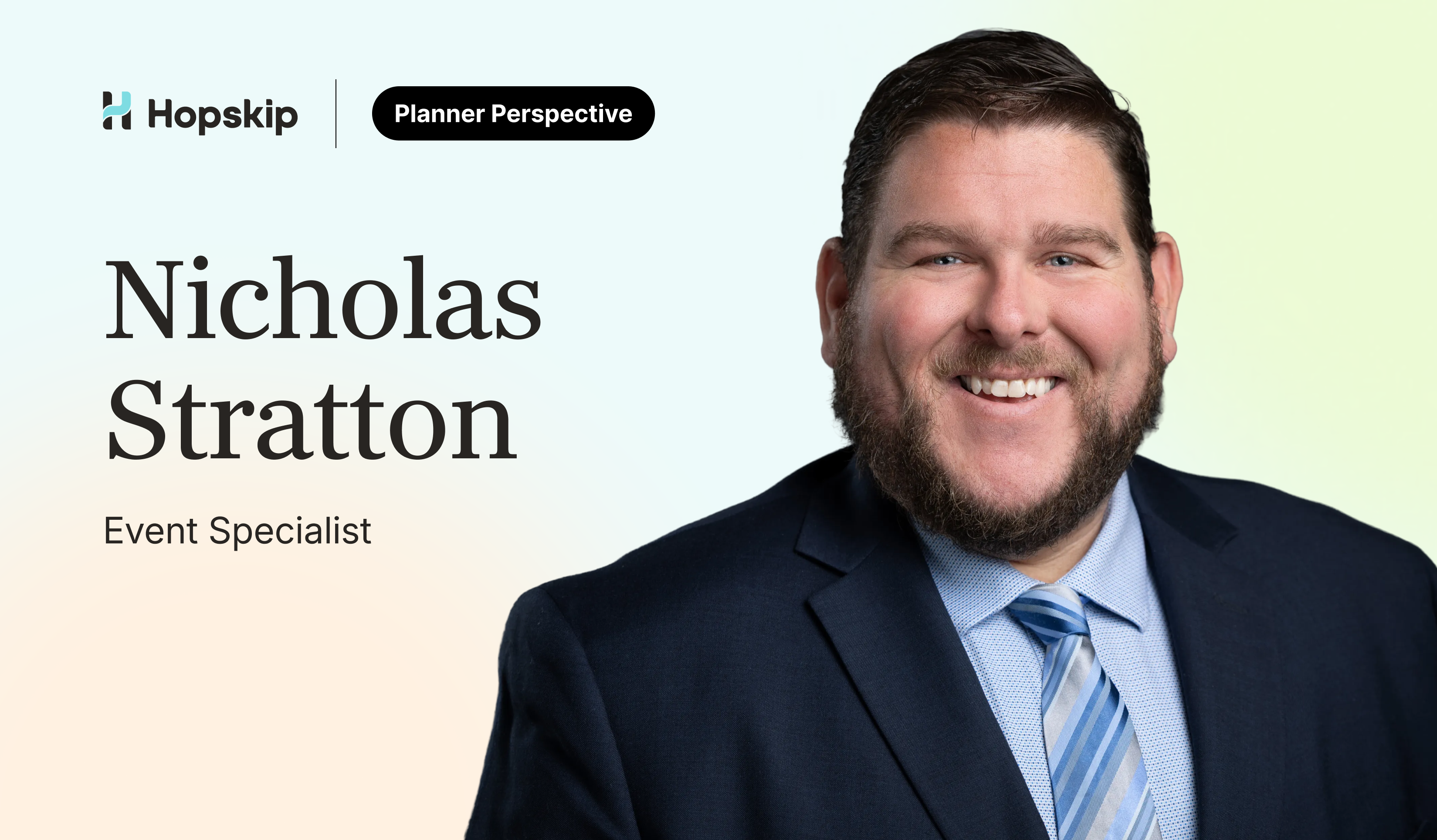
Some event planners fall into the job through hospitality school. Others fall into it through burning buildings.
Nicholas Stratton spent years as a full time paramedic and firefighter before building a second career as a state government meeting and event planner in Michigan. It sounds like an odd pivot until you actually watch him work. Calm under pressure, rapid decision-making, and a service-first mindset don't come from a marketing seminar. They come from responding to actual emergencies, which turns out to be excellent training for the actual emergency that is a 500-person conference with a broken buffet line (more on that shortly).
Stratton spent five years in the nonprofit sector running an annual conference for roughly 500 high school students, then four years planning events for the University of Michigan-Flint, learning to navigate departments, student groups, and outside partners. Today he oversees more than 50 events a year for statewide audiences as an event specialist at Kelley Cawthorne, and serves as President of the Michigan Chapter of the Society of Government Meeting Professionals. In other words: he has seen a lot of banquet halls, and he has opinions worth stealing.
How He Actually Picks a Venue
Ask Stratton how he chooses a hotel and he won't hand you a scoring rubric. He leans on the network he's built over years in the field, his deep knowledge of Convention and Visitors Bureaus (CVBs) across the state, and the confidence to just reach out and ask.
That last part matters more than planners give it credit for. Relationships close deals faster than spec sheets do, and CVBs exist precisely to make local matchmaking easier for planners willing to use them.
Pro tip: if you haven't called your destination's CVB in the last year, you're leaving free local intelligence on the table. They know which hotels are hungry for group business and which ones will actually deliver.
The RFP Still Runs the Show
For all the relationship-building, Stratton's process still starts with paperwork. He builds a detailed RFP and distributes it to his preferred hotels along with the CVB in the market he's targeting, then evaluates responses against the client's goals and budget before recommending a property and moving into contracting.
It's a reminder that even planners with strong personal networks don't skip the RFP step. They use it alongside relationships instead of in place of them. Planners who send RFPs to multiple properties at once tend to see faster response times than those relying on single-property outreach, which is part of why RFP-based sourcing has become standard practice rather than a nice-to-have.
Pro tip: send your RFP to your CVB contact and your go-to properties on the same day. Parallel outreach beats sequential outreach every time.
Budget Creativity That Borders on Genius
Every planner hits a budget wall eventually. Stratton's approach to state event budgets reads like a masterclass in creative reallocation: he shifted desserts from lunch service to an afternoon snack, cut coffee service from gallons to half gallons to nudge attendees toward more mindful consumption, and strategically reclassified some food costs as room rental fees to preserve value without attendees noticing a dip in experience.
None of that shows up in a textbook. It shows up after you've run enough events to know exactly where the fat is and exactly how far you can trim before people start complaining.
Pro tip: before cutting a line item entirely, ask whether it can be resequenced or recategorized instead. Attendees remember disappearing food. They rarely notice when dessert simply moved to 3 PM.
His Tech Stack, No Bloat Included
Stratton's toolkit isn't flashy: Asana for project management, Microsoft Office 365 with Copilot for AI-assisted efficiency, and MailChimp for targeted communications. Layer on streamlined templates and comprehensive event task lists, and that's the whole operation.
It's a useful gut check for planners drowning in software subscriptions. You don't need twelve platforms. You need three that you actually open every day, plus templates so you're not rebuilding the wheel each event.
Pro tip: audit your tech stack once a year and cut anything you haven't logged into in 90 days. If you can't remember your password, you don't need the tool.
Plan the Event Like You'll Actually Attend It
When asked how he improves the attendee experience, Stratton's answer is refreshingly simple: think of being in their shoes. Would I enjoy that session? Is it easy to get there? Where do I park? Be an attendee, then plan.
It's the kind of advice that sounds obvious until you realize how many event agendas are built entirely from the organizer's convenience rather than the attendee's. Parking, badge lines, and quiet nowhere-to-sit space are the details that actually keep guests happy.
Pro tip: walk your venue's parking lot to the ballroom door yourself, at the time your first session starts. If it annoys you, it will annoy them more.
Communication on Autopilot
Stratton runs automatic reporting for every event, whether weekly or monthly, with each event tasked with a report covering updates, struggles, and next items of business. That structure means stakeholders are never surprised, and problems surface while there's still time to fix them.
Pro tip: build your status report template once, then reuse it for every event. Consistency makes stakeholders trust the update, even when the update is "we have a problem."
Networking That Starts With a Snack
For facilitating connections among attendees, Stratton keeps it low-tech: networking starts with appetizers and questions that help jump-start conversation. Food lowers social friction faster than any icebreaker exercise, and a good conversation starter beats an awkward "tell the room your name and favorite hobby" every time.
Pro tip: pair a light appetizer station with two or three printed conversation prompts on the cocktail tables. People need an excuse to talk to strangers, and hors d'oeuvres make an excellent one.
The Disaster Kit That Saves the Day
Ask Stratton about his emergency plan and he doesn't launch into crisis theory. He keeps a disaster event kit stocked with the boring essentials that solve most on-site problems: door stops, tape, a stapler, pens, and other small items that go missing exactly when you need them most.
It's unglamorous advice, and that's precisely why it works. Most on-site emergencies aren't dramatic. They're a door that won't stay open or a sign that won't stay up, and a five-dollar kit fixes both.
Pro tip: build your own kit and keep it in your event bag permanently. The first time it saves you from a signage disaster, it pays for itself for the rest of your career.
When the Buffet Line Breaks (The Story You Came Here For)
Here's the challenge that separates planners who freeze from planners who improvise. At an event of nearly 500 people, roughly a quarter had dietary restrictions, and the list never made it to the chef. The lunch buffet wasn't set up for any dietary adaptations at all.
Instead of panicking, Stratton broke the buffet apart on the spot. What started as a build-your-own Italian buffet became build-your-pasta, then sauce, then meat, then garnish stations, essentially turning the service line into a live cooking demonstration. It became, in his words, a full kitchen-like experience.
That's the difference between a planner who has a plan B and a planner who has a plan B, C, and D memorized because they've lived through enough near-misses to know disaster doesn't announce itself politely. Dietary restrictions and preferences are increasingly common among event attendees, which makes confirming that the dietary list actually reached the kitchen one of the cheapest insurance policies in event planning.
Pro tip: always get written confirmation from the venue's culinary team that the dietary list was received, not just sent. A read receipt has saved more buffets than any contract clause.
Wrapping Up Without Dropping the Ball
Post-event, Stratton's checklist includes a post-event survey, a budget recap, a report summarizing positives and negatives, a follow-up email to the property, and a notes document capturing what needs to be tweaked next year.
That last item is the one most planners skip under deadline pressure, and it's the one with the highest long-term payoff. Future you will not remember which vendor was slow to respond in March. Write it down now.
Measuring Success Without a Single Formula
When it comes to KPIs, Stratton is refreshingly honest: it's hard to answer generically, because each event has its own KPIs depending on the client and the outcome needed. His baseline metrics are strong evaluation results, solid attendance numbers, a budget that breaks even or better, and happy stakeholders.
That's a healthier framework than chasing one universal metric across wildly different event types. A training session and a 500-person conference should never be graded on the same scale.
Advice for Planners Just Starting Out
Stratton's advice to newcomers is straightforward: don't be afraid to ask questions, shadow another event planner, look for task lists to learn from, and go to other events to study their setups and logistics.
It's advice that costs nothing and pays dividends immediately. Most experienced planners are happy to explain their process if you simply ask.
About Hopskip
Hopskip is a sourcing platform that connects event planners directly with hotels and DMOs through streamlined RFP management, giving planners the visibility and control that used to take dozens of phone calls and email chains to piece together.
Planners on Hopskip save 30+ hours per RFP, get cleaner proposals faster, and have all the information they need to make confident venue decisions. The best part? It's free to start for planners. Book a demo today to get started.
Sources
- International Food Information Council, Food and Health Survey (dietary restriction and preference prevalence among US adults)
- Industry sourcing benchmarks on RFP response times for multi-property vs. single-property outreach

.svg)