.svg)
The Event Planner Who Says She Has No Competitors

A sustainability and social impact travel consultant explains why she treats industry peers as collaborators, and how a Lisbon incentive trip became a fundraiser for crime-victim support.
Most founders talk about beating the competition. Kate Cardoso, Founder of the Travel with Purpose Pact, doesn't have a competition to beat. In her words, any organization working on sustainability and social impact in meetings and incentive travel is a potential collaborator, partner, or referral, not a rival.
Here's how that philosophy shapes a business built entirely around helping companies do meetings, events, and incentive travel better for the planet and the communities they touch.
A Mission Built Around Collaboration Instead of Competition
Cardoso founded the Travel with Purpose Pact to encourage more companies to include environmental sustainability and social impact initiatives in their domestic and international meetings, events, and incentives. Because the work is so mission-driven, she doesn't see other organizations in the space as competitors. She sees them as potential collaborators.
She goes further: she actually wants more competition in this specific corner of the industry, because more organizations doing sustainability and social impact work signals the industry is genuinely becoming more environmentally sustainable and socially responsible overall. If sustainability and social impact are treated purely as a competitive advantage, she argues, they were never really the goal to begin with. Collaboration, not competition, is what moves the work further and faster.
Pro tip: if your business serves a mission bigger than your own market share, look for organizations doing adjacent work and treat them as partners before a competitor beats you to the collaboration. Mission-driven spaces often reward cooperation more than they reward exclusivity.
The Mistake: Trying to Do Everything Alone
Cardoso's early mistake was trying to handle everything herself. She's learned she needs to work with people to stay focused, inspired, and committed, and that she would much rather build something as a team than push through it solo.
If she were starting over, she would have created a more formal board of advisors much earlier to accelerate her learning and growth. Surrounded by talented, caring, and experienced people, she recognizes now that she should have asked for more help and support from the very beginning instead of waiting until she felt she'd earned it.
Pro tip: you don't need a fully built advisory board to start benefiting from one. Identify three people whose judgment you trust and schedule a standing check-in with them, even informally, well before you think you need formal advice.
Attendee Engagement Through Genuine Give-Back
Cardoso's approach to attendee engagement centers on giving people the opportunity to give back in an authentic, meaningful, and impactful way. She designs activities where attendees use their time, talent, or resources to help local communities in need, while learning about causes that build empathy and encourage compassion and kindness.
That framing turns a standard CSR activity into something with actual staying power. Attendees don't just check a box for corporate social responsibility. They leave having learned something real about the community they visited.
Pro tip: if you're adding a give-back component to an event, pair the activity with a short piece of context about the cause beforehand. Understanding why a cause matters turns participation into genuine engagement instead of an obligatory volunteer hour.
Setting Expectations Through Direct Honesty
Cardoso describes herself as open, honest, and direct, which she acknowledges isn't always comfortable but is authentically who she is. That directness is exactly what helps her set expectations with clients: she's explicit about what she needs from them to be successful, and equally explicit about what they can expect from her in return.
It's a two-way expectation-setting approach rather than a one-directional list of client deliverables, which keeps the relationship balanced from the start.
Pro tip: when setting expectations with a new client, state your own needs as clearly as you state theirs. A one-sided expectations conversation, where only the client's needs get outlined, sets up an imbalance that tends to surface later.
Staying Calm as the Whole Strategy
Asked about her go-to plan for emergencies, Cardoso keeps it simple: stay calm. Being calm helps her think through difficult or complex situations clearly, and it has a ripple effect, keeping the people around her calm as well.
It's advice that sounds almost too simple until you consider how much a planner's visible state of mind sets the tone for an entire team and vendor group during a crisis.
Pro tip: your calm is contagious, and so is your panic. Before responding to an on-site problem, take one breath specifically to check your own tone before you speak to your team.
Finding Partners Who Make the Work More Affordable
Cardoso names finding partners who could make the work easier and more impactful while still being affordable as a genuine turning point in her growth. In a niche as specific as sustainability and social impact travel, the right partners aren't just vendors. They're collaborators who extend what a small team can realistically deliver.
Pro tip: when evaluating a potential partner in a specialized niche, weigh their willingness to collaborate on mission alongside their pricing. In values-driven work, a partner who shares your goals often delivers more value than a cheaper option who doesn't.
The Lisbon Project That Turned an Incentive Trip Into a Fundraiser
Cardoso's most complicated recent project isn't unconventional so much as it's ambitious in an exciting way. A client wanted their incentive travel program's social impact component to go further than in previous years, with more opportunities for attendees to actually participate and engage, rather than simply observe.
Cardoso's team chose to support APAV, a nonprofit organization providing free, confidential support to victims of crime and violence and their families in the Lisbon community and beyond. The plan includes a silent auction during the welcome dinner, featuring local activities and restaurant gift certificates, with all proceeds going to APAV. Attendees can also participate by donating items from a provided list and dropping them off at the hospitality desk throughout the program.
Cardoso is confident the project will land well, both because of how enthusiastically these particular attendees have supported social impact initiatives in the past, and because of strong collaboration with her DMC partner in Lisbon, who has helped maximize both attendee engagement and the program's financial and educational impact on the organization.
The Advice for Every Planner: It Gets Easier, and Be Nice
Cardoso's tip for other planners has two parts. First, the more you do it, the easier it gets. So much of what caused stress early in her career is now second nature, a reassurance for anyone still early in the learning curve.
Second, and just as important to her: be nice to people. Everyone. The process and the outcome, in her experience, are both meaningfully better and more enjoyable when kindness is the default, not an afterthought.
Pro tip: if a stressful part of your job still feels hard after repeated exposure, that's often a signal the underlying process needs fixing, not that you're simply bad at it. Most operational stress fades with repetition once the system around it is sound.
About Hopskip
Hopskip is a sourcing platform that connects event planners directly with hotels and DMOs through streamlined RFP management, cutting the manual back-and-forth out of finding the right venue partner.
Planners on Hopskip save 30+ hours per RFP, get cleaner proposals faster, and have all the information they need to make confident venue decisions. The best part? It's free to start for planners. Book a demo today to get started.
Sources
- General industry commentary on sustainability and social impact trends in meetings, events, and incentive travel
- Public information on APAV (Associação Portuguesa de Apoio à Vítima), a Lisbon-based nonprofit supporting victims of crime
Curabitur bibendum ad viverra eu fringilla ad eu. Eget placerat ultricies quis amet mattis himenaeos ullamcorper facilisi volutpat.
Start for free
Send your first one for free.

The Event Planner Who Says She Has No Competitors
A sustainability and social impact travel consultant explains why she treats industry peers as collaborators, and how a Lisbon incentive trip became a fundraiser for crime-victim support.
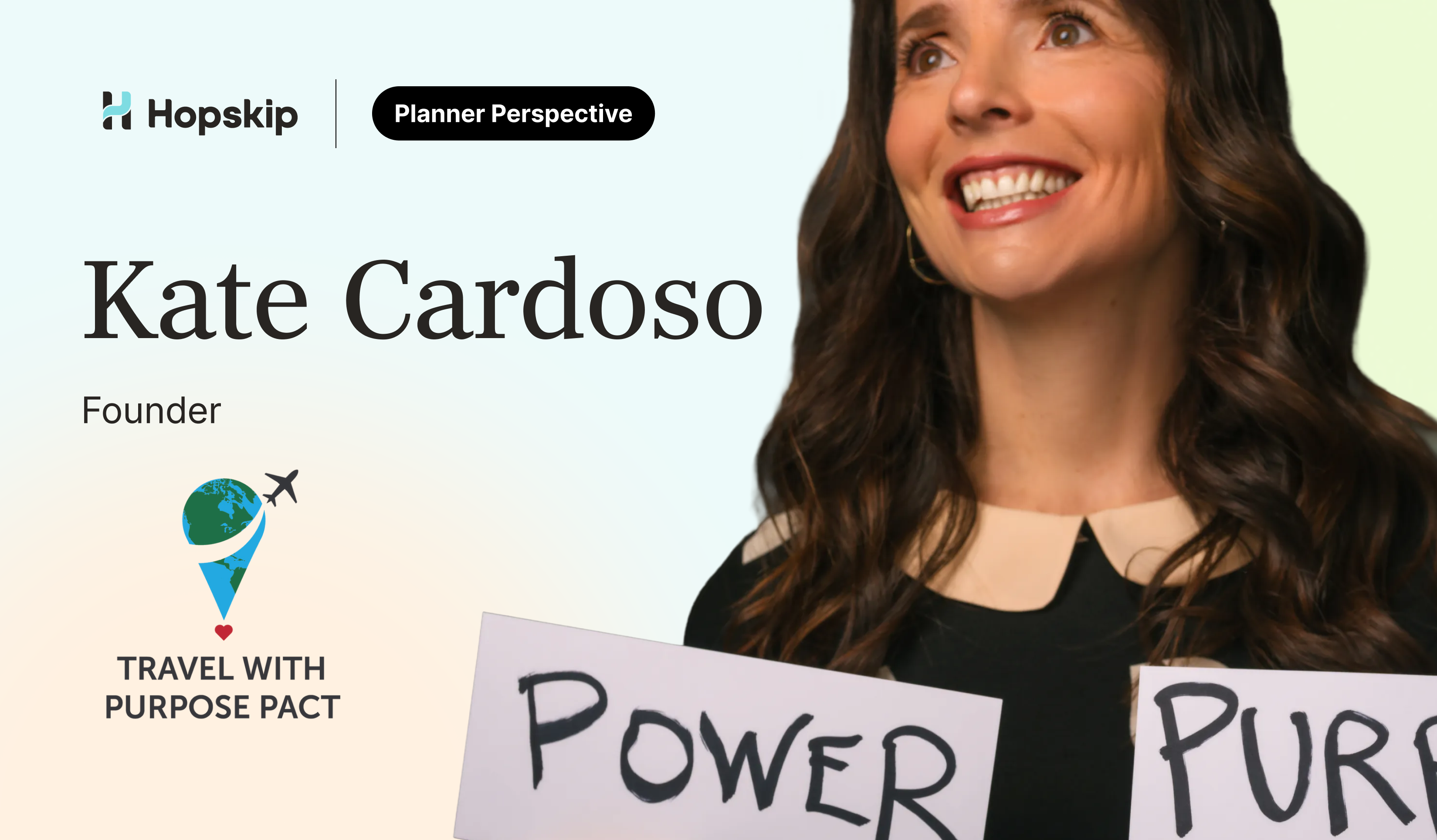
Most founders talk about beating the competition. Kate Cardoso, Founder of the Travel with Purpose Pact, doesn't have a competition to beat. In her words, any organization working on sustainability and social impact in meetings and incentive travel is a potential collaborator, partner, or referral, not a rival.
Here's how that philosophy shapes a business built entirely around helping companies do meetings, events, and incentive travel better for the planet and the communities they touch.
A Mission Built Around Collaboration Instead of Competition
Cardoso founded the Travel with Purpose Pact to encourage more companies to include environmental sustainability and social impact initiatives in their domestic and international meetings, events, and incentives. Because the work is so mission-driven, she doesn't see other organizations in the space as competitors. She sees them as potential collaborators.
She goes further: she actually wants more competition in this specific corner of the industry, because more organizations doing sustainability and social impact work signals the industry is genuinely becoming more environmentally sustainable and socially responsible overall. If sustainability and social impact are treated purely as a competitive advantage, she argues, they were never really the goal to begin with. Collaboration, not competition, is what moves the work further and faster.
Pro tip: if your business serves a mission bigger than your own market share, look for organizations doing adjacent work and treat them as partners before a competitor beats you to the collaboration. Mission-driven spaces often reward cooperation more than they reward exclusivity.
The Mistake: Trying to Do Everything Alone
Cardoso's early mistake was trying to handle everything herself. She's learned she needs to work with people to stay focused, inspired, and committed, and that she would much rather build something as a team than push through it solo.
If she were starting over, she would have created a more formal board of advisors much earlier to accelerate her learning and growth. Surrounded by talented, caring, and experienced people, she recognizes now that she should have asked for more help and support from the very beginning instead of waiting until she felt she'd earned it.
Pro tip: you don't need a fully built advisory board to start benefiting from one. Identify three people whose judgment you trust and schedule a standing check-in with them, even informally, well before you think you need formal advice.
Attendee Engagement Through Genuine Give-Back
Cardoso's approach to attendee engagement centers on giving people the opportunity to give back in an authentic, meaningful, and impactful way. She designs activities where attendees use their time, talent, or resources to help local communities in need, while learning about causes that build empathy and encourage compassion and kindness.
That framing turns a standard CSR activity into something with actual staying power. Attendees don't just check a box for corporate social responsibility. They leave having learned something real about the community they visited.
Pro tip: if you're adding a give-back component to an event, pair the activity with a short piece of context about the cause beforehand. Understanding why a cause matters turns participation into genuine engagement instead of an obligatory volunteer hour.
Setting Expectations Through Direct Honesty
Cardoso describes herself as open, honest, and direct, which she acknowledges isn't always comfortable but is authentically who she is. That directness is exactly what helps her set expectations with clients: she's explicit about what she needs from them to be successful, and equally explicit about what they can expect from her in return.
It's a two-way expectation-setting approach rather than a one-directional list of client deliverables, which keeps the relationship balanced from the start.
Pro tip: when setting expectations with a new client, state your own needs as clearly as you state theirs. A one-sided expectations conversation, where only the client's needs get outlined, sets up an imbalance that tends to surface later.
Staying Calm as the Whole Strategy
Asked about her go-to plan for emergencies, Cardoso keeps it simple: stay calm. Being calm helps her think through difficult or complex situations clearly, and it has a ripple effect, keeping the people around her calm as well.
It's advice that sounds almost too simple until you consider how much a planner's visible state of mind sets the tone for an entire team and vendor group during a crisis.
Pro tip: your calm is contagious, and so is your panic. Before responding to an on-site problem, take one breath specifically to check your own tone before you speak to your team.
Finding Partners Who Make the Work More Affordable
Cardoso names finding partners who could make the work easier and more impactful while still being affordable as a genuine turning point in her growth. In a niche as specific as sustainability and social impact travel, the right partners aren't just vendors. They're collaborators who extend what a small team can realistically deliver.
Pro tip: when evaluating a potential partner in a specialized niche, weigh their willingness to collaborate on mission alongside their pricing. In values-driven work, a partner who shares your goals often delivers more value than a cheaper option who doesn't.
The Lisbon Project That Turned an Incentive Trip Into a Fundraiser
Cardoso's most complicated recent project isn't unconventional so much as it's ambitious in an exciting way. A client wanted their incentive travel program's social impact component to go further than in previous years, with more opportunities for attendees to actually participate and engage, rather than simply observe.
Cardoso's team chose to support APAV, a nonprofit organization providing free, confidential support to victims of crime and violence and their families in the Lisbon community and beyond. The plan includes a silent auction during the welcome dinner, featuring local activities and restaurant gift certificates, with all proceeds going to APAV. Attendees can also participate by donating items from a provided list and dropping them off at the hospitality desk throughout the program.
Cardoso is confident the project will land well, both because of how enthusiastically these particular attendees have supported social impact initiatives in the past, and because of strong collaboration with her DMC partner in Lisbon, who has helped maximize both attendee engagement and the program's financial and educational impact on the organization.
The Advice for Every Planner: It Gets Easier, and Be Nice
Cardoso's tip for other planners has two parts. First, the more you do it, the easier it gets. So much of what caused stress early in her career is now second nature, a reassurance for anyone still early in the learning curve.
Second, and just as important to her: be nice to people. Everyone. The process and the outcome, in her experience, are both meaningfully better and more enjoyable when kindness is the default, not an afterthought.
Pro tip: if a stressful part of your job still feels hard after repeated exposure, that's often a signal the underlying process needs fixing, not that you're simply bad at it. Most operational stress fades with repetition once the system around it is sound.
About Hopskip
Hopskip is a sourcing platform that connects event planners directly with hotels and DMOs through streamlined RFP management, cutting the manual back-and-forth out of finding the right venue partner.
Planners on Hopskip save 30+ hours per RFP, get cleaner proposals faster, and have all the information they need to make confident venue decisions. The best part? It's free to start for planners. Book a demo today to get started.
Sources
- General industry commentary on sustainability and social impact trends in meetings, events, and incentive travel
- Public information on APAV (Associação Portuguesa de Apoio à Vítima), a Lisbon-based nonprofit supporting victims of crime


.svg)