.svg)
The Guest Who Couldn't Use His Phone (And How One Team Made Sure He Came Back)

An operations manager at a corporate incentive travel agency shares how accommodating a Sabbath-observant guest, a "surprise and delight" budget, and her own career pivot shaped her approach to events.
Some of the best event stories aren't about the keynote speaker or the venue. They're about a guest who couldn't use his phone on the Sabbath, and the small operational choices that turned his first-ever conference into one he actually attended fully.
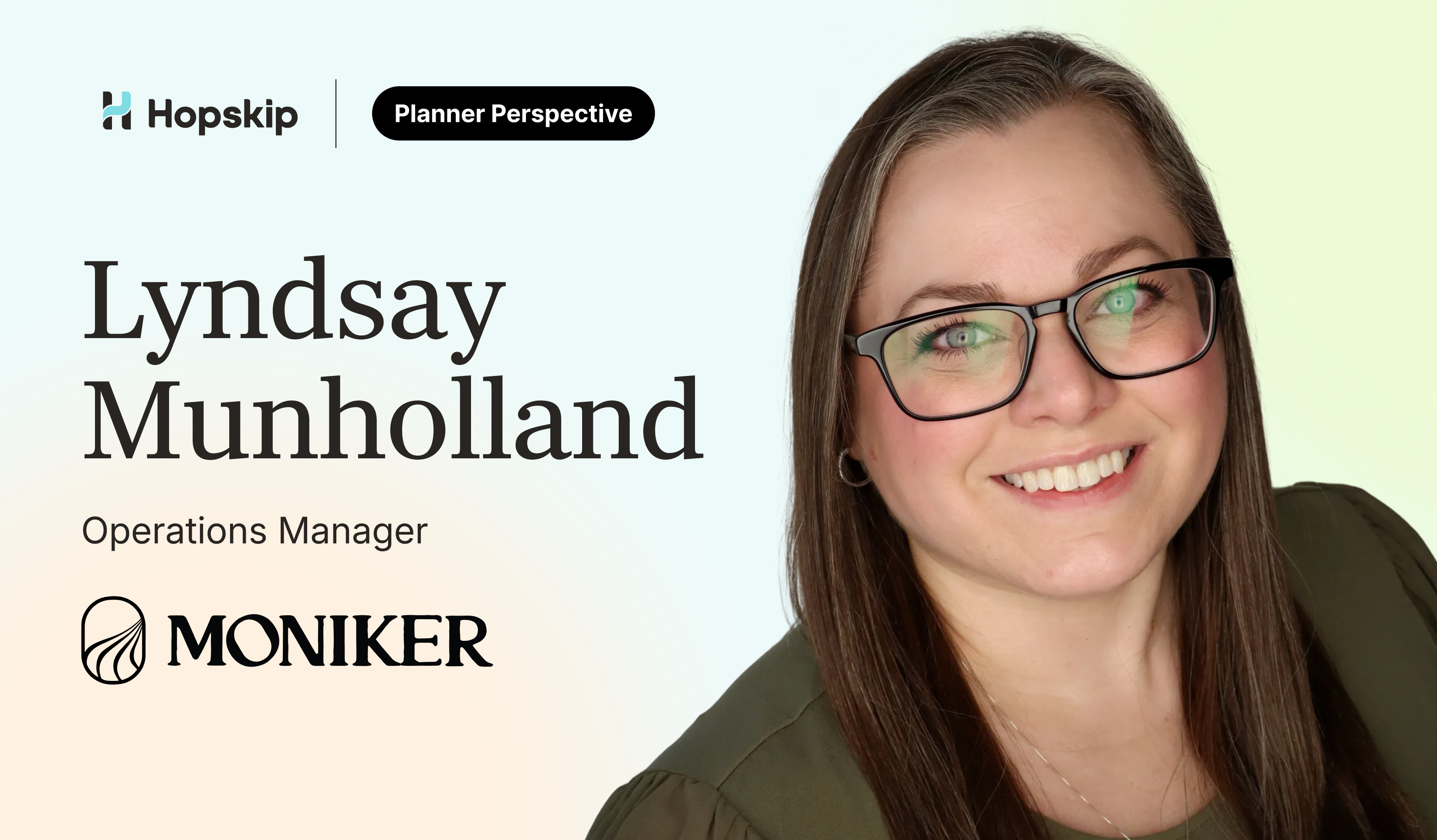
That story belongs to Lyndsay Munholland, Operations Manager at Moniker Partners. Here's what else thirteen years in the industry, several career pivots, and one very specific religious accommodation have taught her.
She Didn't Start the Agency. She Chose It Deliberately.
Munholland is upfront that she didn't found Moniker Partners. She joined it, and the reasons read like a case study in picking an employer on purpose rather than by accident. She'd worked with CEO Sean Hoff nearly a decade earlier when he was her client, and she saw his passion and drive for creating unique client experiences from the very first meeting.
She also watched the business thrive during a period when most competitors were scaling back. In 2020, when corporate retreats and incentive travel were being canceled across the industry, Moniker found its niche and grew instead of contracting. That kind of resilience, visible from the outside for years before she joined, told her something a job posting never could.
Pro tip: if you're evaluating a company to join, look at how it performed during its hardest year, not just its best one. Growth during a downturn is a far stronger signal than growth during a boom.
The Mistake: Waiting Too Long to Invest in Herself
Munholland's formative mistake isn't about the agency. It's personal. She started in an admin role at a large Canadian retailer, supporting an annual conference on the side, and was eventually promoted to Event Planner without a formal education background, learning everything as she went.
For years, she wanted to join industry associations but felt memberships were too expensive on top of the cost of attending events themselves. In hindsight, she believes investing in herself earlier would have accelerated her path in the industry considerably. Since joining MPI (Meeting Professionals International) and volunteering with her local chapter, she has built connections and friendships that have served her career well.
Pro tip: treat one industry association membership as a career investment, not a discretionary expense. The relationships built through volunteering often pay back the membership fee many times over within a year or two.
Client Expectations, the Simple Way
Munholland's approach to client expectations doesn't rely on a framework. It's just the golden rule applied consistently: treat clients the way she'd want to be treated. That means actively listening to what they want, repeating it back to confirm she heard correctly, and paying close attention to hesitations or unspoken concerns.
Those hesitations, she notes, are usually pain points from a past experience that need extra care. Listening for what a client's silence says is as important as listening to what they actually say out loud.
Pro tip: when a client hesitates on a topic without fully explaining why, don't just move past it. Ask a gentle follow-up. Unaddressed hesitation almost always resurfaces later, usually at a worse moment.
The Print Partner Who Never Let Her Down
Munholland's standout vendor relationship is with DigitalWon Imaging, a partner she's worked with for well over a decade producing physical branding and print collateral. One client was notorious for last-minute changes, but because of the established relationship, the print team always found a way to fit the work into their production schedule.
Sometimes that meant Munholland driving to the print shop and picking materials up herself. What mattered was that she never had to doubt whether it would be ready. That kind of reliability, built over years rather than negotiated in a single contract, is what turns a vendor into a genuine safety net.
Pro tip: the vendor relationships worth protecting aren't always your flashiest ones. A print or production partner who reliably delivers under pressure can save an event just as often as a headline-grabbing venue upgrade.
Differentiating Through the "Pod" System
Moniker's approach to standing out in a competitive market is structural. Each program gets assigned a designated "pod" of three staff members, ensuring quick response times and a high level of touchpoint support from initial planning through onsite execution. Clients get the same team for 24/7 onsite support that they've worked with throughout the entire process, rather than handing off to unfamiliar faces on event day.
The agency also builds in a budget guarantee: if a program goes over the agreed client budget for any reason, Moniker covers the difference. That's the kind of reassurance clients are actively looking for when choosing between planners.
Pro tip: if your agency structure already offers continuity (the same team from planning to onsite), say so explicitly in your pitch. Clients rarely assume that continuity by default, and it's a real differentiator when it's true.
The Trend Worth Watching: Personalization Over Scale
Munholland sees companies moving away from large, highly scheduled corporate events toward smaller, personalized experiences. In a digital world where people spend more time online, she believes the value of genuine face-to-face connection is rising, and companies are smart to look for ways to bring people together around intentional, personalized connection rather than a one-size-fits-all agenda.
That includes designing experiences that work whether attendees are neurodivergent or neurotypical, introverted or extroverted. Custom, experience-led travel that actually builds connection, in her view, is where the industry is heading.
Pro tip: audit your next event agenda for built-in flexibility. If every attendee is funneled through an identical schedule with no optional paths, you're likely missing a segment of your audience that needs something different.
Calm First, Delegation Second
Munholland's go-to plan for emergencies starts with staying calm, because panic sets in fast in stressful situations, and people are looking for someone to manage the chaos and take charge. More often than not, that looks like delegating quickly: something as simple as pointing one person toward finding a pen and notepad buys a few seconds to assess the situation and decide on the best course of action.
Pro tip: identify one small, low-stakes delegation task you can hand off instantly in a crisis, even something as minor as fetching supplies. The act of delegating anything immediately signals leadership and buys you thinking time.
Treating Every Attendee Like They're Paying the Bill
Munholland's philosophy on attendee experience is simple: treat every attendee as though they're the one paying the invoice. Guests sometimes ask questions already answered in the FAQ, but answering with a smile costs nothing and usually matters more to them than the FAQ itself.
She describes a moment that captures this directly. A guest traveling with family arriving later in the trip needed side-by-side rooms, and a booking error only surfaced while they were en route to the hotel. It could be fixed, but only if Munholland gave up her own room. Within thirty minutes she had packed up and housekeeping had flipped the room. The guest never knew the operational scramble behind the scenes. They just had a great time with their family.
Moniker also gives each planning team a "surprise and delight" budget, used for things like fireworks on the last night of a retreat or upgraded entertainment a client had cut from their budget as too expensive. Small, unbudgeted moments of generosity, she's found, do more for client loyalty than most line items ever could.
Pro tip: set aside a small discretionary budget per event specifically for unplanned moments of generosity. The return on a modest surprise gesture is often disproportionate to its cost.
The Advice for Every Planner: Don't Fear Change
Munholland's tip for every event planner is not to be afraid of change, and she means it about careers, not just event-day pivots. She was working at a local DMC when every program and client felt new and exciting, until the pandemic hit and she lost that job. She was then hired by an AMC, building long-term client relationships while leading a team of planners and managers, until a change in leadership meant her core values no longer aligned with the company.
She made the switch to Moniker, a move some might consider a step down the career ladder. She firmly believes that embracing change in order to remain true to yourself will always be the right choice, and that it pays off in the long run.
Pro tip: when evaluating whether to leave a role that looks good on paper, weigh values alignment as heavily as title or seniority. A values mismatch tends to compound over time in ways a job title never shows.
The Guest Who Couldn't Use His Phone
The most meaningful accommodation Munholland has ever arranged was for a Kosher guest who followed strict Sabbath observance. Kosher meals were an easy call, but he reached out before registration with a longer list of needs: a room on the lowest possible floor with private stairwell access to the conference floor, housekeeping visits at pre-arranged times to turn lights on and off since he couldn't operate switches on the Sabbath, a manual flush accessibility toilet near the conference ballroom, and a paper schedule, since he couldn't use his phone to access the event app.
When the post-event attendee surveys came back, Munholland's team learned something they hadn't known going in: it was his first time ever attending an industry conference, made possible entirely because the team was willing to make the accommodations he needed.
About Hopskip
Hopskip is a sourcing platform that connects event planners directly with hotels and DMOs through streamlined RFP management, cutting the phone tag and email sprawl out of finding the right venue.
Planners on Hopskip save 30+ hours per RFP, get cleaner proposals faster, and have all the information they need to make confident venue decisions. The best part? It's free to start for planners. Book a demo today to get started.
Sources
- Industry commentary on personalization and experience-led corporate travel trends
- General reporting on accessibility and religious accommodation practices in conference and event planning
Curabitur bibendum ad viverra eu fringilla ad eu. Eget placerat ultricies quis amet mattis himenaeos ullamcorper facilisi volutpat.
Start for free
Send your first one for free.

The Guest Who Couldn't Use His Phone (And How One Team Made Sure He Came Back)
An operations manager at a corporate incentive travel agency shares how accommodating a Sabbath-observant guest, a "surprise and delight" budget, and her own career pivot shaped her approach to events.
Some of the best event stories aren't about the keynote speaker or the venue. They're about a guest who couldn't use his phone on the Sabbath, and the small operational choices that turned his first-ever conference into one he actually attended fully.
That story belongs to Lyndsay Munholland, Operations Manager at Moniker Partners. Here's what else thirteen years in the industry, several career pivots, and one very specific religious accommodation have taught her.
She Didn't Start the Agency. She Chose It Deliberately.
Munholland is upfront that she didn't found Moniker Partners. She joined it, and the reasons read like a case study in picking an employer on purpose rather than by accident. She'd worked with CEO Sean Hoff nearly a decade earlier when he was her client, and she saw his passion and drive for creating unique client experiences from the very first meeting.
She also watched the business thrive during a period when most competitors were scaling back. In 2020, when corporate retreats and incentive travel were being canceled across the industry, Moniker found its niche and grew instead of contracting. That kind of resilience, visible from the outside for years before she joined, told her something a job posting never could.
Pro tip: if you're evaluating a company to join, look at how it performed during its hardest year, not just its best one. Growth during a downturn is a far stronger signal than growth during a boom.
The Mistake: Waiting Too Long to Invest in Herself
Munholland's formative mistake isn't about the agency. It's personal. She started in an admin role at a large Canadian retailer, supporting an annual conference on the side, and was eventually promoted to Event Planner without a formal education background, learning everything as she went.
For years, she wanted to join industry associations but felt memberships were too expensive on top of the cost of attending events themselves. In hindsight, she believes investing in herself earlier would have accelerated her path in the industry considerably. Since joining MPI (Meeting Professionals International) and volunteering with her local chapter, she has built connections and friendships that have served her career well.
Pro tip: treat one industry association membership as a career investment, not a discretionary expense. The relationships built through volunteering often pay back the membership fee many times over within a year or two.
Client Expectations, the Simple Way
Munholland's approach to client expectations doesn't rely on a framework. It's just the golden rule applied consistently: treat clients the way she'd want to be treated. That means actively listening to what they want, repeating it back to confirm she heard correctly, and paying close attention to hesitations or unspoken concerns.
Those hesitations, she notes, are usually pain points from a past experience that need extra care. Listening for what a client's silence says is as important as listening to what they actually say out loud.
Pro tip: when a client hesitates on a topic without fully explaining why, don't just move past it. Ask a gentle follow-up. Unaddressed hesitation almost always resurfaces later, usually at a worse moment.
The Print Partner Who Never Let Her Down
Munholland's standout vendor relationship is with DigitalWon Imaging, a partner she's worked with for well over a decade producing physical branding and print collateral. One client was notorious for last-minute changes, but because of the established relationship, the print team always found a way to fit the work into their production schedule.
Sometimes that meant Munholland driving to the print shop and picking materials up herself. What mattered was that she never had to doubt whether it would be ready. That kind of reliability, built over years rather than negotiated in a single contract, is what turns a vendor into a genuine safety net.
Pro tip: the vendor relationships worth protecting aren't always your flashiest ones. A print or production partner who reliably delivers under pressure can save an event just as often as a headline-grabbing venue upgrade.
Differentiating Through the "Pod" System
Moniker's approach to standing out in a competitive market is structural. Each program gets assigned a designated "pod" of three staff members, ensuring quick response times and a high level of touchpoint support from initial planning through onsite execution. Clients get the same team for 24/7 onsite support that they've worked with throughout the entire process, rather than handing off to unfamiliar faces on event day.
The agency also builds in a budget guarantee: if a program goes over the agreed client budget for any reason, Moniker covers the difference. That's the kind of reassurance clients are actively looking for when choosing between planners.
Pro tip: if your agency structure already offers continuity (the same team from planning to onsite), say so explicitly in your pitch. Clients rarely assume that continuity by default, and it's a real differentiator when it's true.
The Trend Worth Watching: Personalization Over Scale
Munholland sees companies moving away from large, highly scheduled corporate events toward smaller, personalized experiences. In a digital world where people spend more time online, she believes the value of genuine face-to-face connection is rising, and companies are smart to look for ways to bring people together around intentional, personalized connection rather than a one-size-fits-all agenda.
That includes designing experiences that work whether attendees are neurodivergent or neurotypical, introverted or extroverted. Custom, experience-led travel that actually builds connection, in her view, is where the industry is heading.
Pro tip: audit your next event agenda for built-in flexibility. If every attendee is funneled through an identical schedule with no optional paths, you're likely missing a segment of your audience that needs something different.
Calm First, Delegation Second
Munholland's go-to plan for emergencies starts with staying calm, because panic sets in fast in stressful situations, and people are looking for someone to manage the chaos and take charge. More often than not, that looks like delegating quickly: something as simple as pointing one person toward finding a pen and notepad buys a few seconds to assess the situation and decide on the best course of action.
Pro tip: identify one small, low-stakes delegation task you can hand off instantly in a crisis, even something as minor as fetching supplies. The act of delegating anything immediately signals leadership and buys you thinking time.
Treating Every Attendee Like They're Paying the Bill
Munholland's philosophy on attendee experience is simple: treat every attendee as though they're the one paying the invoice. Guests sometimes ask questions already answered in the FAQ, but answering with a smile costs nothing and usually matters more to them than the FAQ itself.
She describes a moment that captures this directly. A guest traveling with family arriving later in the trip needed side-by-side rooms, and a booking error only surfaced while they were en route to the hotel. It could be fixed, but only if Munholland gave up her own room. Within thirty minutes she had packed up and housekeeping had flipped the room. The guest never knew the operational scramble behind the scenes. They just had a great time with their family.
Moniker also gives each planning team a "surprise and delight" budget, used for things like fireworks on the last night of a retreat or upgraded entertainment a client had cut from their budget as too expensive. Small, unbudgeted moments of generosity, she's found, do more for client loyalty than most line items ever could.
Pro tip: set aside a small discretionary budget per event specifically for unplanned moments of generosity. The return on a modest surprise gesture is often disproportionate to its cost.
The Advice for Every Planner: Don't Fear Change
Munholland's tip for every event planner is not to be afraid of change, and she means it about careers, not just event-day pivots. She was working at a local DMC when every program and client felt new and exciting, until the pandemic hit and she lost that job. She was then hired by an AMC, building long-term client relationships while leading a team of planners and managers, until a change in leadership meant her core values no longer aligned with the company.
She made the switch to Moniker, a move some might consider a step down the career ladder. She firmly believes that embracing change in order to remain true to yourself will always be the right choice, and that it pays off in the long run.
Pro tip: when evaluating whether to leave a role that looks good on paper, weigh values alignment as heavily as title or seniority. A values mismatch tends to compound over time in ways a job title never shows.
The Guest Who Couldn't Use His Phone
The most meaningful accommodation Munholland has ever arranged was for a Kosher guest who followed strict Sabbath observance. Kosher meals were an easy call, but he reached out before registration with a longer list of needs: a room on the lowest possible floor with private stairwell access to the conference floor, housekeeping visits at pre-arranged times to turn lights on and off since he couldn't operate switches on the Sabbath, a manual flush accessibility toilet near the conference ballroom, and a paper schedule, since he couldn't use his phone to access the event app.
When the post-event attendee surveys came back, Munholland's team learned something they hadn't known going in: it was his first time ever attending an industry conference, made possible entirely because the team was willing to make the accommodations he needed.
About Hopskip
Hopskip is a sourcing platform that connects event planners directly with hotels and DMOs through streamlined RFP management, cutting the phone tag and email sprawl out of finding the right venue.
Planners on Hopskip save 30+ hours per RFP, get cleaner proposals faster, and have all the information they need to make confident venue decisions. The best part? It's free to start for planners. Book a demo today to get started.
Sources
- Industry commentary on personalization and experience-led corporate travel trends
- General reporting on accessibility and religious accommodation practices in conference and event planning


.svg)