.svg)
The Piano in the Forest: One Agency's Playbook for Pulling Off the Impossible

An executive event producer shares how her agency handles vendor emergencies, sets expectations from day one, and once moved a piano through a forest for a client.
Most event planners have a story about the request that should not have worked. Vanessa Langevin, Executive Event Producer at Vocation Events Inc. in Montreal, has one that ends with a Grammy-nominated pianist playing a private set in a forest clearing that guests could only reach by ATV.
More on that shortly. First, the parts of her playbook that do not require moving a piano through the woods.
A Partnership Built on Filling Each Other's Gaps
Langevin has more than ten years in event coordination, and she is candid that the real inflection point in her career was not a project. It was a person. A chance encounter with Vocation's Creative Director reshaped how she approached the whole industry. The two spent months acting as sounding boards for each other's work, and Langevin realized the Creative Director's instincts covered exactly the ground she did not.
That kind of pairing, someone who obsesses over the "how" next to someone who obsesses over the "what if," turns out to be a durable formula. Vocation now runs on it.
Pro tip: if you are strong on execution but thin on concepting (or vice versa), look for that complement deliberately. A good creative-operations pairing produces work neither person could pull off solo.
Growth Without a Single Big Moment
Ask Langevin to name the turning point in Vocation's growth and she resists the premise. There was not one. Growth came from a "deliberate, upward trajectory of compounding successes," built on a culture of curiosity and constant learning that let the agency move from boutique projects to large, complex mandates without a dramatic pivot.
That is a useful corrective for planners waiting for their own lightning-bolt moment. Trust compounds. The real turning point, in her words, is the moment a client realizes the agency is as invested in their success as they are, and that moment tends to arrive quietly, project after project, not all at once.
Pro tip: stop looking for the one break that changes everything. Track the smaller signs of compounding trust instead, like repeat bookings or clients looping you in earlier each time.
The Mistake: Treating Every Event Like "Just Another Wedding"
Langevin's formative mistake happened at 19, deep in a grueling wedding season on the catering side. Back-to-back dates bred a routine mindset, the kind where every event starts to look identical and every client's anxieties get quietly dismissed as ordinary.
The catering company's owner caught the collective fatigue during a pre-event huddle and reset the room's perspective for good. The lesson stuck: stop "doing" and start truly seeing people. Whether Vocation is working a global brand activation or a private client's event, the team treats every mandate as singular, because for the client, it is.
Pro tip: build a standing check-in question into your pre-event huddles: "What does this specific client need that a generic client would not?" It is a fast way to catch routine-mindset drift before it shows up in the room.
Setting Expectations Through Radical Transparency
Langevin's approach to client expectations is not about drawing boundaries. It is about handing over control. Vocation shares a pro-forma contract early in the pitch process, not as a legal formality but as a tool that lets clients understand scope, ask sharper questions, and build confidence in the fit before anything is signed.
Layered with detailed workback schedules and visual supports, the goal is a client who feels like an informed decision-maker at every stage, not someone hoping the planner has it handled.
Pro tip: share your contract structure before the client asks for it. Proactive transparency reads as confidence. Waiting to be asked reads as reluctance.
When the Glassware Never Got Ordered
Every planner needs a vendor story, and Langevin's involves 700 guests, a fragmented multi-vendor ordering process, and a gala that came within three hours of missing its own dining tables.
Nobody had ordered the glassware. Langevin's account manager, Linda, did not just notice the gap. She proactively audited the full multi-vendor setup against the guest count, caught the discrepancy, and coordinated an emergency delivery of 1,400 glasses to the venue within two hours. The doors opened on schedule, and the crisis stayed invisible to guests.
It reinforced something Langevin already believed: a great agency is only as strong as its partners. Treat vendors as an extension of your own team, and they stop just filling orders. They start watching your back.
Pro tip: ask one trusted vendor per event to informally cross-check your order list against your guest count before load-in. A second set of eyes catches the gaps a busy production team misses.
The Differentiator: Logistics and Storytelling in the Same Person
Asked what sets Vocation apart in a crowded market, Langevin points to what she calls a professional alchemy: the bridge between meticulous logistical delivery and rapid-fire creative innovation. The agency positions itself past the "event planner" label entirely, acting instead as strategic brand storytellers who translate a client's brand into a human-centric moment guests actually remember.
Boutique, senior-level focus is part of the pitch too. Radical transparency and personal investment are harder to fake at scale, which gives smaller agencies a real edge against larger firms that struggle to replicate that level of attention.
Pro tip: if you are competing against bigger firms, do not try to out-scale them. Out-attend them instead. Personal investment is a differentiator large firms structurally cannot match.
The Trend Worth Watching: Micro-Experiences Inside Macro-Events
Langevin's read on where the industry is heading centers on purposeful micro-experiences. The wow factor in 2026, she argues, is no longer about the size of the room. It is about the depth of engagement, even inside a massive program.
Vocation is designing "relationship engines" inside its largest mandates: curated meetups, targeted workshops, and breakout sessions built for specific niche audiences layered into the macro-event. The scale stays big. The experience gets personal.
Pro tip: pick one large-scale event on your calendar and carve out a single micro-moment inside it, a curated 20-minute breakout or a small-group meetup. You do not need to redesign the whole program to start testing this.
What She Would Do Differently
If Langevin were starting Vocation today, she would build the architecture of scalability much sooner. A decade of independent coordination taught her deep execution skills, but she believes an early stint inside a global agency, observing proprietary systems and tech stacks, would have accelerated everything.
The bigger shift would be letting go of the "hero" instinct earlier. True growth, she has learned, requires relinquishing control: implementing delegation and project management infrastructure from day one instead of trying to be the one holding every detail personally.
Pro tip: if you are still the single point of failure for every event detail, that is the clearest sign it is time to build delegation infrastructure, not just hire more hands.
Staying Calm Enough to Let the Team Solve Problems
Vocation's emergency approach starts with anticipation: index a solution for every moving part before the problem arises. But when something truly unforeseen happens on-site, Langevin says the most powerful tool is attitude. A "solutions-first" presence, calm and grounded, sets the tone for the entire vendor team and the client's experience, because nobody solves problems well while feeling defensive or panicked.
Pro tip: your visible calm is a resource you're managing in real time, not just a personality trait. Practice narrating problems out loud in a steady tone before you need to do it under real pressure.
Designing the Attendee's Actual Hour
Vocation's attendee experience strategy runs on what Langevin calls Attendee Journey Mapping: mentally living every hour of the event through a guest's eyes and asking what they see first, what they need in that moment, and where the unspoken friction points sit.
That often means pushing back on clients who default to the standard eight-hour passive conference format, because engagement dies in a vacuum. Dynamic flows and unexpected moments get the advocacy instead.
Pro tip: walk your own event's agenda hour by hour as if you were an attendee with no context. The dead spots you find are the ones worth redesigning first.
The Advice Most Planners Skip: Recover Like It's Part of the Job
Langevin's single tip for every event planner is to treat post-production recovery as a professional requirement, not a luxury. The industry glorifies the hustle and the "event hangover," but execution days are genuinely grueling, and skipping recovery catches up with you.
Her personal system rests on four pillars: nature (get outside and reset your nervous system), connection (pre-schedule time with people who recharge you), restorative sleep (wake up without an alarm when you can), and nourishment (eat food that comforts as much as it fuels). None of it is complicated. All of it gets skipped anyway, which is exactly the problem.
Pro tip: block recovery time on your calendar with the same seriousness as a run-of-show. If it is not scheduled, it will not happen.
The Piano in the Forest
Early in her career, a client handed Langevin a request that broke every logistical convention: a ceremony in a remote forest clearing in the Laurentians, reachable only by a narrow ATV path, with a performance by the globally renowned musician Patrick Watson as the centerpiece. The catch: Watson performs exclusively on a baby grand piano and would not use an electric substitute.
The client bought a piano specifically for the event. Langevin's team then had to maneuver a delicate, high-value instrument through a forest and extract it before evening dew could warp the wood, using a hand-picked crew of specialized movers and a meticulously timed strategy. It remains one of her proudest moments, and she still describes sitting in that clearing after guests left, listening to a private set while the transport team arrived, as a reminder that with the right team, impossible is just a starting point.
About Hopskip
Hopskip is a sourcing platform that connects event planners directly with hotels and DMOs through streamlined RFP management, cutting out the spreadsheets and email chains that eat into a producer's week.
Planners on Hopskip save 30+ hours per RFP, get cleaner proposals faster, and have all the information they need to make confident venue decisions. The best part? It's free to start for planners. Book a demo today to get started.
Sources
- Industry commentary on experiential and micro-event design trends in corporate event production
- General workforce data on burnout and recovery practices among high-stress event and production roles
Curabitur bibendum ad viverra eu fringilla ad eu. Eget placerat ultricies quis amet mattis himenaeos ullamcorper facilisi volutpat.
Start for free
Send your first one for free.

The Piano in the Forest: One Agency's Playbook for Pulling Off the Impossible
An executive event producer shares how her agency handles vendor emergencies, sets expectations from day one, and once moved a piano through a forest for a client.
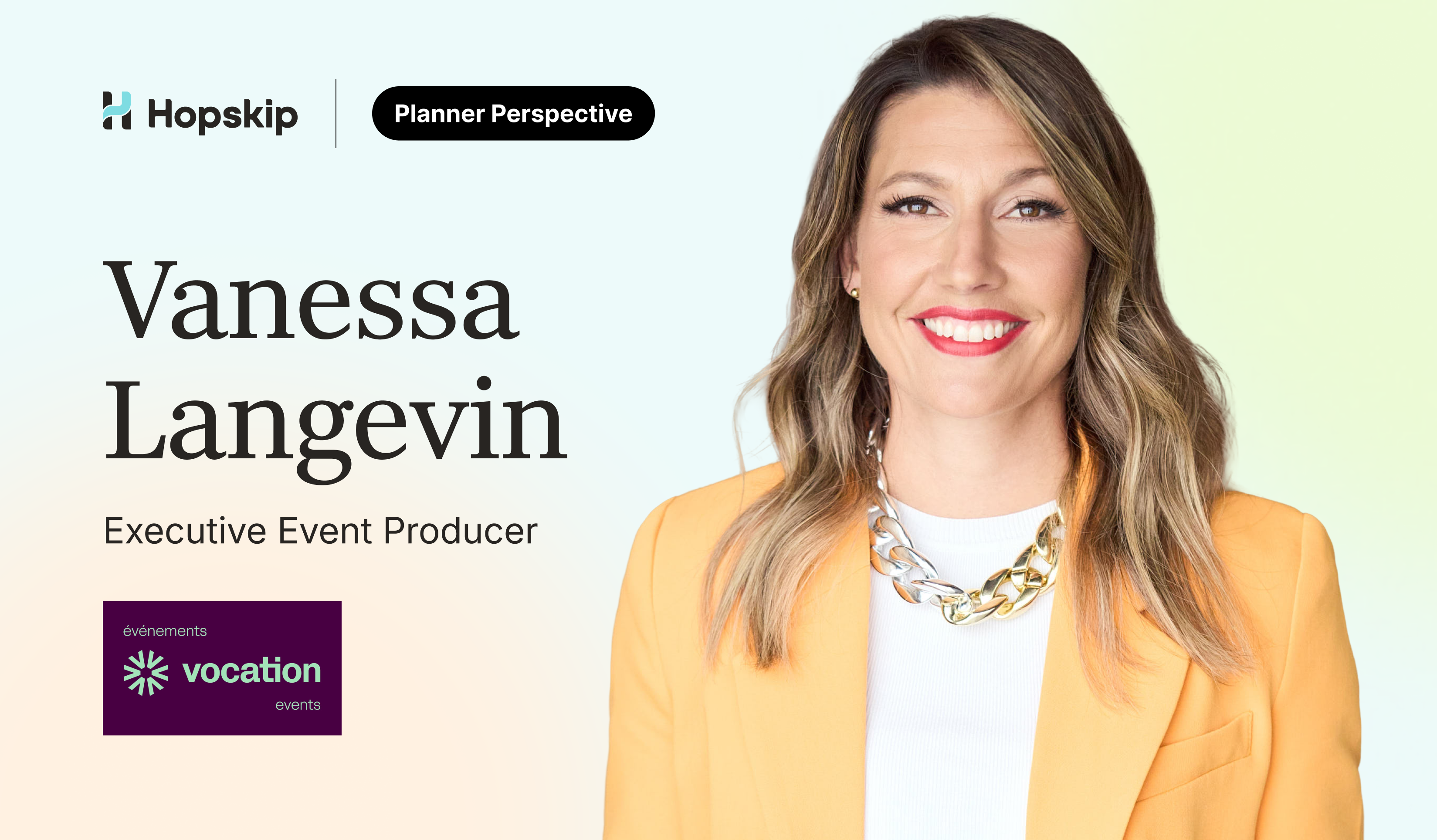
Most event planners have a story about the request that should not have worked. Vanessa Langevin, Executive Event Producer at Vocation Events Inc. in Montreal, has one that ends with a Grammy-nominated pianist playing a private set in a forest clearing that guests could only reach by ATV.
More on that shortly. First, the parts of her playbook that do not require moving a piano through the woods.
A Partnership Built on Filling Each Other's Gaps
Langevin has more than ten years in event coordination, and she is candid that the real inflection point in her career was not a project. It was a person. A chance encounter with Vocation's Creative Director reshaped how she approached the whole industry. The two spent months acting as sounding boards for each other's work, and Langevin realized the Creative Director's instincts covered exactly the ground she did not.
That kind of pairing, someone who obsesses over the "how" next to someone who obsesses over the "what if," turns out to be a durable formula. Vocation now runs on it.
Pro tip: if you are strong on execution but thin on concepting (or vice versa), look for that complement deliberately. A good creative-operations pairing produces work neither person could pull off solo.
Growth Without a Single Big Moment
Ask Langevin to name the turning point in Vocation's growth and she resists the premise. There was not one. Growth came from a "deliberate, upward trajectory of compounding successes," built on a culture of curiosity and constant learning that let the agency move from boutique projects to large, complex mandates without a dramatic pivot.
That is a useful corrective for planners waiting for their own lightning-bolt moment. Trust compounds. The real turning point, in her words, is the moment a client realizes the agency is as invested in their success as they are, and that moment tends to arrive quietly, project after project, not all at once.
Pro tip: stop looking for the one break that changes everything. Track the smaller signs of compounding trust instead, like repeat bookings or clients looping you in earlier each time.
The Mistake: Treating Every Event Like "Just Another Wedding"
Langevin's formative mistake happened at 19, deep in a grueling wedding season on the catering side. Back-to-back dates bred a routine mindset, the kind where every event starts to look identical and every client's anxieties get quietly dismissed as ordinary.
The catering company's owner caught the collective fatigue during a pre-event huddle and reset the room's perspective for good. The lesson stuck: stop "doing" and start truly seeing people. Whether Vocation is working a global brand activation or a private client's event, the team treats every mandate as singular, because for the client, it is.
Pro tip: build a standing check-in question into your pre-event huddles: "What does this specific client need that a generic client would not?" It is a fast way to catch routine-mindset drift before it shows up in the room.
Setting Expectations Through Radical Transparency
Langevin's approach to client expectations is not about drawing boundaries. It is about handing over control. Vocation shares a pro-forma contract early in the pitch process, not as a legal formality but as a tool that lets clients understand scope, ask sharper questions, and build confidence in the fit before anything is signed.
Layered with detailed workback schedules and visual supports, the goal is a client who feels like an informed decision-maker at every stage, not someone hoping the planner has it handled.
Pro tip: share your contract structure before the client asks for it. Proactive transparency reads as confidence. Waiting to be asked reads as reluctance.
When the Glassware Never Got Ordered
Every planner needs a vendor story, and Langevin's involves 700 guests, a fragmented multi-vendor ordering process, and a gala that came within three hours of missing its own dining tables.
Nobody had ordered the glassware. Langevin's account manager, Linda, did not just notice the gap. She proactively audited the full multi-vendor setup against the guest count, caught the discrepancy, and coordinated an emergency delivery of 1,400 glasses to the venue within two hours. The doors opened on schedule, and the crisis stayed invisible to guests.
It reinforced something Langevin already believed: a great agency is only as strong as its partners. Treat vendors as an extension of your own team, and they stop just filling orders. They start watching your back.
Pro tip: ask one trusted vendor per event to informally cross-check your order list against your guest count before load-in. A second set of eyes catches the gaps a busy production team misses.
The Differentiator: Logistics and Storytelling in the Same Person
Asked what sets Vocation apart in a crowded market, Langevin points to what she calls a professional alchemy: the bridge between meticulous logistical delivery and rapid-fire creative innovation. The agency positions itself past the "event planner" label entirely, acting instead as strategic brand storytellers who translate a client's brand into a human-centric moment guests actually remember.
Boutique, senior-level focus is part of the pitch too. Radical transparency and personal investment are harder to fake at scale, which gives smaller agencies a real edge against larger firms that struggle to replicate that level of attention.
Pro tip: if you are competing against bigger firms, do not try to out-scale them. Out-attend them instead. Personal investment is a differentiator large firms structurally cannot match.
The Trend Worth Watching: Micro-Experiences Inside Macro-Events
Langevin's read on where the industry is heading centers on purposeful micro-experiences. The wow factor in 2026, she argues, is no longer about the size of the room. It is about the depth of engagement, even inside a massive program.
Vocation is designing "relationship engines" inside its largest mandates: curated meetups, targeted workshops, and breakout sessions built for specific niche audiences layered into the macro-event. The scale stays big. The experience gets personal.
Pro tip: pick one large-scale event on your calendar and carve out a single micro-moment inside it, a curated 20-minute breakout or a small-group meetup. You do not need to redesign the whole program to start testing this.
What She Would Do Differently
If Langevin were starting Vocation today, she would build the architecture of scalability much sooner. A decade of independent coordination taught her deep execution skills, but she believes an early stint inside a global agency, observing proprietary systems and tech stacks, would have accelerated everything.
The bigger shift would be letting go of the "hero" instinct earlier. True growth, she has learned, requires relinquishing control: implementing delegation and project management infrastructure from day one instead of trying to be the one holding every detail personally.
Pro tip: if you are still the single point of failure for every event detail, that is the clearest sign it is time to build delegation infrastructure, not just hire more hands.
Staying Calm Enough to Let the Team Solve Problems
Vocation's emergency approach starts with anticipation: index a solution for every moving part before the problem arises. But when something truly unforeseen happens on-site, Langevin says the most powerful tool is attitude. A "solutions-first" presence, calm and grounded, sets the tone for the entire vendor team and the client's experience, because nobody solves problems well while feeling defensive or panicked.
Pro tip: your visible calm is a resource you're managing in real time, not just a personality trait. Practice narrating problems out loud in a steady tone before you need to do it under real pressure.
Designing the Attendee's Actual Hour
Vocation's attendee experience strategy runs on what Langevin calls Attendee Journey Mapping: mentally living every hour of the event through a guest's eyes and asking what they see first, what they need in that moment, and where the unspoken friction points sit.
That often means pushing back on clients who default to the standard eight-hour passive conference format, because engagement dies in a vacuum. Dynamic flows and unexpected moments get the advocacy instead.
Pro tip: walk your own event's agenda hour by hour as if you were an attendee with no context. The dead spots you find are the ones worth redesigning first.
The Advice Most Planners Skip: Recover Like It's Part of the Job
Langevin's single tip for every event planner is to treat post-production recovery as a professional requirement, not a luxury. The industry glorifies the hustle and the "event hangover," but execution days are genuinely grueling, and skipping recovery catches up with you.
Her personal system rests on four pillars: nature (get outside and reset your nervous system), connection (pre-schedule time with people who recharge you), restorative sleep (wake up without an alarm when you can), and nourishment (eat food that comforts as much as it fuels). None of it is complicated. All of it gets skipped anyway, which is exactly the problem.
Pro tip: block recovery time on your calendar with the same seriousness as a run-of-show. If it is not scheduled, it will not happen.
The Piano in the Forest
Early in her career, a client handed Langevin a request that broke every logistical convention: a ceremony in a remote forest clearing in the Laurentians, reachable only by a narrow ATV path, with a performance by the globally renowned musician Patrick Watson as the centerpiece. The catch: Watson performs exclusively on a baby grand piano and would not use an electric substitute.
The client bought a piano specifically for the event. Langevin's team then had to maneuver a delicate, high-value instrument through a forest and extract it before evening dew could warp the wood, using a hand-picked crew of specialized movers and a meticulously timed strategy. It remains one of her proudest moments, and she still describes sitting in that clearing after guests left, listening to a private set while the transport team arrived, as a reminder that with the right team, impossible is just a starting point.
About Hopskip
Hopskip is a sourcing platform that connects event planners directly with hotels and DMOs through streamlined RFP management, cutting out the spreadsheets and email chains that eat into a producer's week.
Planners on Hopskip save 30+ hours per RFP, get cleaner proposals faster, and have all the information they need to make confident venue decisions. The best part? It's free to start for planners. Book a demo today to get started.
Sources
- Industry commentary on experiential and micro-event design trends in corporate event production
- General workforce data on burnout and recovery practices among high-stress event and production roles


.svg)