.svg)
The Event Reveal That Made an Entire Room Gasp

A corporate event producer shares how she scaled from word-of-mouth referrals to large multi-room productions, and the reveal experience that stopped a room cold.
Some event producers build their reputation on flawless logistics. KC Kaicher, Founder and Event Producer at Kalo Productions, built hers on something a little more theatrical: a full room reveal, concealed until the exact second she wanted guests to see it.
More on that reveal shortly. First, how Kaicher went from wanting creative freedom to producing large-scale, multi-room events with the discipline that requires.
She Took the Leap to Build Something of Her Own
Kaicher didn't start Kalo Productions on a whim. After years of hands-on experience across production, operations, and venue management, she felt ready to step out and build a company that reflected her own vision, standards, and approach. She wanted the freedom to be more creative, more intentional, and more hands-on with clients in a way that felt authentic to her specific style.
Starting Kalo meant trusting her experience, taking a real risk, and building something she genuinely believed in rather than continuing to execute someone else's vision.
Pro tip: if you're weighing whether you have enough experience to go independent, take stock of which parts of your current role you'd keep doing exactly the same way if you had full authority. That list is usually a strong signal you're ready.
The Mistake: Holding Onto Every Role
Early on, Kaicher tried managing too many roles herself instead of delegating and building the right support structure. A strong sense of ownership over every detail felt necessary at the time, but it limited efficiency and scalability more than it protected quality.
Over time, she realized that trusting the right people and clearly defining roles actually leads to stronger execution, not weaker oversight. That shift let Kalo operate more seamlessly, empower its team, and deliver a higher level of service to clients than one person juggling everything ever could.
Pro tip: if you notice your business growth flattening even as your workload increases, check whether you're the actual bottleneck. Ownership and control are not the same thing, and only one of them scales.
Client Expectations Built on Alignment
From the very first conversation, Kaicher focuses on alignment, both creative and operational. She asks thoughtful questions to understand not just what a client wants, but what success genuinely looks like for them specifically. From there, she clearly outlines the process, timelines, deliverables, and communication style so there are no surprises later.
Strong expectations, in her view, create strong partnerships. When clients understand exactly how Kalo works and what's needed from them, the whole engagement moves more efficiently and collaboratively.
Pro tip: ask a client to describe what success looks like in their own words before you propose anything. Their answer often differs from what you assumed, and catching that gap early saves a difficult conversation later.
When a Vendor Partnership Became a True Partnership
Kaicher's standout vendor story involves a large-scale event where a key element was delayed much closer to showtime than expected. Because of relationships built over time, one phone call to a trusted vendor partner got an immediate response: they stepped in, adjusted their own schedule, and helped problem-solve in real time.
What mattered most wasn't just that they delivered. It's that they did it calmly and collaboratively, which kept the entire team grounded during a stressful stretch. Kaicher describes it as a reminder that great vendor relationships aren't transactional. They're true partnerships that can make or break an event.
Pro tip: when evaluating a vendor, ask how they behave under pressure, not just how they perform when everything's on schedule. Calm collaboration during a crunch is a rarer and more valuable trait than raw capability.
Differentiating Through Ownership, Not Just Execution
Asked how Kalo Productions stands out, Kaicher points to the level of care and ownership brought to every project. The team isn't just executing a checklist. They're deeply invested in the outcome and in how the event actually feels for every person in the room.
From the earliest planning stages through on-site execution, the team stays hands-on, detail-oriented, and responsive. Clients know they can rely on Kalo to think ahead, solve problems before they surface, and represent their brand with the same care they'd bring themselves.
Pro tip: ask yourself whether your team solves problems before clients notice them or after. That distinction, more than any service list, is what separates a vendor from a true partner.
What She Would Do Differently
If Kaicher were starting Kalo today, she would invest in marketing much earlier and more consistently. Relying heavily on word of mouth worked well enough in the beginning, but she now sees real value in building a strong, visible brand presence from day one.
That means consistent content, clear messaging, and showing the full scope of what the company does, not just the final polished event, but the process behind it. That kind of visibility builds trust, attracts better-aligned clients, and creates opportunities without depending entirely on referrals.
Pro tip: document your process, not just your finished events, for your own marketing content. Clients are often just as interested in how you think through a problem as they are in the final result.
The Trend Worth Watching: Experience-Driven Programming
Kaicher's read on where the industry is heading centers on intentional, experience-driven programming. Guests are no longer satisfied with simply attending an event. They want to feel something, which means more interactive elements, thoughtful flow, and programming that actively encourages connection.
Whether that's curated networking, wellness activations, or immersive brand moments, the shift is away from simply hosting an event and toward creating a meaningful experience that resonates well after it ends.
Pro tip: pick one moment in your next event agenda and ask whether it's designed to be felt, not just attended. If every moment on your run of show is purely functional, you're likely missing opportunities guests will actually remember.
Preparation as the Whole Emergency Plan
Kaicher's approach to unexpected situations starts long before doors open. Detailed run of shows, contingency plans, and clear communication channels all get built before the event begins. On-site, she stays calm, assesses quickly, and focuses on solutions rather than dwelling on the problem itself.
Tight internal communication is what allows the team to pivot seamlessly without disrupting the guest experience. The goal, always, is that clients and attendees never feel the pressure of what's happening behind the scenes.
Pro tip: treat your run of show as a living contingency document, not just a schedule. Build in explicit "if this happens, then this" notes for your highest-risk moments rather than relying purely on improvisation.
The Turning Point: Scaling Into Complexity
A major turning point for Kalo Productions came when the company began producing large-scale, multi-layered events with complex programming, multiple rooms, and high attendee volume. Stepping into that level of production forced Kaicher to elevate everything at once: systems, communication, team structure, and on-site execution.
That shift pushed the company to become more disciplined, more strategic, and more proactive in how it operates. It also positioned Kalo as a trusted partner for high-impact, large-scale experiences rather than a strong solo operator handling smaller events well.
Pro tip: before taking on a significantly larger or more complex event than you've handled before, audit your systems first, not just your team's bandwidth. Complexity exposes weak systems faster than it exposes weak people.
Details Matter. Communication Matters More.
Kaicher's single piece of advice for every planner is simple: details matter, but communication matters more. The best plan in the world falls apart quickly if a team and its vendors aren't aligned. Clear, consistent communication before and during an event is what actually keeps everything running smoothly when the details inevitably shift.
Pro tip: before your next event, confirm every vendor has explicitly acknowledged the current timeline, not just received it. A plan that was sent isn't the same as a plan that was actually read and understood.
The Reveal That Stopped a Room
Asked for her most unconventional client request, Kaicher describes a full "surprise reveal" experience, where guests had no idea what they were walking into until the exact moment the program began. That meant completely concealing the main space, rerouting guest flow, and staging a dramatic opening where the entire room was revealed at once.
Pulling it off required tight coordination across lighting, staging, timing, and guest management. The team built a controlled arrival experience, held guests in a separate space, and timed the reveal down to the second. When the doors finally opened, the reaction was immediate and overwhelming. It created a true moment of impact that set the tone for the entire event and made it feel unforgettable from the very first second.
About Hopskip
Hopskip is a sourcing platform that connects event planners directly with hotels and DMOs through streamlined RFP management, cutting the spreadsheets and email chains out of finding the right venue.
Planners on Hopskip save 30+ hours per RFP, get cleaner proposals faster, and have all the information they need to make confident venue decisions. The best part? It's free to start for planners. Book a demo today to get started.
Sources
- Industry commentary on experience-driven event design and attendee engagement trends
- General reporting on solo and small-agency scaling challenges in the events industry
Curabitur bibendum ad viverra eu fringilla ad eu. Eget placerat ultricies quis amet mattis himenaeos ullamcorper facilisi volutpat.
Start for free
Send your first one for free.

The Event Reveal That Made an Entire Room Gasp
A corporate event producer shares how she scaled from word-of-mouth referrals to large multi-room productions, and the reveal experience that stopped a room cold.
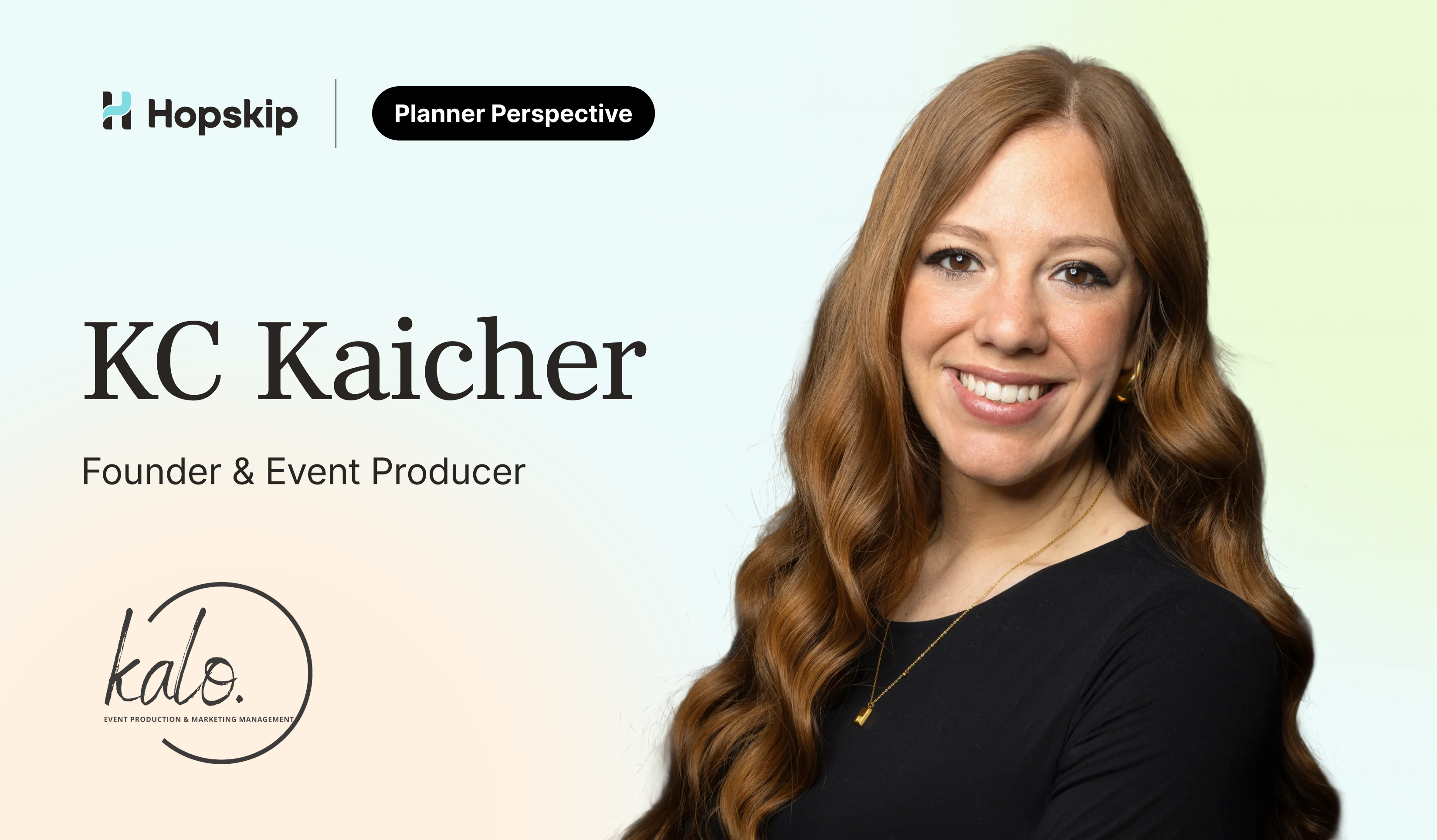
Some event producers build their reputation on flawless logistics. KC Kaicher, Founder and Event Producer at Kalo Productions, built hers on something a little more theatrical: a full room reveal, concealed until the exact second she wanted guests to see it.
More on that reveal shortly. First, how Kaicher went from wanting creative freedom to producing large-scale, multi-room events with the discipline that requires.
She Took the Leap to Build Something of Her Own
Kaicher didn't start Kalo Productions on a whim. After years of hands-on experience across production, operations, and venue management, she felt ready to step out and build a company that reflected her own vision, standards, and approach. She wanted the freedom to be more creative, more intentional, and more hands-on with clients in a way that felt authentic to her specific style.
Starting Kalo meant trusting her experience, taking a real risk, and building something she genuinely believed in rather than continuing to execute someone else's vision.
Pro tip: if you're weighing whether you have enough experience to go independent, take stock of which parts of your current role you'd keep doing exactly the same way if you had full authority. That list is usually a strong signal you're ready.
The Mistake: Holding Onto Every Role
Early on, Kaicher tried managing too many roles herself instead of delegating and building the right support structure. A strong sense of ownership over every detail felt necessary at the time, but it limited efficiency and scalability more than it protected quality.
Over time, she realized that trusting the right people and clearly defining roles actually leads to stronger execution, not weaker oversight. That shift let Kalo operate more seamlessly, empower its team, and deliver a higher level of service to clients than one person juggling everything ever could.
Pro tip: if you notice your business growth flattening even as your workload increases, check whether you're the actual bottleneck. Ownership and control are not the same thing, and only one of them scales.
Client Expectations Built on Alignment
From the very first conversation, Kaicher focuses on alignment, both creative and operational. She asks thoughtful questions to understand not just what a client wants, but what success genuinely looks like for them specifically. From there, she clearly outlines the process, timelines, deliverables, and communication style so there are no surprises later.
Strong expectations, in her view, create strong partnerships. When clients understand exactly how Kalo works and what's needed from them, the whole engagement moves more efficiently and collaboratively.
Pro tip: ask a client to describe what success looks like in their own words before you propose anything. Their answer often differs from what you assumed, and catching that gap early saves a difficult conversation later.
When a Vendor Partnership Became a True Partnership
Kaicher's standout vendor story involves a large-scale event where a key element was delayed much closer to showtime than expected. Because of relationships built over time, one phone call to a trusted vendor partner got an immediate response: they stepped in, adjusted their own schedule, and helped problem-solve in real time.
What mattered most wasn't just that they delivered. It's that they did it calmly and collaboratively, which kept the entire team grounded during a stressful stretch. Kaicher describes it as a reminder that great vendor relationships aren't transactional. They're true partnerships that can make or break an event.
Pro tip: when evaluating a vendor, ask how they behave under pressure, not just how they perform when everything's on schedule. Calm collaboration during a crunch is a rarer and more valuable trait than raw capability.
Differentiating Through Ownership, Not Just Execution
Asked how Kalo Productions stands out, Kaicher points to the level of care and ownership brought to every project. The team isn't just executing a checklist. They're deeply invested in the outcome and in how the event actually feels for every person in the room.
From the earliest planning stages through on-site execution, the team stays hands-on, detail-oriented, and responsive. Clients know they can rely on Kalo to think ahead, solve problems before they surface, and represent their brand with the same care they'd bring themselves.
Pro tip: ask yourself whether your team solves problems before clients notice them or after. That distinction, more than any service list, is what separates a vendor from a true partner.
What She Would Do Differently
If Kaicher were starting Kalo today, she would invest in marketing much earlier and more consistently. Relying heavily on word of mouth worked well enough in the beginning, but she now sees real value in building a strong, visible brand presence from day one.
That means consistent content, clear messaging, and showing the full scope of what the company does, not just the final polished event, but the process behind it. That kind of visibility builds trust, attracts better-aligned clients, and creates opportunities without depending entirely on referrals.
Pro tip: document your process, not just your finished events, for your own marketing content. Clients are often just as interested in how you think through a problem as they are in the final result.
The Trend Worth Watching: Experience-Driven Programming
Kaicher's read on where the industry is heading centers on intentional, experience-driven programming. Guests are no longer satisfied with simply attending an event. They want to feel something, which means more interactive elements, thoughtful flow, and programming that actively encourages connection.
Whether that's curated networking, wellness activations, or immersive brand moments, the shift is away from simply hosting an event and toward creating a meaningful experience that resonates well after it ends.
Pro tip: pick one moment in your next event agenda and ask whether it's designed to be felt, not just attended. If every moment on your run of show is purely functional, you're likely missing opportunities guests will actually remember.
Preparation as the Whole Emergency Plan
Kaicher's approach to unexpected situations starts long before doors open. Detailed run of shows, contingency plans, and clear communication channels all get built before the event begins. On-site, she stays calm, assesses quickly, and focuses on solutions rather than dwelling on the problem itself.
Tight internal communication is what allows the team to pivot seamlessly without disrupting the guest experience. The goal, always, is that clients and attendees never feel the pressure of what's happening behind the scenes.
Pro tip: treat your run of show as a living contingency document, not just a schedule. Build in explicit "if this happens, then this" notes for your highest-risk moments rather than relying purely on improvisation.
The Turning Point: Scaling Into Complexity
A major turning point for Kalo Productions came when the company began producing large-scale, multi-layered events with complex programming, multiple rooms, and high attendee volume. Stepping into that level of production forced Kaicher to elevate everything at once: systems, communication, team structure, and on-site execution.
That shift pushed the company to become more disciplined, more strategic, and more proactive in how it operates. It also positioned Kalo as a trusted partner for high-impact, large-scale experiences rather than a strong solo operator handling smaller events well.
Pro tip: before taking on a significantly larger or more complex event than you've handled before, audit your systems first, not just your team's bandwidth. Complexity exposes weak systems faster than it exposes weak people.
Details Matter. Communication Matters More.
Kaicher's single piece of advice for every planner is simple: details matter, but communication matters more. The best plan in the world falls apart quickly if a team and its vendors aren't aligned. Clear, consistent communication before and during an event is what actually keeps everything running smoothly when the details inevitably shift.
Pro tip: before your next event, confirm every vendor has explicitly acknowledged the current timeline, not just received it. A plan that was sent isn't the same as a plan that was actually read and understood.
The Reveal That Stopped a Room
Asked for her most unconventional client request, Kaicher describes a full "surprise reveal" experience, where guests had no idea what they were walking into until the exact moment the program began. That meant completely concealing the main space, rerouting guest flow, and staging a dramatic opening where the entire room was revealed at once.
Pulling it off required tight coordination across lighting, staging, timing, and guest management. The team built a controlled arrival experience, held guests in a separate space, and timed the reveal down to the second. When the doors finally opened, the reaction was immediate and overwhelming. It created a true moment of impact that set the tone for the entire event and made it feel unforgettable from the very first second.
About Hopskip
Hopskip is a sourcing platform that connects event planners directly with hotels and DMOs through streamlined RFP management, cutting the spreadsheets and email chains out of finding the right venue.
Planners on Hopskip save 30+ hours per RFP, get cleaner proposals faster, and have all the information they need to make confident venue decisions. The best part? It's free to start for planners. Book a demo today to get started.
Sources
- Industry commentary on experience-driven event design and attendee engagement trends
- General reporting on solo and small-agency scaling challenges in the events industry


.svg)