.svg)
How to Pull Off an Event in One Week (And Other Lessons From an Association Event Pro)

A nonprofit association event agency president shares how she rescued a one-week event, why she stopped trying to do everything herself, and what vendor relationships taught her.
Most event planners can point to the week that tested them. For Krista Hook, President and CEO of EIS Management Group, it was the week a client's previous event planner left unexpectedly, with a full in-person educational event due in seven days.
More on how that turned out shortly. First, the parts of her career that did not require a one-week miracle.
She Didn't Plan to Start an Agency. It Grew Into Her.
Hook's path into the association industry started in an administrative role, learning the field under a mentor she credits with everything that followed. Through that mentorship, she built confidence, developed her skills, and discovered a genuine love for connecting with people and bringing events to life through careful planning.
What grew from that role was not a calculated business plan. It was a natural extension of work she was already good at and already loved, built one client relationship at a time into a company with values she holds her team to daily.
Pro tip: if you are early in your career and unsure whether to go independent, pay attention to which parts of your current role energize you rather than drain you. That is usually the actual business hiding inside the job.
The Mistake: Trying to Do Everything Herself
Hook's early misstep is one of the most common in the industry: taking on every detail personally, from client communication to logistics to on-site coordination, convinced that hands-on control was the only way to guarantee perfection.
It led to burnout, and worse, small things started slipping through the cracks anyway. The fix was building a reliable team, delegating effectively, and trusting others to carry the vision forward, along with clearer processes that made delegation actually work instead of just feeling risky.
Pro tip: track which tasks you redo yourself "just to be safe" for one month. That list is your delegation roadmap. If you cannot let go of something, ask why, specifically, rather than assuming it has to stay with you.
Setting Expectations With Honesty, Not Just Optimism
From the very first conversation, Hook leads with honesty, clarity, and structure. She listens closely to a client's vision, goals, and priorities, while being transparent about what is realistic given budget, timeline, and scope, then walks them through her process so they know exactly what to expect at each stage.
Roles, responsibilities, and communication practices get outlined early and explicitly, which heads off the ambiguity that causes most mid-project friction. Being upfront and consistent from day one builds the trust that carries a client through the harder stretches of planning.
Pro tip: write down your communication cadence (who updates whom, how often, through which channel) in the very first proposal. Vague communication expectations are one of the most common quiet sources of client frustration.
The Vendor That Saved a Virtual Pivot
Hook's standout vendor story lands squarely in the COVID era, when one of her conferences had to pivot to a fully virtual format with little runway. Her AV team, a partner she still works with today specifically because of moments like this, jumped in when a presenter hit a technical issue mid-session and troubleshot it in real time, finding a workaround that got her back online.
The audience never realized anything had gone wrong. It is the kind of outcome that never shows up in a highlight reel, precisely because it worked.
Pro tip: ask your AV and technical vendors how they handle live troubleshooting before you book them, not after something breaks. Their answer tells you more about reliability than their equipment list does.
Differentiating Through Authenticity, Not Just Logistics
Asked how she stands out in a competitive industry, Hook points past logistics entirely. EIS Management Group leads with authenticity, strong values, and a genuinely personalized approach to every client and event, going deeper than execution to build real relationships and tailor services to specific needs.
Experience lets the team anticipate challenges before they surface, and attention to detail keeps things from slipping. What ultimately sets the agency apart, in her words, is trust: clients know they can count on the team not just to execute an event, but to represent who they are throughout it.
Pro tip: ask a recent client what they would tell a colleague considering hiring you. Their answer, more than any pitch deck line, is your actual differentiator.
The Trend She's Watching: Hybrid Events and AI
Hook sees the continued rise of hybrid events, blending in-person and virtual experiences into one cohesive program, as the trend planners need to take seriously right now. Even as in-person gatherings return in force, audiences expect flexibility, accessibility, and interactive digital elements, and hybrid formats extend an event's reach while creating content that lives on afterward.
She also flags AI tools as a genuine game-changer, useful for personalizing attendee experiences, streamlining logistics, and analyzing data to sharpen future events. Planners who combine strong hybrid strategy with AI adoption, in her view, will be better positioned to deliver events that exceed expectations rather than merely meet them.
Pro tip: pick one low-risk part of your next event, like post-event survey analysis or attendee segmentation, to test an AI tool on before rolling it into higher-stakes planning work.
What She Would Change
If Hook were starting her agency today, she would be bolder about defining her niche and telling that story from the outset. Trying to be everything to everyone early on stretched her thin and slowed growth. She would instead focus on attracting clients who genuinely align with her values and vision, building deeper relationships rather than chasing volume.
Pro tip: write down the type of client you do your best work for, specifically, not generically. Then audit your last five proposals against that description. Chasing broad appeal usually costs more in energy than it gains in pipeline.
Calm, Communication, and a Contingency Plan for Everything
Hook's go-to plan for emergencies runs on preparation, communication, and staying calm under pressure. Before an event begins, she builds a detailed contingency plan anticipating challenges from weather issues to technical glitches to last-minute speaker changes, and makes sure her team and key vendors know their roles and have access to backup resources.
During the event itself, she stays present and focused, assessing quickly and making decisions without panicking. Clear, calm communication with clients, vendors, and attendees keeps everyone reassured even when something shifts. Foresight paired with flexibility is what turns surprises into solutions rather than crises.
Pro tip: write your contingency plan as a shared document your key vendors can see, not just an internal file. Shared visibility means faster response when something actually goes sideways.
Designing the Full Attendee Journey
Hook's approach to attendee experience centers on guiding people through a purposeful journey rather than a checklist of sessions. Seamless logistics, clear communication, and thoughtful touches like branded experiences and curated networking opportunities all serve that goal, alongside technology that keeps participants connected throughout.
Real-time feedback collection during the event, paired with post-event feedback, lets her team continually refine the experience rather than waiting until the next cycle to learn what worked. The goal throughout: attendees feel seen, inspired, and fully immersed from start to finish.
Pro tip: build one real-time feedback checkpoint into your next event, even something as simple as a mid-day pulse survey. Waiting until the post-event survey means you learn what went wrong after it is too late to fix it.
The Advice for Every Planner: Relationships Are the Multiplier
Hook's single tip for every event planner is not to underestimate the power of relationships. Strong, trusted connections with clients, vendors, speakers, and your own team are what separate a good event from a great one. When people trust you and know you genuinely care, they go the extra mile, adapt when challenges arise, and help build experiences that exceed expectations.
Pro tip: invest in vendor and speaker relationships during your slow season, not just when you need a favor. The relationship that saves your event is almost always one you built before you needed it.
The Week She Had No Business Pulling Off
The most unconventional request Hook ever received arrived as a genuine emergency: a client needed a full, in-person, one-day educational event planned in a single week, after their previous event planner left unexpectedly.
Most people would have called it impossible. Hook dove in headfirst, coordinating vendors, speakers, and logistics on an unforgivingly tight timeline. The event went smoothly, the client walked away thrilled, and they have remained a loyal client ever since. The experience taught her that creativity, flexibility, and sheer determination can turn even the most "impossible" asks into lasting results.
About Hopskip
Hopskip is a sourcing platform that connects event planners directly with hotels and DMOs through streamlined RFP management, replacing the scattered phone calls and email chains that eat into a planner's week with one clear system.
Planners on Hopskip save 30+ hours per RFP, get cleaner proposals faster, and have all the information they need to make confident venue decisions. The best part? It's free to start for planners. Book a demo today to get started.
Sources
- Industry reporting on hybrid event format adoption and attendee expectations post-2020
- General industry commentary on AI tool adoption for event personalization and logistics
Curabitur bibendum ad viverra eu fringilla ad eu. Eget placerat ultricies quis amet mattis himenaeos ullamcorper facilisi volutpat.
Start for free
Send your first one for free.

How to Pull Off an Event in One Week (And Other Lessons From an Association Event Pro)
A nonprofit association event agency president shares how she rescued a one-week event, why she stopped trying to do everything herself, and what vendor relationships taught her.
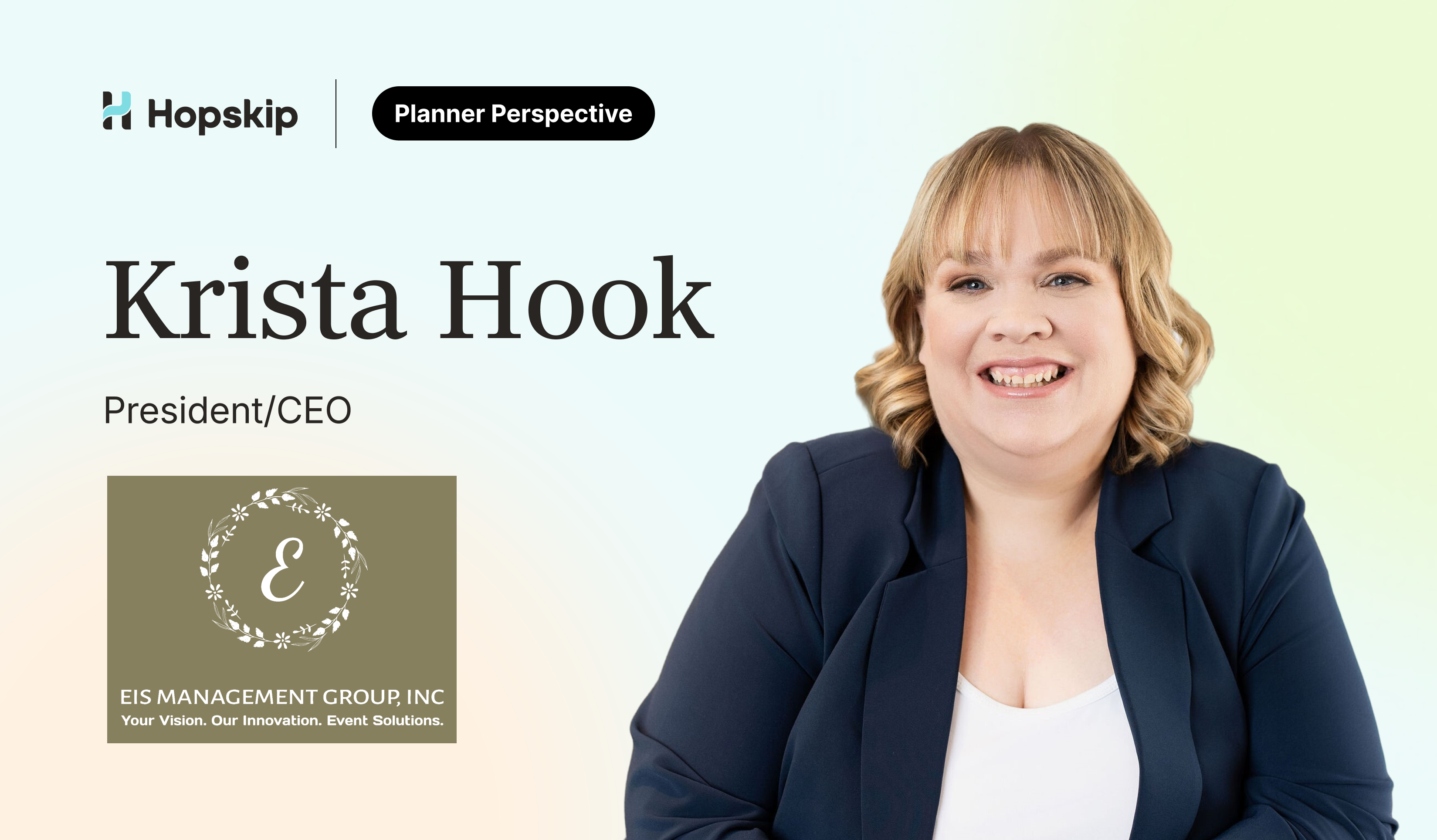
Most event planners can point to the week that tested them. For Krista Hook, President and CEO of EIS Management Group, it was the week a client's previous event planner left unexpectedly, with a full in-person educational event due in seven days.
More on how that turned out shortly. First, the parts of her career that did not require a one-week miracle.
She Didn't Plan to Start an Agency. It Grew Into Her.
Hook's path into the association industry started in an administrative role, learning the field under a mentor she credits with everything that followed. Through that mentorship, she built confidence, developed her skills, and discovered a genuine love for connecting with people and bringing events to life through careful planning.
What grew from that role was not a calculated business plan. It was a natural extension of work she was already good at and already loved, built one client relationship at a time into a company with values she holds her team to daily.
Pro tip: if you are early in your career and unsure whether to go independent, pay attention to which parts of your current role energize you rather than drain you. That is usually the actual business hiding inside the job.
The Mistake: Trying to Do Everything Herself
Hook's early misstep is one of the most common in the industry: taking on every detail personally, from client communication to logistics to on-site coordination, convinced that hands-on control was the only way to guarantee perfection.
It led to burnout, and worse, small things started slipping through the cracks anyway. The fix was building a reliable team, delegating effectively, and trusting others to carry the vision forward, along with clearer processes that made delegation actually work instead of just feeling risky.
Pro tip: track which tasks you redo yourself "just to be safe" for one month. That list is your delegation roadmap. If you cannot let go of something, ask why, specifically, rather than assuming it has to stay with you.
Setting Expectations With Honesty, Not Just Optimism
From the very first conversation, Hook leads with honesty, clarity, and structure. She listens closely to a client's vision, goals, and priorities, while being transparent about what is realistic given budget, timeline, and scope, then walks them through her process so they know exactly what to expect at each stage.
Roles, responsibilities, and communication practices get outlined early and explicitly, which heads off the ambiguity that causes most mid-project friction. Being upfront and consistent from day one builds the trust that carries a client through the harder stretches of planning.
Pro tip: write down your communication cadence (who updates whom, how often, through which channel) in the very first proposal. Vague communication expectations are one of the most common quiet sources of client frustration.
The Vendor That Saved a Virtual Pivot
Hook's standout vendor story lands squarely in the COVID era, when one of her conferences had to pivot to a fully virtual format with little runway. Her AV team, a partner she still works with today specifically because of moments like this, jumped in when a presenter hit a technical issue mid-session and troubleshot it in real time, finding a workaround that got her back online.
The audience never realized anything had gone wrong. It is the kind of outcome that never shows up in a highlight reel, precisely because it worked.
Pro tip: ask your AV and technical vendors how they handle live troubleshooting before you book them, not after something breaks. Their answer tells you more about reliability than their equipment list does.
Differentiating Through Authenticity, Not Just Logistics
Asked how she stands out in a competitive industry, Hook points past logistics entirely. EIS Management Group leads with authenticity, strong values, and a genuinely personalized approach to every client and event, going deeper than execution to build real relationships and tailor services to specific needs.
Experience lets the team anticipate challenges before they surface, and attention to detail keeps things from slipping. What ultimately sets the agency apart, in her words, is trust: clients know they can count on the team not just to execute an event, but to represent who they are throughout it.
Pro tip: ask a recent client what they would tell a colleague considering hiring you. Their answer, more than any pitch deck line, is your actual differentiator.
The Trend She's Watching: Hybrid Events and AI
Hook sees the continued rise of hybrid events, blending in-person and virtual experiences into one cohesive program, as the trend planners need to take seriously right now. Even as in-person gatherings return in force, audiences expect flexibility, accessibility, and interactive digital elements, and hybrid formats extend an event's reach while creating content that lives on afterward.
She also flags AI tools as a genuine game-changer, useful for personalizing attendee experiences, streamlining logistics, and analyzing data to sharpen future events. Planners who combine strong hybrid strategy with AI adoption, in her view, will be better positioned to deliver events that exceed expectations rather than merely meet them.
Pro tip: pick one low-risk part of your next event, like post-event survey analysis or attendee segmentation, to test an AI tool on before rolling it into higher-stakes planning work.
What She Would Change
If Hook were starting her agency today, she would be bolder about defining her niche and telling that story from the outset. Trying to be everything to everyone early on stretched her thin and slowed growth. She would instead focus on attracting clients who genuinely align with her values and vision, building deeper relationships rather than chasing volume.
Pro tip: write down the type of client you do your best work for, specifically, not generically. Then audit your last five proposals against that description. Chasing broad appeal usually costs more in energy than it gains in pipeline.
Calm, Communication, and a Contingency Plan for Everything
Hook's go-to plan for emergencies runs on preparation, communication, and staying calm under pressure. Before an event begins, she builds a detailed contingency plan anticipating challenges from weather issues to technical glitches to last-minute speaker changes, and makes sure her team and key vendors know their roles and have access to backup resources.
During the event itself, she stays present and focused, assessing quickly and making decisions without panicking. Clear, calm communication with clients, vendors, and attendees keeps everyone reassured even when something shifts. Foresight paired with flexibility is what turns surprises into solutions rather than crises.
Pro tip: write your contingency plan as a shared document your key vendors can see, not just an internal file. Shared visibility means faster response when something actually goes sideways.
Designing the Full Attendee Journey
Hook's approach to attendee experience centers on guiding people through a purposeful journey rather than a checklist of sessions. Seamless logistics, clear communication, and thoughtful touches like branded experiences and curated networking opportunities all serve that goal, alongside technology that keeps participants connected throughout.
Real-time feedback collection during the event, paired with post-event feedback, lets her team continually refine the experience rather than waiting until the next cycle to learn what worked. The goal throughout: attendees feel seen, inspired, and fully immersed from start to finish.
Pro tip: build one real-time feedback checkpoint into your next event, even something as simple as a mid-day pulse survey. Waiting until the post-event survey means you learn what went wrong after it is too late to fix it.
The Advice for Every Planner: Relationships Are the Multiplier
Hook's single tip for every event planner is not to underestimate the power of relationships. Strong, trusted connections with clients, vendors, speakers, and your own team are what separate a good event from a great one. When people trust you and know you genuinely care, they go the extra mile, adapt when challenges arise, and help build experiences that exceed expectations.
Pro tip: invest in vendor and speaker relationships during your slow season, not just when you need a favor. The relationship that saves your event is almost always one you built before you needed it.
The Week She Had No Business Pulling Off
The most unconventional request Hook ever received arrived as a genuine emergency: a client needed a full, in-person, one-day educational event planned in a single week, after their previous event planner left unexpectedly.
Most people would have called it impossible. Hook dove in headfirst, coordinating vendors, speakers, and logistics on an unforgivingly tight timeline. The event went smoothly, the client walked away thrilled, and they have remained a loyal client ever since. The experience taught her that creativity, flexibility, and sheer determination can turn even the most "impossible" asks into lasting results.
About Hopskip
Hopskip is a sourcing platform that connects event planners directly with hotels and DMOs through streamlined RFP management, replacing the scattered phone calls and email chains that eat into a planner's week with one clear system.
Planners on Hopskip save 30+ hours per RFP, get cleaner proposals faster, and have all the information they need to make confident venue decisions. The best part? It's free to start for planners. Book a demo today to get started.
Sources
- Industry reporting on hybrid event format adoption and attendee expectations post-2020
- General industry commentary on AI tool adoption for event personalization and logistics

.svg)